AI for Accounting Firms: Isaac Perdomo on Automating Workflows and Efficiency
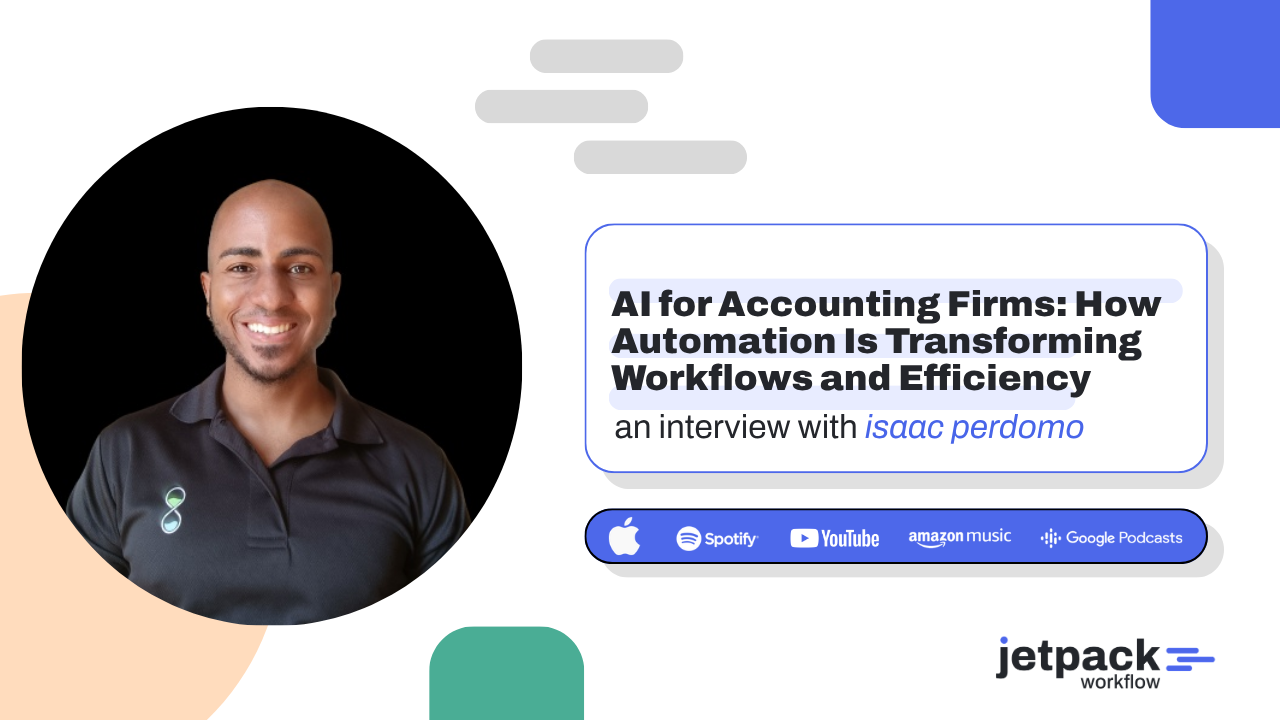
AI for accounting firms is changing how bookkeeping, reporting, and operational workflows are managed. Firms are using automation to reduce manual work, improve quality control, and handle recurring processes more efficiently. The biggest gains are happening in workflow management, bookkeeping automation, and operational visibility. Firms that combine AI with structured workflow systems are positioned to scale faster and operate more efficiently.
Key Takeaways
- AI is helping accounting firms reduce manual work and improve efficiency
- Automation can significantly reduce bookkeeping and review time
- Clean and centralized data is essential for successful AI adoption
- AI quality control is becoming a major operational advantage
- Meeting transcripts and workflow systems create better visibility
- Firms adopting AI early may gain a strong competitive edge
Introduction
AI for accounting firms is no longer experimental. It is becoming part of daily operations.
Accounting firms are using AI and automation to improve workflows, reduce repetitive work, and increase operational efficiency without adding headcount. Tasks that once required hours of manual effort can now be automated through workflow systems, AI-driven reviews, and process automation.
In a recent discussion, automation consultant Isaac Perdomo explained how some firms dramatically reduced bookkeeping time through AI-driven workflows:
“They were spending like 2 hours per client per month to do their books, and we got that down to about 15 minutes.”
The firms seeing the biggest results are not simply testing AI tools. They are redesigning how work flows through the firm.
For accounting firm owners, this shift is important because operational efficiency is becoming a competitive advantage. Firms that continue relying on disconnected spreadsheets, manual follow-ups, and inconsistent workflows may struggle to keep up with firms using automation and AI-assisted systems.
Why AI Adoption Is Growing in Accounting Firms
Accounting firms are under pressure to improve efficiency while maintaining service quality. At the same time, many firms are dealing with staffing shortages, increasing client demands, and tighter turnaround expectations.
AI helps firms automate many operational tasks that traditionally consumed large amounts of staff time.
Common AI use cases include:
- Bookkeeping automation
- Workflow automation
- Financial statement reviews
- Task generation
- Meeting summaries
- Client follow-up tracking
- Quality control processes
This shift allows firms to focus more on advisory work and client relationships instead of repetitive processing tasks.
Many firms are also realizing that AI is not replacing accountants. Instead, it is helping accounting teams operate more efficiently by reducing low-value manual work. This allows staff to spend more time reviewing, advising, and communicating with clients.

How Automation Improves Accounting Workflows
One of the biggest benefits of AI for accounting firms is workflow efficiency.
Automation helps firms:
- Reduce repetitive manual tasks
- Standardize recurring workflows
- Improve task visibility
- Reduce missed deadlines
- Improve consistency across teams
Instead of manually managing every step, firms create systems that automate repetitive operational work.
Examples include:
- Automated transaction categorization
- AI-assisted journal entries
- Workflow triggers for recurring tasks
- Automated report reviews
- Task creation from client communications
This reduces operational friction and creates a more scalable workflow system.
Many accounting firms still rely heavily on team memory, email chains, or spreadsheets to track work. As firms grow, those systems become harder to manage consistently. Workflow automation reduces that dependency by creating repeatable systems that keep work moving even as workload increases.
How AI Is Transforming Bookkeeping Processes
Bookkeeping is one of the areas seeing the fastest automation improvements.
Accounting firms are combining:
- Automation rules
- AI categorization
- Banking integrations
- Workflow automation
- AI review systems
to reduce manual bookkeeping work significantly.
Automation can help firms:
- Categorize transactions faster
- Reduce data entry
- Flag unusual transactions
- Generate recurring journal entries
- Improve reconciliation processes
This allows accountants to spend less time processing transactions and more time reviewing and advising clients.
The impact becomes even more significant when these automations are applied across dozens or hundreds of clients. Small efficiency gains compound quickly, especially for firms managing large volumes of recurring bookkeeping work every month.
Why AI Quality Control Matters
Quality control is becoming one of the most valuable AI use cases for accounting firms.
Many firms now use AI to:
- Review financial reports
- Run internal checklists
- Identify inconsistencies
- Flag missing information
- Improve reporting accuracy
Instead of relying entirely on manual review, firms create an additional layer of automated quality assurance.
This helps reduce:
- Human error
- Missed issues
- Inconsistent reviews
- Last-minute corrections
AI quality control also improves operational consistency across teams.
For firms that are scaling quickly, consistency becomes harder to maintain. AI-assisted review systems help standardize how work is checked and reviewed, which can improve both internal efficiency and client confidence.
Why Data Organization Is Critical for AI
AI systems are only as effective as the data they can access.
Many accounting firms still manage information across:
- Multiple spreadsheets
- Separate databases
- Different software systems
- Disconnected workflow tools
This creates operational inefficiency and limits AI effectiveness.
Firms preparing for AI adoption should focus on organizing:
- Client information
- Workflow data
- Recurring tasks
- Meeting notes
- CRM records
- Operational processes
As Isaac Perdomo explained:
“For the people that wanna be AI-centric, like you have to be data-centric first.”
Clean, centralized data allows AI systems to operate more effectively across workflows.
Without organized data, AI tools struggle to generate accurate insights, automate processes properly, or maintain operational consistency. Centralized systems create the structure AI needs to operate effectively.
How Meeting Transcripts Improve Accounting Operations
Meeting transcripts are becoming valuable operational assets for accounting firms.
AI tools can now analyze client meetings and automatically:
- Create action items
- Generate follow-up emails
- Capture client context
- Identify client concerns
- Update workflows
- Improve accountability
This helps firms reduce manual follow-ups and improve communication consistency.
Meeting transcript automation also improves:
- Team visibility
- Client continuity
- Workflow documentation
- Advisory preparation
Instead of relying on scattered notes, firms create searchable operational records that improve future interactions.
This becomes especially valuable for firms managing multiple team members across different client accounts. Important client information is less likely to get lost when conversations are automatically documented and integrated into workflows.
How Workflow Systems Support AI Adoption
AI tools alone do not solve operational problems.
Without structure, firms still experience:
- Missed deadlines
- Workflow bottlenecks
- Poor visibility
- Repeated tasks
- Inconsistent processes
This is where workflow software for accountants becomes essential.
Accounting workflow software helps firms:
- Manage recurring work
- Track deadlines
- Assign responsibilities
- Standardize workflows
- Improve operational visibility
When AI is combined with workflow systems, firms create scalable operational processes instead of disconnected automation experiments.
The result is greater consistency, visibility, and scalability.
Firms that adopt AI without improving their workflows often struggle because automation alone does not fix operational disorganization. Structured workflows help ensure AI-generated tasks, reviews, and automations actually move through the firm consistently.
What an AI-Driven Accounting Firm Looks Like
Accounting firms adopting AI successfully tend to focus on:
- Centralized operational data
- Standardized workflows
- Automated recurring processes
- AI-assisted quality reviews
- Workflow visibility
- Advisory-focused staff roles
In this model:
- AI handles repetitive processing
- Automation handles execution
- Workflow systems manage accountability
- Accountants focus on review and advisory work
This creates a more scalable and efficient firm structure.
Rather than spending large amounts of time on manual data processing, accounting professionals can focus on interpretation, strategic guidance, and client communication. That shift is one of the biggest long-term operational changes AI may create in the accounting industry.
Why Early AI Adoption Creates an Advantage
Firms adopting AI early may gain significant operational advantages.
Benefits can include:
- Faster turnaround times
- Higher operational efficiency
- Reduced staffing pressure
- Better scalability
- Improved profit margins
- Better client experience
As automation improves, firms operating manually may struggle to compete with firms using AI-driven workflows and operational systems.
The firms building systems today may have a major efficiency advantage over slower-moving competitors.
Early adopters also gain time to refine their workflows, train their teams, and improve operational systems before AI becomes standard across the industry. That operational head start may become increasingly important as competition intensifies and firms look for ways to improve margins and efficiency.
Conclusion
AI for accounting firms is transforming workflows, bookkeeping, and operational efficiency at a rapid pace. The firms seeing the biggest results are not simply experimenting with AI tools. They are building structured systems around automation, workflows, and operational visibility.
As AI capabilities continue to improve, accounting firms that combine automation with organized workflow systems will be better positioned to scale efficiently and stay competitive.
Firms that start improving their workflows today will likely adapt faster as AI becomes more deeply integrated into accounting operations over the next several years.
Frequently Asked Questions
How are accounting firms using AI today?
Accounting firms use AI for bookkeeping automation, workflow management, quality control, meeting summaries, and recurring task management.
Can AI automate bookkeeping?
AI can automate many bookkeeping tasks such as transaction categorization, reconciliation support, and recurring journal entry processes.
Why is workflow software important for AI?
Workflow software helps organize recurring work, track deadlines, assign tasks, and ensure AI-driven processes operate consistently.
Does AI replace accountants?
No. AI reduces repetitive work, but accountants still provide judgment, review, strategy, and client advisory services.
What is the biggest challenge with AI adoption?
One of the biggest challenges is poor data organization. AI requires clean and centralized operational data to work effectively.
Can small accounting firms benefit from AI?
Yes. Small firms can use AI and automation to improve efficiency, reduce manual work, and scale operations without hiring large teams.
Related Articles
- How to Simplify Your Accounting Firm: 5 Systems to Eliminate Bottlenecks
- The Future of Accounting Firms in an AI Driven World with Ryan Lazanis
- How Coaching Transforms Accounting Leaders: Lessons from Douglas Slaybaugh
- How Tailor Hartman Took His Accounting Firm to 200K in Year 1
- Why Outsourcing plus Workflow Software is the Future of Accounting Firms
- AI Tools That Help Accounting Firms Scale Faster
- How to Scale to a $1M Accounting Firm Without Hiring More Staff
- Tax Resolution for Accountants: A $100K Client Opportunity
- ChatGPT for Accountants: How to Create High-Level Advisory Reports with Better Prompts
- How Jeff Seibert Is Using AI Accounting Firm Automation to Build a 90% Automated Firm
- How Nonprofits Manage Grants Using QuickBooks (And Where It Falls Short)
Build an AI-Ready Workflow System for Your Accounting Firm
AI works best when your workflows are structured and organized.
Jetpack Workflow helps accounting firms manage recurring work, improve visibility, and create scalable operational systems that support long-term growth.
Share this article