AI Tools That Help Accounting Firms Scale Faster: Insights from Anderson Petergeorge
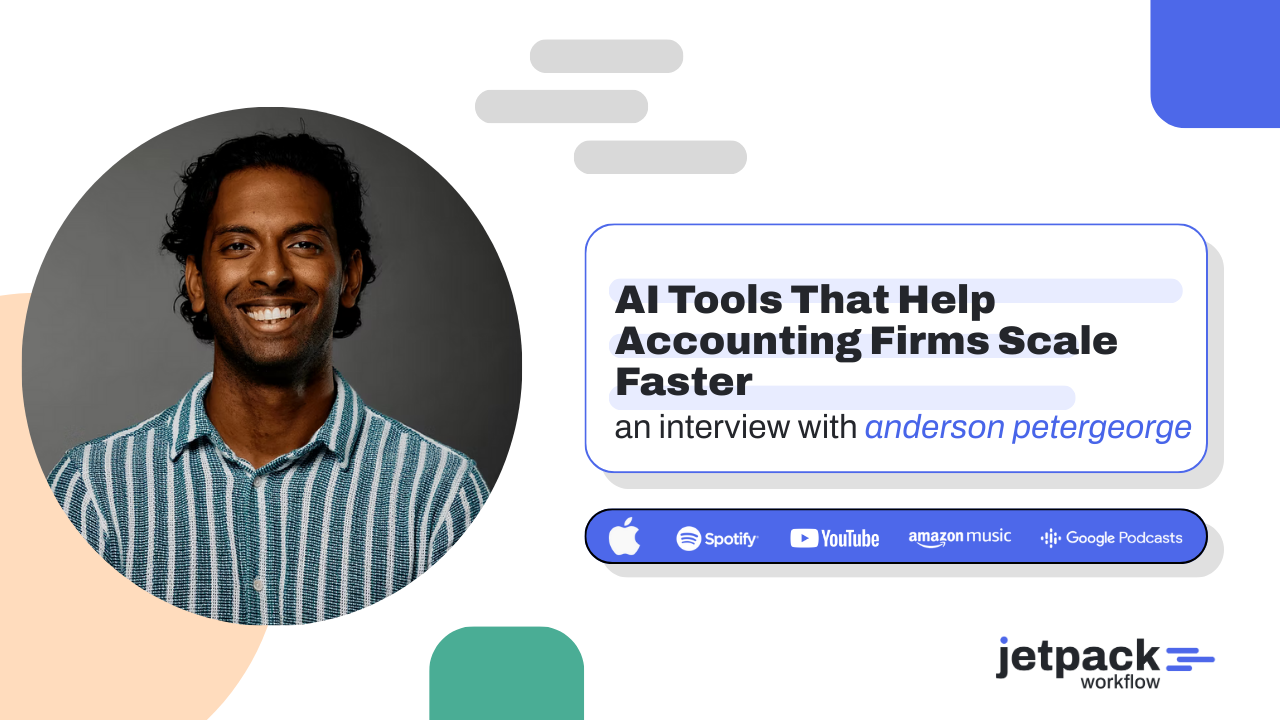
Anderson Petergeorge, co-founder of Quanto, explains how accounting firms can scale from startup to multi-million-dollar operations by using ChatGPT, meeting transcript tools, and modern ledgers. He argues that AI will not replace accountants but empower them to work faster, smarter, and more human.
Key Takeaways
-
Firms can reach $1M in revenue using basic AI tools like ChatGPT and meeting note automation.
-
ChatGPT can write its own prompts and streamline advisory workflows.
-
Meeting transcripts are valuable data for training staff and personalizing client experiences.
-
Post-$1M, automation shifts toward system integrations and API connections between ledgers and workflow tools.
-
The most successful firms blend AI efficiency with deep client relationships and niche expertise.
The Journey from Bookkeeper to Fractional CTO
Anderson Petergeorge started his career at KPMG before earning his master’s at Oxford. After returning to Toronto, he launched a bookkeeping practice powered by AI-native tools, scaling to 40 clients within months. His co-founder, a software engineer, helped automate repetitive tasks and eliminate manual data work.
Their success led to an evolution: helping other firms modernize through technology. As Anderson put it, “You could think of me as a fractional CTO for accounting firms.”
This approach allows firms to focus on clients while outsourcing technical innovation. The result is higher capacity, lower burnout, and faster growth.
The AI Stack That Actually Works
Anderson’s advice to firms is surprisingly simple: stop chasing every new tool. “We’ve seen firms hit seven figures easily with just ChatGPT,” he said. “Ignore the noise. Get really good at one tool.”
ChatGPT use cases he recommends:
-
Writing business plans and marketing copy
-
Analyzing client financials from transcripts and PDFs
-
Drafting emails and summaries based on meeting notes
-
Building cash flow forecasts with structured prompts
He also emphasized the value of meeting transcripts.
“That’s your gold. Feed those transcripts into ChatGPT so you can show up to client calls knowing every pain point.”
Tools like Vinyl and Otter.ai help firms automatically capture conversations, while AI summarization prepares advisors for follow-up and accountability.
How to Prompt ChatGPT the Smart Way
Anderson’s biggest tip: make ChatGPT do the work. “The number one rule in prompting, get the AI to prompt for you,” he explained.
Instead of spending time crafting perfect commands, ask ChatGPT to write its own prompts.
“Here’s a balance sheet, income statement, and client meeting note. Write me a prompt to create a 12-month cash flow plan.”
He recommends using ChatGPT Projects to store instructions, rather than repeating them each time. Within a project, you can define the model’s persona (for example, “You are a senior CFO with 20 years of experience”) and connect it to client-specific data.
This approach helps teams delegate without losing quality. Staff can use the same project settings to replicate an owner’s thought process.
Scaling Beyond $1 Million: From Manual to Integrated
When firms cross the $1M threshold, their pain points change. “At that point, you hit the question: am I on the most optimal tech stack?” Anderson explained.
He described how firms move from manual copy-and-paste work to connected systems. For example:
-
Integrating Jetpack Workflow task lists with internal training and checklists
-
Pulling data from QuickBooks, Xero, or new AI-native ledgers
-
Using direct API connections instead of human data entry
The goal is seamless data movement across tools, which is the point where firms move beyond copying and pasting and begin truly scaling.
Anderson noted that firms leveraging AI correctly have achieved profit margins of 60 % or more, a mix of stronger pricing and automation that frees teams from repetitive work.
The Rise of AI-Native Ledgers
In discussing the next phase of accounting software, Anderson highlighted Xero’s MCP (multi-capability platform) as a major leap forward, noting that it allows developers to pull data into AI tools much faster. He also pointed out that QuickBooks has not taken this step yet.
He also pointed to two emerging platforms:
-
Count – A developer-friendly ledger that allows secure data mapping and integrations.
-
Puzzle – A system built specifically for AI agents, offering context-rich financial data for better automation.
The more “language” a ledger can provide around its numbers, Anderson said, the smarter the AI will become.
“Numbers need context. The more a ledger explains them in language, the better decisions your agents can make.”
Staying Independent in a Private Equity World
As private equity firms target accounting practices, Anderson offered a pragmatic view.
He advised owners to strengthen their technology stack, process documentation, and client relationships before considering an offer. He emphasized that meeting notes and SOPs function as the firm’s most valuable assets because they help fine-tune future AI agents and create differentiation in a competitive market.
For firms that stay independent, niche expertise and relationship-based service remain the strongest defenses against commoditization.
“PE can be rocket fuel for some firms. For others, it’s not a cultural fit.”
Conclusion
AI is reshaping every layer of accounting, from data entry to client advisory. But as Anderson Petergeorge shared, the firms winning in this new landscape are those blending automation with authenticity.
By mastering ChatGPT, integrating their tech stack, and documenting client knowledge, firm owners can scale without losing the human touch that defines great service.
Frequently Asked Questions
How can accounting firms use ChatGPT effectively?
Firms can use ChatGPT for report writing, financial analysis, prompt generation, and training staff on communication patterns through meeting transcripts.
What tools help accountants use AI in daily workflows?
Meeting transcript tools like Vinyl and Otter.ai, combined with ChatGPT Projects, help automate documentation and client insights.
When should firms invest in automation beyond ChatGPT?
After $1M in revenue, firms should focus on API integrations between ledgers, workflow platforms, and practice management tools to reduce manual data entry.
Will AI replace accountants?
No. AI amplifies efficiency, but firms that combine automation with niche expertise and strong client relationships will lead the next decade.
Related Articles
- The First 100 Days After an Acquisition: Ashley Rhoden’s Integration Framework
- Questions Every Firm Leader Should Ask Before Taking Private Equity: Jennifer Wilson’s Guide
- How to Finance Accounting Firm Acquisitions: SBA Insights from Sarah Sharp and Shannon Hay
- I Sold My Accounting Firm: A Panel Discussion on the Process and Lessons
- Inside the Minds of Firm Buyers: Lessons from Accounting M and A Leaders
- The Future of Accounting Firms in an AI Driven World with Ryan Lazanis
- How Coaching Transforms Accounting Leaders: Lessons from Douglas Slaybaugh
- What is CAS Accounting? Services, Benefits and Growth
- How Tailor Hartman Took His Accounting Firm to 200K in Year 1
- Why Outsourcing plus Workflow Software is the Future of Accounting Firms
Transform Your Workflow with Automation Built for Accounting Teams
Jetpack Workflow helps accounting leaders automate recurring work, document every process, and gain full visibility across clients and deadlines. Free your time to focus on what matters most, your team and your clients.
Share this article