How to Simplify Your Accounting Firm: 5 Systems to Eliminate Bottlenecks
To simplify your accounting firm, you must narrow your services, define your ideal clients, and build systems that reduce friction. Most bottlenecks are caused by unclear processes and tool overload, not a lack of effort. When you intentionally streamline what you sell, who you serve, and how you deliver, capacity naturally increases.
Key Takeaways
-
Simplifying your accounting firm starts with narrowing what you sell and who you serve.
-
Bottlenecks are usually caused by unclear systems, not a lack of effort.
-
The right operating system reduces tech bloat and improves team capacity.
-
Roadmaps turn reactive firms into proactive advisory partners.
-
Removing friction creates capacity, and capacity creates freedom.
Introduction
To simplify your accounting firm, you must intentionally reduce complexity in your services, client base, systems, and internal processes. Most bottlenecks in accounting firms are not caused by workload. They are caused by unclear positioning, scattered tools, and inconsistent delivery.
At a recent industry summit, Darren Root, author of The Simple Firm, outlined five core systems that help firms move from burnout and busyness to clarity and capacity. His central premise was direct: complexity is often self-created, and simplicity must be designed.
“Clarity and simplicity are where freedom really begins.” – Darren
If your firm feels overloaded despite strong demand, this framework offers a practical reset.
Why Do Accounting Firms Become So Complex Over Time?
Accounting firms become complex because they grow reactively. They say yes to every opportunity, layer on new tools, and add services without redefining their model.
Most firms begin with survival. Revenue comes first. Structure comes later. Over time, that creates what Darren described as a “messy closet” of services, pricing structures, and workflows.
1. Complexity Is the Result of Reactive Growth
When firms accept clients outside their expertise or add services without refining delivery systems, they accumulate friction. Teams struggle with unclear expectations. Leaders review everything. Bottlenecks form at the partner level.
“Most firms weren’t built intentionally.” – Darren
The result is a firm that generates revenue but drains energy.
Simplicity does not mean offering less value. It means offering fewer things, better.
What Should You Stop Selling to Simplify Your Accounting Firm?
You simplify your accounting firm by intentionally defining what you deliver exceptionally well and eliminating the rest.
Many firms offer audits, tax, bookkeeping, advisory, payroll, and niche services under one umbrella. But excellence requires focus.
2. A Simple Firm Only Offers What It Can Deliver Exceptionally Well Every Time
Darren shared that when he narrowed his firm to service-based businesses and then to optometry practices, revenue did not shrink. It doubled. Focus improved delivery, clarity, and profitability.
Packaging and pricing also play a major role. Bundled services with defined outcomes eliminate ambiguity for both clients and staff.
Ask:
-
What services are we truly world-class at?
-
Which services consistently create bottlenecks?
-
What would happen if we eliminated the bottom 20%?
Clarity in your “what” reduces downstream friction across every workflow.
How Do You Identify the Right Clients to Eliminate Bottlenecks?
You eliminate bottlenecks by defining and enforcing a clear Ideal Client Profile.
When every client fits your ICP, delivery becomes repeatable. When clients vary wildly, systems break down.
3. Simplifying Who You Serve Makes Everything Else Easier
Darren emphasized the goal of reaching 100 percent ICP alignment. That means:
-
Industry focus
-
Revenue range clarity
-
Defined service scope
-
Shared communication expectations
When your client base is aligned, your tech stack, pricing, staffing, and workflows naturally become simpler.
Without that alignment, friction multiplies. The wrong clients create review bottlenecks, scope creep, and communication breakdowns.
This is especially important in what Darren described as the “Golden Age of Accounting,” where demand exceeds supply. Firms now have the leverage to choose.
How Should You Design Your Firm’s Operating System?
You simplify your accounting firm by separating production tools from your firm operating system and minimizing tool sprawl.
Many firms do not struggle with tax software or bookkeeping platforms. They struggle with workflow, portals, billing tools, communication systems, and overlapping apps.
4. Consistency Is the Backbone of Client Experience and Team Sanity
Darren noted that the goal is to use the minimum number of tools required to deliver a world-class experience.
This requires asking:
-
What experience are we trying to create?
-
Which tools directly support that outcome?
-
Which tools are redundant or rarely used?
Technology bloat creates hidden friction. Every new login, every duplicate portal, and every disconnected app adds cognitive load to your team.
A streamlined operating system increases visibility, accountability, and capacity.
What Role Do Roadmaps Play in Simplifying an Accounting Firm?
Roadmaps transform a reactive firm into a proactive advisory firm.
Rather than responding to issues as they arise, a roadmap defines the complete service pathway for an ideal client type.
5. Roadmaps Turn a Firm From Reactive to Transformational
Darren suggested using structured planning to identify the top tax and business planning strategies for a specific client profile. From there, you identify gaps between what the client is currently doing and what they should be doing.
That gap becomes your advisory opportunity.
Instead of waiting for client questions, you guide the journey.
Roadmaps:
-
Standardize advisory delivery
-
Create upsell clarity
-
Reduce uncertainty
-
Improve team coordination
They eliminate the blank page problem and replace it with structured execution.
How Do You Remove Friction and Increase Capacity?
You remove friction by identifying bottlenecks in processes, technology, and expectations, then addressing them quarterly.
Bottlenecks are friction. Darren confirmed this directly: yes, bottlenecks are a form of friction.
Often, the partner becomes the bottleneck because everything funnels upward.
Friction typically appears in three places:
-
Processes
-
Technology
-
Client expectations
For example, if clients inconsistently submit documents, the problem may not be compliance. It may be unclear expectations.
“When you remove friction, you start creating capacity. And capacity leads to freedom.” – Darren
Capacity creates:
-
Time freedom
-
Financial leverage
-
Better hiring decisions
-
Clearer purpose
Simplification is not about working less. It is about removing what slows the firm down.
Traditional Firm vs. Simple Firm Model
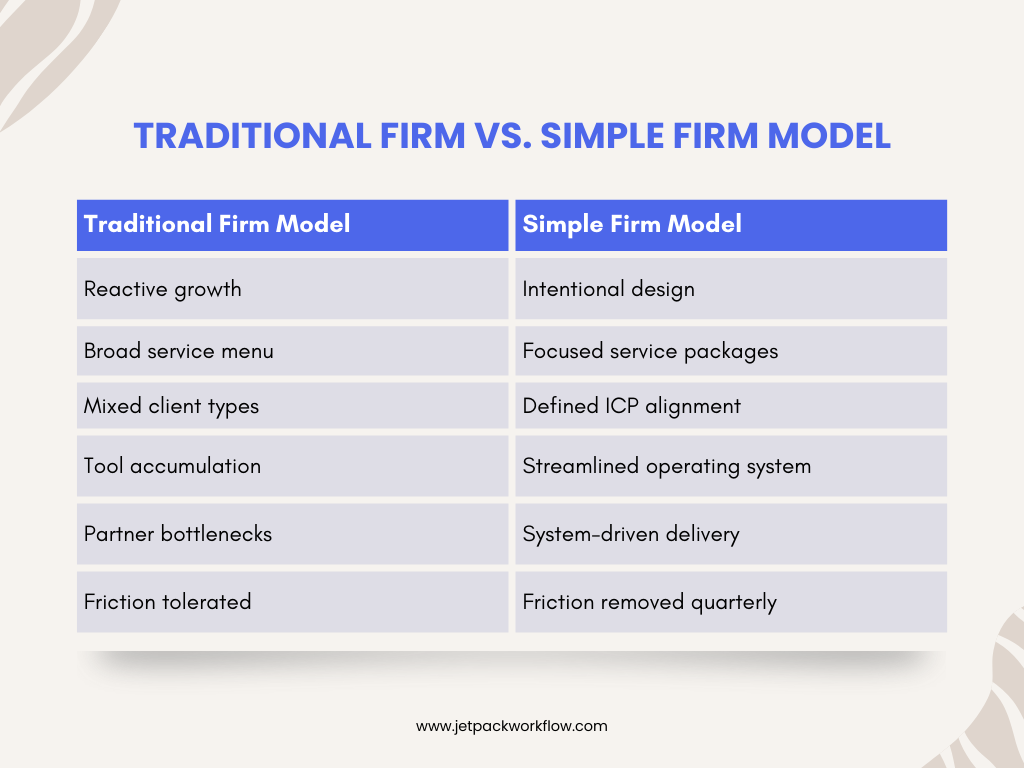
This shift is strategic, not cosmetic.
Conclusion
If you want to simplify your accounting firm, start by redefining what you sell, who you serve, and how you deliver. Bottlenecks are not signs of failure. They are signals of misalignment.
Simplicity is strategic. It requires saying no. It requires system design. And it requires removing friction consistently.
When you build systems that eliminate bottlenecks, you create capacity. And capacity gives you options.
If you are evaluating your firm’s operating system, client workflows, or recurring task visibility, consider whether your current systems are helping reduce friction or adding to it. The right workflow foundation can support the clarity this framework demands.
Frequently Asked Questions
How do I simplify my accounting firm without losing revenue?
You simplify by narrowing services and ideal clients, not by reducing value. Focus often increases profitability because delivery becomes more efficient and pricing becomes clearer.
What causes bottlenecks in accounting firms?
Bottlenecks are usually caused by unclear systems, partner review overload, tech sprawl, or inconsistent client expectations.
How often should firms review internal friction?
Quarterly reviews are recommended to identify process inefficiencies, technology overlap, and communication breakdowns.
What is an Ideal Client Profile in accounting?
An Ideal Client Profile defines the specific industry, size, service needs, and behavioral traits that align with your firm’s delivery model.
Does simplifying mean using fewer tools?
Not necessarily fewer tools, but fewer redundant tools. The goal is to use the minimum number required to deliver a consistent, high-quality experience.
How do roadmaps improve advisory services?
Roadmaps define the full planning framework for a client type, making advisory proactive instead of reactive.
Can small firms implement this framework?
Yes. In fact, smaller firms often benefit most because they can pivot faster and eliminate complexity earlier.
Related Articles
- Questions Every Firm Leader Should Ask Before Taking Private Equity: Jennifer Wilson’s Guide
- How to Finance Accounting Firm Acquisitions: SBA Insights from Sarah Sharp and Shannon Hay
- I Sold My Accounting Firm: A Panel Discussion on the Process and Lessons
- Inside the Minds of Firm Buyers: Lessons from Accounting M and A Leaders
- The Future of Accounting Firms in an AI Driven World with Ryan Lazanis
- How Coaching Transforms Accounting Leaders: Lessons from Douglas Slaybaugh
- What is CAS Accounting? Services, Benefits and Growth
- How Tailor Hartman Took His Accounting Firm to 200K in Year 1
- Why Outsourcing plus Workflow Software is the Future of Accounting Firms
- AI Tools That Help Accounting Firms Scale Faster
- How to Scale to a $1M Accounting Firm Without Hiring More Staff
Eliminate Bottlenecks and Simplify Your Accounting Firm
Share this article