Why Accounting Firm Owners Burn Out (And How to Fix It with Better Operations)
Accounting firm burnout is rarely about long hours alone. It is usually caused by broken operational systems, unclear processes, excessive rework, and owners acting as the “chief Wikipedia officer” of their firms. The fix is not working harder. It is building a scalable operating system that removes the owner as the bottleneck.

Key Takeaways

  • Burnout in accounting firms is usually operational, not personal.

  • Rework and poor handoffs often consume up to 30% of team capacity.

  • Owners become bottlenecks when systems do not replace tribal knowledge.

  • A structured operations audit can quickly identify profit and capacity leaks.

  • Sustainable growth requires a documented operating system, not heroic effort.

Jetpack Workflow Free Trial

Introduction

Accounting firm burnout happens when the business depends too heavily on the owner. When workflows are unclear, handoffs break down, and decisions route back to one person, exhaustion becomes predictable.

In a recent conversation on the Growing Your Firm podcast, Chase Damiano, Founder and CEO of Human at Scale, explained how operational inefficiency quietly drives stress inside accounting firms. His work focuses exclusively on helping firms build scalable operating systems that improve margins, restore capacity, and reduce overwhelm.

What Causes Accounting Firm Burnout?

Burnout often presents as fatigue, frustration, or stalled growth. Beneath the surface, the drivers are structural.

Common patterns include:

  • Endless internal questions directed at the owner

  • Weak client onboarding and poor handoffs

  • Excessive Slack or Teams interruptions

  • Rework loops between staff

  • No standardized KPIs

  • Lack of documented processes

When asked what he would expect to find in most struggling firms, Damiano summarized it in three words:

“Speed, quality, accuracy. When those three elements are misaligned, the strain spreads across the entire team.”

When any of those break down, stress increases across the entire organization.

How Does Poor Operations Create Burnout?

Burnout is not just about long hours. It is about unsustainable patterns that drain mental energy.

Excessive Rework

One of the most damaging inefficiencies is rework. In some firms, teams spend up to 30 percent of their time in unnecessary back and forth communication.

That includes:

  • Internal clarification messages

  • Re review cycles

  • Waiting for approvals

  • Restarting tasks

  • Correcting incomplete information

Even if someone works 40 hours per week, losing 30 percent of that to friction creates frustration and fatigue.

Rework does not feel productive. It feels like spinning in place.

The CEO Bottleneck Effect

In many accounting firms, the owner becomes the fastest path to resolution.

As Damiano described it:

“The CEO turns into this like chief Wikipedia officer.”

When team members encounter uncertainty, they default to messaging the owner. It works quickly. It feels efficient. It reinforces the habit.

The pattern looks like this:

  1. Problem arises

  2. Team pings owner

  3. Owner answers immediately

  4. Work continues

  5. Behavior repeats

Over time, the owner becomes overwhelmed. The team becomes dependent. Growth slows because leadership attention stays down and in the business.

Broken Client Onboarding

Another hidden burnout driver is weak onboarding.

Sales teams collect partial information. Handoffs lack clarity. Cleanup teams discover missing accounts or incomplete documentation after work begins.

This leads to:

  • Restarted engagements

  • Client frustration

  • Team confusion

  • Escalations back to the owner

Operational gaps between sales and delivery multiply stress.

How Can Better Operations Reduce Burnout?

The solution is not adding more people. It is creating clarity.

Damiano’s approach begins with an operations audit.

Conduct a 360 Degree Operations Audit

A comprehensive audit typically includes:

  • Leadership interviews

  • Frontline team interviews

  • Financial margin analysis

  • Client profitability review

  • Tech stack evaluation

  • Practice management adoption review

The goal is to identify operational blockers in priority order. Fixing one often unlocks the next two.

Clarity reduces chaos.

What Metrics Should Accounting Firms Track?

Burnout often correlates with weak operational visibility.

Firms should measure:
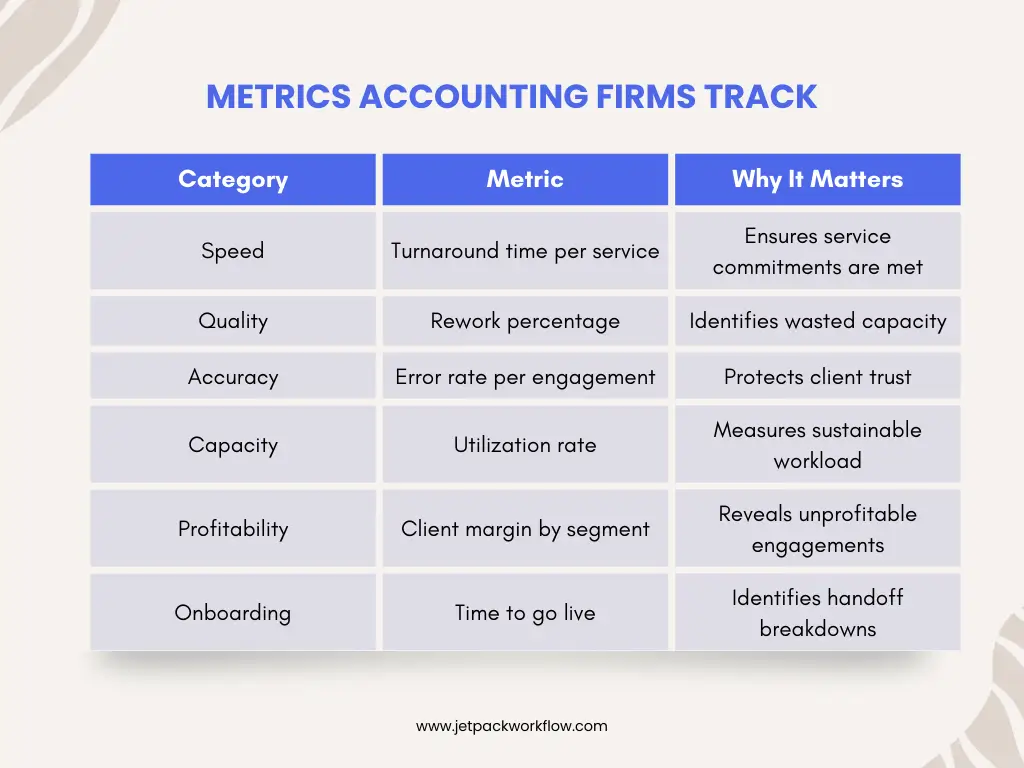
Metrics Accounting Firms Track

Service level agreements should not live only inside engagement letters. They should be reviewed consistently.

How Do You Break the Ask the Owner Habit?

Behavior change requires structure.

Damiano recommends two shifts.

First, reference the system. When a question comes in, ask whether the documented process has been reviewed. This reinforces autonomy.

Second, delay immediate answers.

Nine times out of ten, the team member resolves the issue independently before the meeting. The owner is no longer the path of least resistance.

When solutions are documented, future interruptions decrease.

As Damiano put it:

“Solve them one time.”

That mindset transforms recurring questions into permanent operational assets.

What Is an Operating System for an Accounting Firm?

An operating system is not software. It is a management framework.

It includes:

  • Defined KPIs

  • Structured meeting rhythms

  • Clear role ownership

  • Documented client workflows

  • Standardized onboarding

  • Shared dashboards

An operating system reduces dependency on personalities and increases organizational stability.

It allows the owner to shift from reactive problem solving to proactive strategy.

High Impact Fixes That Reduce Burnout Quickly

Firms can implement these improvements immediately:

  1. Document recurring decisions inside your workflow platform

  2. Standardize client onboarding checklists

  3. Measure and report rework monthly

  4. Consolidate redundant technology tools

  5. Run weekly KPI meetings with defined agendas

  6. Delay instant Slack responses to reduce dependency

  7. Remove or restructure unprofitable clients

Small efficiency gains compound across teams.

Saving 15 minutes per day per staff member equals more than 50 hours annually.

Signs Your Burnout Is Operational

Look for these signals:

  • You answer the same questions repeatedly

  • Staff wait for approvals to move forward

  • Engagements restart mid process

  • Sales promises exceed delivery capacity

  • Team morale drops during busy season

  • You feel constantly interrupted

These are not personality flaws. They are system design gaps.

Burnout Is a Leadership Design Issue

Many firm owners believe burnout is the price of growth. It is not.

Burnout often reflects a firm that depends too heavily on the founder’s memory, availability, and constant review.

Sustainable firms build systems where:

  • Processes outlive personalities

  • Documentation replaces tribal knowledge

  • Metrics guide decisions

  • Meetings replace message chaos

Operational maturity protects leadership energy.

Frequently Asked Questions

Why do accounting firm owners burn out?

Most burn out because they become the central hub for decisions, approvals, and problem solving due to weak operational systems.

What is the biggest cause of burnout in accounting firms?

Excessive rework and owner bottlenecks are major contributors.

How can I reduce burnout in my accounting firm?

Conduct an operations audit, document workflows, measure rework, and implement a structured operating system.

What is an operations audit?

It is a comprehensive review of leadership processes, financial performance, tech stack usage, and team workflows to identify inefficiencies.

How do I stop being the bottleneck?

Delay immediate answers, reinforce documentation, and turn recurring questions into permanent process updates.

Conclusion

Accounting firm burnout is rarely about effort. It is about structure.

When owners become the center of every operational decision, exhaustion follows. By implementing a documented operating system, reducing rework, and reinforcing autonomy, leaders regain clarity and capacity.

The goal is not to work more. The goal is to design a firm that works without constant intervention.

Related Articles

Fix Operational Bottlenecks Before They Burn You Out

If your firm is stuck in rework, constant approvals, or leadership overload, it is time to redesign your workflows. Clear processes and real-time visibility reduce burnout and restore capacity.

See how Jetpack Workflow helps accounting firms build structured systems that free owners to focus on growth.

See How It Works

See Jetpack Workflow In Action

Get under the hood of Jetpack Workflow’s accounting workflow and project management platform. See some of the top features and how it helps your firm standardize, automate, and track client work more efficiently.
How Accounting Firms Can Fix Broken Workflows Before Automating

Leaders across the accounting profession are reexamining how firms design their workflows as growth, complexity, and client expectations continue to rise. In this lightning talk from the Growing Your Firm Summit, Dan Luthi explains why many accounting firms experience inefficiency and burnout long before automation ever delivers meaningful results.

Drawing on his experience building workflows and financial systems at Ignite Spot Accounting, Dan breaks down the real cost of broken processes and shares a practical framework for fixing them. The session focuses on defining, documenting, and refining workflows before automating, helping firms reduce rework, improve visibility, and create systems that scale without adding unnecessary complexity.

Key Takeaways

  • Broken workflows create hidden costs through rework, confusion, and burnout.

  • Automation should come after workflows are clearly defined and documented.

  • Most inefficiencies come from unclear handoffs and inconsistent client inputs.

  • Simplifying workflows often delivers more impact than adding new software.

  • Small daily improvements compound into significant annual time savings.

Jetpack Workflow Free Trial

Accounting firms can fix broken workflows by clearly defining, documenting, and refining their processes before introducing automation. Automating chaos only makes inefficiencies move faster.

This matters now because many firms are investing heavily in new tools while still struggling with missed handoffs, client confusion, and team burnout. Without strong workflow foundations, technology becomes a liability instead of a lever for growth.

What Does a Broken Workflow Look Like in an Accounting Firm?

A broken workflow is rarely obvious at first. It usually shows up as friction that feels normal over time.

Common symptoms include:

  • Team members repeatedly asking for the same client information

  • Work being sent back and forth due to unclear ownership

  • Multiple tools doing overlapping jobs

  • Clients unsure where or how to submit documents

  • Managers stepping in to resolve preventable issues

“Broken workflows do more than slow work down.” – Dan Luthi

They create chaos that erodes confidence, both internally and with clients. Over time, this chaos becomes a major contributor to burnout.

Why Automating Broken Workflows Makes Problems Worse

Automation does not fix broken workflows. It amplifies them.

When firms automate before understanding their processes, they often:

  • Lock inefficiencies into software

  • Add more tools to compensate for unclear steps

  • Increase complexity for clients and staff

  • Create rigid systems that are difficult to fix later

Automation works best when it supports a clear process. Without that clarity, even the best tools introduce more friction.

How Should Accounting Firms Fix Workflows Before Automating?

Fixing workflows requires discipline, not technology. Dan Luthi outlined a practical, repeatable framework that firms can apply to any process.

1. Define the Goal Clearly
Every workflow must start with a specific outcome. “Deliver quality books” is not a goal. “Deliver monthly financial statements by the 15th using complete client data” is.

Clear definition prevents assumptions and sets expectations for everyone involved.

2. Document the Process End to End
Documentation is not bureaucracy. It is visibility.

Writing down each step reveals:

  • Where information is missing

  • Where manual work repeats

  • Where decisions stall progress

This step often exposes issues teams did not realize existed.

3. Refine Before Automating
Refinement is where improvement happens.

At this stage, firms should:

  • Remove unnecessary steps

  • Consolidate client touchpoints

  • Clarify responsibilities

  • Reduce handoffs

Only after refinement should automation be considered.

What Are the Most Common Workflow Bottlenecks?

Most accounting workflow bottlenecks fall into a few predictable categories.

1. Decision Fatigue
Too many choices slow work down. This often comes from offering clients too many options for submitting documents or paying bills.

2. Poor Handoffs
Unclear ownership between team members leads to delays and rework.

3. Inconsistent Client Processes
Clients using different tools without clear standards increase internal complexity.

Identifying these bottlenecks requires asking why delays occur, not just where they occur.

How Can Firms Simplify Without Reducing Service Quality?

Simplification improves service when done intentionally.

Dan shared an example where his firm allowed clients to submit documents through many platforms to “meet them where they were.” While well intentioned, it created confusion internally.

Simplification came from:

  • Reducing the number of supported tools

  • Standardizing client workflows

  • Eliminating unused systems

This did not reduce flexibility. It increased efficiency and clarity.

Does Fixing Workflows Mean Reducing the Tech Stack?

Not always, but it often means using fewer tools more effectively.

Many firms use only 20 to 30 percent of a tool’s capabilities while layering multiple tools on top of each other. This creates cost, training burden, and fragmented data.

Simplifying the tech stack:

  • Reduces errors

  • Improves adoption

  • Lowers subscription and transaction costs

  • Improves client experience

In some cases, consolidating tools delivers more value than buying new ones.

How Do Small Workflow Improvements Create Big Gains?

Large transformations are not required to see meaningful results.

Saving 15 minutes per day:

  • Saves over one hour per week

  • Adds up to more than 50 hours per year

Small, consistent improvements compound. Starting small also makes change easier to adopt and sustain.

When Should Accounting Firms Reassess Their Workflows?

Not all workflows need constant review.

Best practice includes:

  • Reviewing core systems periodically to avoid disruption

  • Continuously refining client interaction workflows

  • Creating internal feedback loops for team input

Some firms use dedicated communication channels to surface friction points in real time, allowing incremental improvement without major disruption.

Conclusion

Accounting firms do not need more automation. They need better workflows.

By defining goals, documenting processes, and refining systems before automating, firms create clarity, reduce burnout, and improve client outcomes. Technology then becomes an accelerator, not a crutch.

If your firm is evaluating automation or struggling with workflow inefficiencies, start by fixing the process first. Strong workflow foundations make every future investment more effective.

Frequently Asked Questions

What causes broken workflows in accounting firms?

Broken workflows are caused by unclear processes, inconsistent client inputs, poor documentation, and premature automation.

Should accounting firms automate workflows first or last?

Automation should come last, after workflows are defined, documented, and refined.

Can fixing workflows reduce burnout?

Yes. Clear workflows reduce rework, interruptions, and decision fatigue, which are major drivers of burnout.

How often should workflows be reviewed?

Core systems should be reviewed periodically, while client-facing workflows should be refined continuously.

Do standardized workflows reduce client flexibility?

No. Standardization improves clarity and efficiency while still allowing controlled flexibility where needed.

Is workflow documentation worth the time?

Yes. Documentation reveals inefficiencies and prevents knowledge loss, making improvement possible.

Related Articles

Fix Your Firm’s Workflows Before Automating

If your firm is dealing with rework, unclear handoffs, or tools that are not delivering the efficiency you expected, it may be time to revisit how your workflows are designed.

See how Jetpack Workflow helps accounting firms standardize recurring work, improve visibility across teams, and build automation on top of clear, proven processes.

See How It Works

See Jetpack Workflow In Action

Get under the hood of Jetpack Workflow’s accounting workflow and project management platform. See some of the top features and how it helps your firm standardize, automate, and track client work more efficiently.
The Future of the Accounting Profession

Firm leaders throughout the accounting industry are reassessing how their organizations grow, function, and remain sustainable in a time of constant change. In this Future of the Profession roundtable from the Growing Your Firm Summit, industry voices Daniel Hood, Jennifer Wilson, and Randy Crabtree come together to unpack what firm leaders must prepare for next.

Drawing on decades of experience across accounting media, firm leadership, coaching, and specialization, the panel explores the real challenges facing firms today, from burnout and outdated business models to cultural shifts, AI adoption, and change management. Rather than focusing on fear or hype, the discussion offers grounded insights into where opportunity exists for firms willing to adapt with intention and clarity.

Key Takeaways

  • The accounting profession is not in decline, but it is being reshaped by culture shifts, AI, and new business models.

  • Burnout, outdated firm structures, and poor change management are bigger threats than technology itself.

  • AI will not replace accountants, but firms that fail to adapt how they work will fall behind.

  • Firms that invest in communication, leadership skills, and niche expertise will outperform peers.

  • The next decade will reward firms that move from compliance-first to advisory-led models.

Jetpack Workflow Free Trial

The future of the accounting profession is bright, but only for firms willing to change how they operate. Firm leaders must prepare now for cultural shifts, rapid technology adoption, and evolving expectations from clients and staff.

“I think the future of the profession is pretty bright. There’s a lot of challenges going forward, but I think in general, there are a lot of opportunities for accountants.” – Daniel Hood

That optimism is justified, but it comes with responsibility.

What Is Changing in the Accounting Profession Right Now?

The accounting profession is experiencing more change in this decade than it did in the previous hundred years. Technology, client expectations, workforce dynamics, and firm ownership models are all shifting at once.

At the center of this conversation are leaders like Daniel Hood, Jennifer Wilson, and Randy Crabtree, who have spent years observing how firms operate and where they struggle.

Key changes reshaping firms today include:

  • The erosion of rigid, billable-hour-first firm models

  • Rapid adoption of AI and workflow automation

  • A shift from compliance-heavy work to advisory services

  • Cultural tension driven by succession, private equity, and generational turnover

These are not temporary disruptions. They represent a structural shift in how firms must operate to remain relevant.

What Are Firm Leaders Most Worried About?

Firm leaders are less worried about technology itself and more concerned about what might be lost along the way.

1. Cultural Drift Inside the Profession

One of the strongest concerns raised during the discussion was cultural. As ownership structures evolve, some firms risk losing the profession’s long-standing commitment to serving clients, people, and communities, not just shareholders.

 “What I’m most worried about right now is shifting our culture in the profession… making it okay to be focused on my personal benefit versus the greater good.” – Jennifer Wilson

When culture weakens, trust declines internally and externally.

2. Burnout Driven by Math, Not Motivation

Burnout remains one of the most damaging forces in accounting firms, and it is rarely caused by a lack of passion.

Instead, it is driven by simple arithmetic. Workload continues to increase while staffing and systems lag behind. Busy seasons now stretch across the entire year, making recovery impossible.

This is not sustainable leadership. It is deferred failure.

3. Resistance to Necessary Change

For decades, firms could afford to wait. That era is over.

Some leaders believe they can delay change because retirement is near. That mindset shifts the cost of inaction onto successors, teams, and clients. Firms that fail to build change capability now will struggle later.

Why Is Change Management Now a Core Accounting Skill?

Change management is no longer optional. It is a leadership competency.

The problem is not that firms need to change. The problem is that most firms are not equipped to manage change well.

Effective change requires:

  • Clear and repeated communication

  • Early involvement of skeptics and objectors

  • Defined ownership and timelines

  • Space for feedback and course correction

Poor execution drains energy. Strong leadership reduces friction.

“Change is fatiguing because it takes so long.” – Jennifer Wilson

Accounting professionals are trained for precision, not persuasion. Yet communication is the engine of successful transformation.

How Will AI Impact the Accounting Profession?

AI is not replacing accountants. It is replacing the least valuable parts of their work.

What AI Will Remove

AI will continue to automate:

  • Transaction coding

  • Reconciliations

  • Draft compliance outputs

  • Repetitive reporting tasks

These activities consume time without deepening client relationships.

What AI Will Enable

AI allows accountants to focus on:

  • Advisory conversations

  • Scenario modeling

  • Strategic planning

  • Relationship-driven client work

This mirrors past technology shifts, such as spreadsheets replacing manual ledgers. Automation elevated the profession then, and it will do so again.

What Business Models Are Gaining Momentum?

The profession now has permission to rethink assumptions that once felt immovable.

1. Moving Beyond the Billable Hour

More firms are adopting:

  • Fixed-fee pricing

  • Subscription services

  • Outcome-based advisory packages

These models align value with results, not time logged.

2. Advisory-First Firm Design

Compliance work remains essential, but it no longer needs to define a firm’s identity.

Advisory services include:

  • Cash flow planning

  • Tax strategy

  • Growth and profitability analysis

  • Operational decision support

Firms that package advisory intentionally see higher margins and stronger client loyalty.

3. Niche and Lifestyle Firms

Not every firm needs to scale aggressively.

Some leaders are choosing smaller teams, focused industries, and predictable workloads. Others are leaning into niche expertise, creating clarity and differentiation in crowded markets.

What Opportunities Are Firms Overlooking Right Now?

1. Strategic Hiring During Uncertainty
Periods of economic uncertainty slow job movement, creating opportunities to attract high-quality talent that may not be actively searching.

2. Client Transitions
Mergers and ownership changes leave some clients seeking alternatives. Firms with strong culture and clarity can attract them.

3. Knowledge Sharing as a Growth Strategy
Sharing expertise builds trust. As Randy Crabtree emphasized, educating others often creates demand rather than diminishing value.

“Educating others often creates demand rather than diminishing value.” – Randy Crabtree

Conclusion

The future of the accounting profession will favor firms that adapt without abandoning their values. Technology and AI create leverage, but leadership determines outcomes.

Firms that act now can build healthier teams, stronger client relationships, and sustainable growth models.

To explore how modern workflow systems support advisory-first accounting firms, book a demo or access free resources designed to help firms prepare for what comes next.

FAQs About the Future of the Accounting Profession

What is the future of the accounting profession?

The future of accounting is advisory-led, technology-enabled, and relationship-focused, with compliance as a foundation rather than the destination.

Will AI replace accountants?

No. AI replaces repetitive tasks, not professional judgment, strategy, or relationships.

Why are accounting firms struggling with burnout?

Burnout occurs when workload grows faster than systems and staffing, not because people lack resilience.

How should firms prepare for change?

Firms should invest in leadership development, communication, and technology while involving teams early.

Are advisory services in demand?

Yes. Clients increasingly expect proactive guidance, not just historical reporting.

Related Articles

Prepare Your Firm for the Next Era of Accounting

If your firm is feeling the strain of year-round busy seasons, growing workloads, or constant change, it may be time to rethink how your workflows support advisory work and long-term sustainability.

See how Jetpack Workflow helps accounting firms standardize recurring work, improve visibility across teams, and create capacity for higher-value client advisory services.

See How It Works

See Jetpack Workflow In Action

Get under the hood of Jetpack Workflow’s accounting workflow and project management platform. See some of the top features and how it helps your firm standardize, automate, and track client work more efficiently.
How to Scale a Niche Accounting Firm Without Chasing Referrals

Matt Gardner scaled Hiline by moving beyond referral-only growth and building systems designed to scale. By niching down, investing ahead of demand, restructuring sales roles, and embracing automation and technology, Hiline created a predictable growth engine that does not rely on founder hustle.

Scaling an accounting firm beyond referrals is one of the hardest challenges firm owners face. In this episode of Growing Your Firm, Matt Gardner shares how Hiline grew by niching down, investing ahead of growth, and building a real go-to-market engine instead of relying on referrals or founder hustle.

Key Takeaways

  • Referrals eventually cap growth, even for high-quality firms

  • Niching down simplifies sales, marketing, and delivery

  • Investing ahead of growth creates long-term leverage

  • Founder-led sales can transition with the right structure

  • Technology and automation are central to future firm models

Jetpack Workflow Free Trial

From Public Accounting to Building a Scalable Firm

Matt Gardner co-founded Hiline in 2016 after spending nearly a decade in public accounting. While the experience provided technical grounding, it also shaped his vision for what a modern accounting firm should not look like.

“I spent nine years doing audits, and I hated it for almost the entire nine years.”

From the beginning, Hiline was not designed as a traditional lifestyle firm. The goal was to build an accounting firm that could scale beyond the founders, operate with consistency, and grow without burning out its team.

This mindset influenced early decisions around pricing, service structure, and long-term investments.

Why Hiline Moved Beyond the Traditional Partner Model

Like many firms, Hiline originally followed the partner-name model common in accounting. That approach quickly showed its limitations.

Partner-centric branding made it harder to stand out, harder to scale geographically, and harder to build a firm that could grow independently of individual founders.

“We didn’t feel like the two names on the wall were going to get it done.”

Rebranding was not cosmetic. It reflected a shift toward building a scalable brand that clients could recognize, trust, and associate with a clear value proposition rather than specific individuals.

Using Traditional Services to Fund Growth

In its early stages, Hiline maintained a small tax and attestation practice alongside its core services. This was not intended as a long-term growth strategy.

Instead, the traditional service line generated predictable cash flow that allowed the founders to reinvest aggressively into the future of the firm. That capital funded early hires, technology investments, and internal systems that most firms delay until much later.

Over time, the traditional services became a distraction. As the core business grew faster, it became clear that focus mattered more than incremental revenue.

The firm ultimately sold off that side of the business and committed fully to a scalable accounting firm model.

Investing Ahead of Growth Instead of Reacting to It

One of the defining characteristics of Hiline’s growth strategy was investing before it felt necessary.

Rather than waiting until the firm was stretched thin, Hiline built infrastructure early. This included sales support, marketing operations, people operations, finance, and technology.

At one point, nearly half of the team was not directly involved in service delivery. This is uncommon in accounting firms but intentional.

“We were always focused on what we were going to need 18 to 24 months from now.”

This approach created leverage. When growth accelerated, the systems were already in place to support it, reducing chaos and protecting service quality.

Why Referrals Alone Eventually Cap Growth

Referrals are a powerful early growth channel for accounting firms. They signal trust and quality. But they also come with limits.

Every firm experiences churn. Referrals alone rarely replace lost revenue at scale. Eventually, growth slows even when demand exists.

Hiline experienced this firsthand. Early attempts to hire sales without sufficient inbound demand failed. Founder-led sales carried the business longer than expected, but that model was not scalable.

The lesson was clear. Sales requires demand. Demand requires positioning, brand presence, and consistent marketing.

Building a Real Go-to-Market Engine for an Accounting Firm

Hiline’s growth accelerated when go-to-market became a dedicated function instead of a side responsibility.

This included intentional investments in marketing, sales, onboarding, and customer experience. These functions were designed to work together rather than operate in silos.

Content played a central role. Instead of marketing to other accountants, Hiline focused on speaking directly to its ideal clients. The goal was clarity, not volume.

Clear positioning made sales conversations easier. Prospects understood what Hiline did, who it served, and why it was different before ever booking a call.

Why Niching Down Simplified Everything

Niching down was not about excluding opportunities. It was about focus.

By concentrating on specific client types with shared needs, Hiline improved delivery consistency, clarified its messaging, and reduced operational complexity.

Nonprofits emerged as a strong focus because of their similar financial challenges, underserved market, and alignment with Hiline’s service model.

“When you know who you serve best, sales becomes easier.”

Rather than trying to serve everyone equally, Hiline focused its go-to-market investment where product-market fit was strongest.

Rethinking Sales Roles in Accounting Firms

Sales in accounting firms is highly stage-dependent. What works early often breaks as the firm grows.

In Hiline’s early stages, sales responsibility stayed close to the work. Team members with strong technical backgrounds were best positioned to explain value, scope services accurately, and earn trust during discovery calls. This approach reduced friction and prevented overpromising.

As Hiline’s positioning became clearer and inbound demand increased, the sales function evolved into a more traditional structure supported by marketing.

Key shifts in Hiline’s sales model included:

  • Moving from founder-led sales to trained internal sellers

  • Aligning sales roles with clear niches and ideal client profiles

  • Supporting sales with inbound content and brand visibility

Compensation also mattered. Sales incentives were tied to accountability, not just activity. Clear quotas and outcomes created focus and predictability.

This evolution reduced pressure on the founders while creating a scalable, repeatable revenue engine that could grow with the firm.

Technology, Automation, and the Future of Accounting Firms

Technology is not an add-on in Hiline’s operating model. It is foundational to how the firm scales.

Automation and AI are used to reduce manual work, improve consistency, and eliminate repetitive tasks that limit capacity. This allows teams to spend more time on insight, problem-solving, and advisory work.

Hiline’s approach to technology focuses on:

  • Automating transactional and repetitive workflows

  • Integrating systems to reduce handoffs and errors

  • Using data to surface insights, not just reports

Firms that invest early in automation and system design gain leverage. They can support more clients without increasing burnout or headcount at the same rate.

This shift also changes the role of accountants. Instead of acting primarily as processors, team members become system thinkers, advisors, and interpreters of financial information. Firms that adapt early are better positioned for long-term relevance and growth.

Building an Accounting Firm for the Long Term

Hiline’s approach emphasizes strategic positioning over operational sameness.

Many accounting firms compete primarily on efficiency and responsiveness. Over time, this leads to price pressure and burnout.

Strategic positioning creates differentiation. Combined with early investment, clear niches, and strong systems, it allows firms to grow sustainably.

Conclusion

Scaling an accounting firm without chasing referrals requires a fundamental shift. Matt Gardner’s experience at Hiline shows that predictable growth comes from clarity, intentional investment, and systems built for the future.

By niching down, building a real go-to-market engine, and embracing technology, accounting firms can move beyond founder-led growth and create businesses that truly scale.

Frequently Asked Questions

How did Matt Gardner scale Hiline without relying on referrals?

Matt Gardner scaled Hiline by niching down, investing ahead of growth, and building a structured go-to-market engine. Referrals helped early, but predictable growth came from systems, positioning, and inbound demand.

Why do referrals eventually stop working for accounting firms?

Referrals plateau as firms grow and cannot consistently replace churn. Without marketing, positioning, and sales systems, growth slows even when demand exists.

Why is niching down important for accounting firm growth?

Niching down simplifies marketing, sales, and delivery. It improves product-market fit, shortens sales cycles, and allows firms to build repeatable systems.

How should accounting firms think about sales roles?

Sales roles should evolve with the firm’s stage. Early sales often work best with technically strong team members. As positioning matures, firms can support dedicated sales roles with inbound demand.

What role does technology play in scaling an accounting firm?

Technology and automation reduce manual work, increase consistency, and create capacity for advisory services. Firms that invest early gain long-term leverage and scalability.

Related Articles

Build Predictable Growth Without Relying on Referrals

If your firm has hit a growth ceiling or still depends heavily on founder-led sales and referrals, it may be time to rethink how your workflows support scale.

Start a free trial of Jetpack Workflow to see how standardized processes, real-time visibility, and scalable systems help accounting firms grow with clarity and consistency.

See How It Works

See Jetpack Workflow In Action

Get under the hood of Jetpack Workflow’s accounting workflow and project management platform. See some of the top features and how it helps your firm standardize, automate, and track client work more efficiently.
Real-Time Visibility Into Client Work and Team Capacity for Accounting Firms

Growing accounting firms lose visibility when work is tracked across spreadsheets, emails, and individual systems. Our demo call with Sheri shows how real-time workflow visibility gives firm owners a clear view of client work, team workload, and capacity without daily check-ins or micromanagement.

  • Visibility breaks down when client work lives in spreadsheets and inboxes

  • Real-time workflow views replace daily status emails and manual follow-ups

  • Standardized templates support recurring work without removing flexibility

  • Capacity planning helps firm owners rebalance work before deadlines slip

  • Centralized systems reduce owner stress and reliance on memory

Jetpack Workflow Free Trial

Why Visibility Breaks Down as Accounting Firms Grow

In the early stages, spreadsheets often feel sufficient. A few clients, a small team, and manual updates can work well enough.

As firms grow, complexity increases. Client work becomes recurring. Teams become distributed. Processes vary by person. Visibility shifts from being automatic to something firm owners must actively chase.

At that point, the issue is no longer productivity. It is the lack of a shared system that shows what is happening across the firm in real time.

Real Demo Call Insight: When Spreadsheets Stop Scaling

Sheri H (Accounting Firm Owner):
“We’re literally using nothing. We have Excel spreadsheets everywhere, so if I’m going to look and see where we’re at on projects, I’m literally filing through several different spreadsheets to find out where everybody’s at and who’s doing what.”

Beatty (Jetpack Workflow Specialist):
“That’s exactly where workflow software helps. Instead of everything living in a spreadsheet, you build it once in the system, put it on a schedule, and it just automatically repeats.”

Sheri:
“I just need something centralized. I don’t want to babysit.”

This moment reflects where many growing accounting firms realize spreadsheets are no longer enough.

What Real-Time Visibility Looks Like in Practice

With centralized workflow visibility, all client work lives in one system. Firm owners can see:

  • Which client work is active or overdue

  • Who is responsible for each task

  • Where projects are stalled

  • When work was last updated

Visibility becomes passive. Owners no longer need to request updates or piece together information from multiple sources.

Centralizing Client Work Without Losing Flexibility

Centralization does not mean rigidity. Recurring services can follow standardized workflows while still allowing client-specific customization.

Firms can document unique instructions, adjust task lists, and apply changes once without manually rebuilding future work. This creates consistency without forcing every client into the same mold.

Eliminating Daily Status Emails

In the demo call, Sheri described relying on end-of-day emails to understand what her team was working on. That approach adds overhead and creates unnecessary friction.

Shared visibility removes the need for constant check-ins. The system becomes the source of truth, allowing teams to focus on delivery instead of reporting.

Seeing Team Capacity Before Problems Appear

Visibility is not only about tracking tasks. It also supports capacity planning.

When firm owners can see how much work each team member has remaining, they can rebalance assignments, spot bottlenecks early, and make better decisions about onboarding new clients or hiring.

This reduces burnout and prevents last-minute fire drills.

Why This Matters for Firm Owners

When visibility improves, decision-making improves.

Firm owners can clearly answer questions like:

  • Are projects moving forward as expected?

  • Who has capacity this week?

  • Where is work backing up?

  • Can we take on more clients right now?

Clarity replaces guesswork.

Building a More Sustainable Firm

Real-time visibility is not about control. It is about clarity and confidence.

When client work and team capacity are visible in one place, firms operate more intentionally instead of reacting to problems after they surface. That shift is what makes growth sustainable.

Conclusion

As accounting firms grow, visibility becomes the limiting factor.

When client work is tracked across spreadsheets and emails, firm owners lose clarity and rely on constant check-ins. Centralized workflow visibility removes that friction by showing client status, task progress, and team capacity in one place.

The demo call shows that real-time visibility is not about control. It is about clarity. When work is visible, firms make better decisions, reduce oversight, and scale without losing control of client delivery.

This is the foundation for sustainable growth in modern accounting firms.

Frequently Asked Questions

What does real-time visibility mean for accounting firms?
It means firm owners can instantly see client work status, task progress, and team workload without relying on emails or manual updates.

Why do spreadsheets stop scaling for accounting firms?
Spreadsheets require manual updates and do not provide shared, real-time visibility as teams and recurring work grow.

How does centralized workflow reduce micromanagement?
When work status is visible in one system, firm owners no longer need to ask for updates or monitor progress manually.

Can accounting workflows still be customized for individual clients?
Yes. Firms can standardize recurring work while customizing tasks and instructions at the client level.

How does visibility help with capacity planning?
It allows firm owners to see how much work each team member has remaining and rebalance workloads before deadlines are impacted.

Related Articles

See Real-Time Visibility in Action

Explore how accounting firms centralize client work and team capacity by starting a free trial or booking a live demo.

FREE TRIAL

See Jetpack Workflow In Action

Get under the hood of Jetpack Workflow’s accounting workflow and project management platform. See some of the top features and how it helps your firm standardize, automate, and track client work more efficiently.
Fixing Turnover and Capacity Problems Inside Growing Accounting Firms

Growing accounting firms often misdiagnose turnover and capacity issues. Erin Daiber explains why these problems usually start at the partner level, how trust breakdowns create hidden churn, and what firms must fix first before hiring or offshoring. The firms that stabilize fastest focus on leadership alignment, clear expectations, and disciplined workflows.

Key Takeaways

  • High turnover is usually a symptom, not the real problem.

  • Partner misalignment quietly erodes trust and drives talent out.

  • Capacity issues often come from bottlenecks, not staffing shortages.

  • Pricing, scope control, and manager behavior directly affect workload.

  • Firms that want to stay independent must operate like they are always preparing for succession.

Jetpack Workflow Free Trial

Why Turnover Spikes in Growing Accounting Firms

When accounting firms lose multiple team members in a short period, leaders often assume the issue is training, compensation, or workload. According to Erin Daiber, that assumption frequently misses the real cause.

She explained that when firms come to her after losing key people, the first question she asks is simple and uncomfortable: what actually happened. Exit interviews rarely tell the full story, especially when people are already burned out and emotionally checked out.

“If you are asking someone as they are walking out the door why they are leaving, you are probably not going to get the best feedback in that moment.”

Instead of relying on surface-level explanations, her team goes directly to the source by interviewing team members at every level, from administrative staff to partners. This allows firms to identify the root cause instead of treating symptoms.

The Hidden Cost of Partner Misalignment

One of the most damaging patterns Erin sees is misalignment inside the partner group. Firms may believe they have a manager training problem or a senior development issue, when in reality trust has broken down at the top.

She shared an example of a firm that lost an entire class of seniors in a single year. Leadership believed the solution was better manager training. After conducting firm-wide interviews, Erin discovered the real issue was a lack of trust among partners, combined with private disagreements leaking into the broader team.

“There was a total breakdown of trust between the partner group and the rest of the firm.”

When partners appear aligned publicly but disagree privately, staff quickly sense the inconsistency. Policies feel unfair, communication becomes unreliable, and people leave rather than fight a system they cannot influence.

Why Training Alone Does Not Fix Cultural Problems

Training programs cannot fix cultural fractures that start at the partner level. Erin is clear that any transformation must begin with leadership behavior, not downstream processes.

Before implementing new systems or training managers, firms must first determine whether partners are willing to do the hard work. That sometimes means addressing uncomfortable truths or even letting go of high-performing rainmakers who damage the culture.

Erin explains this boundary clearly to clients: if leaders are unwilling to make difficult decisions in service of the firm’s future, meaningful change is unlikely.

Real transformation requires:

  • Alignment on values and decision-making

  • Clear policies applied consistently

  • Psychological safety within the partner group

  • Accountability for both words and actions

How Long Cultural Turnarounds Really Take

Cultural repair is not quick. Erin emphasized that firms often underestimate the time required to rebuild trust and stabilize teams.

In cases involving deep partner misalignment, meaningful progress can take at least 18 months of focused effort. This includes offsite partner retreats, facilitated conversations, and structured processes for healthy conflict.

The key principle is consistency. Teams watch leadership behavior closely, and credibility is rebuilt only when actions match stated intentions over time.

Psychological Safety as a Practical Tool

To help partners and managers speak openly, Erin often introduces the concept of psychological safety. Rather than treating it as an abstract idea, she uses assessments to make the conversation practical and less personal.

These assessments help individuals understand what they need in order to speak up and disagree productively. This creates a neutral starting point for conversations that might otherwise feel confrontational.

In addition, Erin uses coaching and role-playing to help leaders prepare for moments of disagreement. Practicing how to raise objections and manage discomfort allows people to respond differently in real meetings instead of defaulting to silence.

Why Capacity Problems Are Rarely About Hiring

When client demand outpaces capacity, firms often jump straight to hiring or offshoring. Erin cautions that this is usually not the fastest or most effective solution.

Capacity issues often come from internal bottlenecks, such as:

  • Managers fixing work instead of sending it back

  • Undefined or inconsistent processes

  • Poor scope control with clients

  • Weak feedback loops between preparers and reviewers

One of the most common patterns Erin sees is work flowing upward and getting stuck with managers who are uncomfortable giving feedback. This creates review bottlenecks and exhausts leadership.

Before adding headcount, firms should examine how work actually moves through the firm and where it slows down.

The Role of Pricing and Scope Control

Pricing is closely tied to capacity, even when firms do not realize it. Underpriced work increases workload without improving profitability, making it harder to hire or invest in systems.

Erin recommends reviewing fees as an early lever because pricing adjustments can reduce workload while maintaining or improving revenue. Combined with tighter scope control and clearer client expectations, this often creates faster relief than staffing changes.

Staying Independent in a Consolidating Industry

As private equity and mergers reshape the accounting landscape, Erin works with many firms that want to remain independent. Her guidance is straightforward: the work required to stay independent is the same work required to build firm value.

That means focusing on:

  • Efficient, documented processes

  • Strong technology integration

  • Leadership development and internal succession

  • Consistent profitability aligned with market standards

Firms become most vulnerable when succession planning is delayed. Normalizing conversations about exit paths, even years in advance, reduces risk and preserves optionality.

Building Firms That Can Absorb Change

Whether a firm plans to sell, merge, or stay independent, the same foundation applies. Leaders must shift from working in the business to working on the business.

As Erin summarized:

“All of the steps you need to take are the same, which is growing the value of the firm.”

That value comes from trust, clarity, and systems that do not rely on heroics from a few exhausted people.

How Jetpack Workflow Supports These Changes

Many of the issues Erin describes surface when work visibility breaks down. Firms struggle to see where work stalls, who owns what, and when deadlines slip.

Jetpack Workflow helps accounting firms document processes, assign accountability, and create consistent visibility across engagements. By clarifying workflows and expectations, firms reduce bottlenecks and support healthier delegation as they grow.

Frequently Asked Questions

What causes high turnover in accounting firms?
Turnover is often driven by leadership misalignment, lack of trust, unclear expectations, and unmanaged workloads rather than compensation alone.

Why do capacity problems persist even after hiring?
Capacity issues frequently come from internal bottlenecks, inefficient reviews, and poor scope control rather than a lack of staff.

How long does cultural change take in accounting firms?
Deep cultural change typically takes 12 to 18 months of consistent leadership alignment and behavior change.

Can firms stay independent despite private equity pressure?
Yes. Firms that invest in leadership, succession planning, and operational discipline are better positioned to remain independent.

Related Articles

Create Capacity Without Burning Out Your Team

If your firm is dealing with turnover, bottlenecks, or growing client demand, workflow clarity is essential.

Start a free trial of Jetpack Workflow to see how structured processes and real-time visibility can help your team scale sustainably.

See How It Works

See Jetpack Workflow In Action

Get under the hood of Jetpack Workflow’s accounting workflow and project management platform. See some of the top features and how it helps your firm standardize, automate, and track client work more efficiently.