The Accounting Workflow Process Framework Every Firm Should Follow
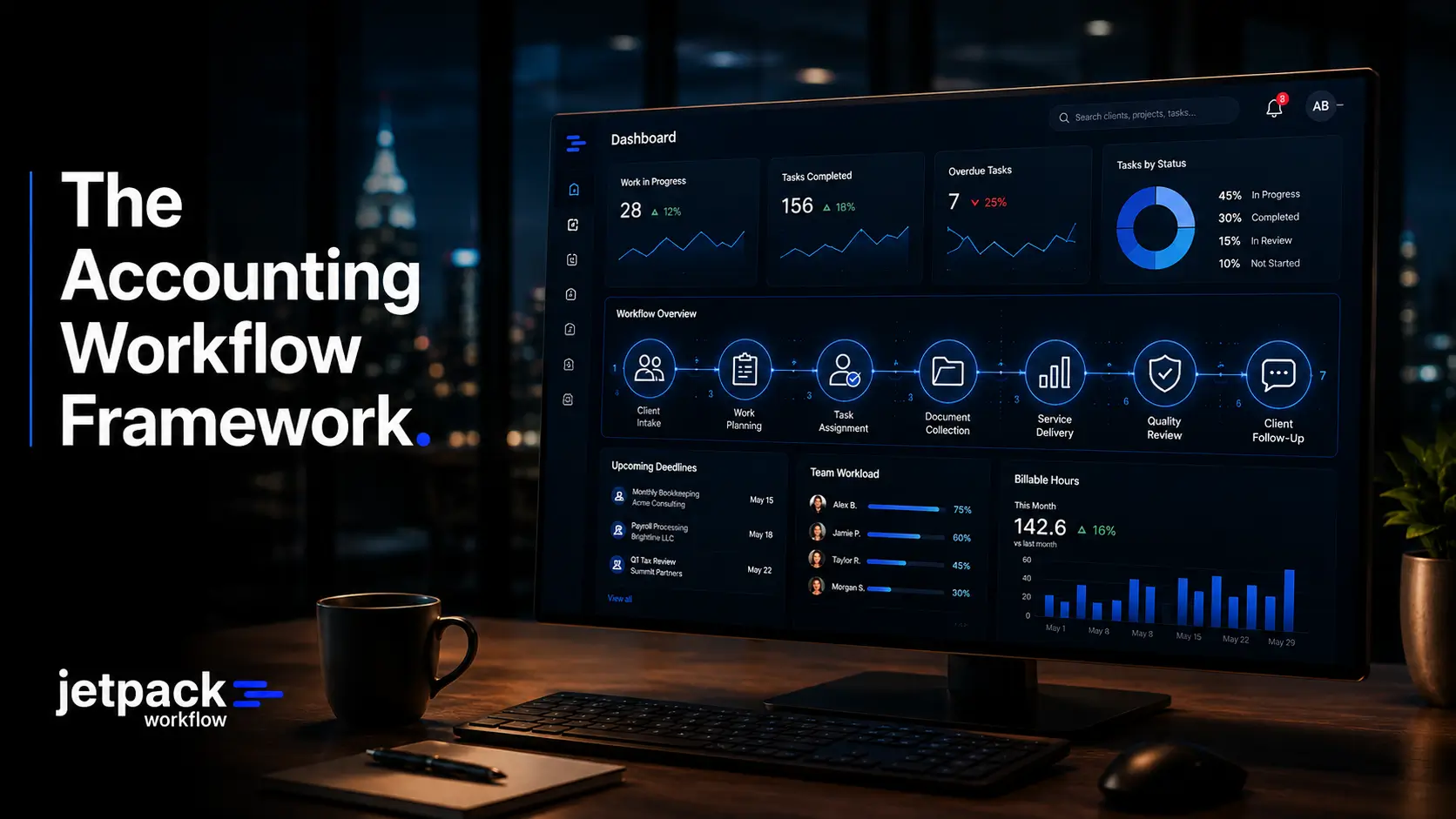
An accounting workflow process is the structured sequence of steps an accounting firm follows to manage client work from intake to completion. Firms that standardize their accounting workflow process often improve visibility, reduce missed deadlines, increase team accountability, and scale more efficiently. As firms grow, having a documented workflow framework becomes essential for maintaining quality, managing recurring work, and supporting automation.
Key Takeaways
- A standardized accounting workflow process reduces operational bottlenecks.
- Clear workflows improve team accountability and workload visibility.
- Documented processes make onboarding and training easier.
- Workflow automation helps eliminate repetitive administrative tasks.
- Firms with strong workflow systems are better positioned to scale.
- Accounting workflow software helps manage recurring deadlines and client work.
Many accounting firms do excellent technical work but struggle with operational consistency.
The problem is rarely accounting expertise. More often, it is the lack of a clearly defined accounting workflow process.
As firms grow, work becomes more complex. New team members join. Client requests increase. Recurring deadlines multiply. Without a structured process, tasks can fall through the cracks, communication becomes fragmented, and managers lose visibility into what is happening across the firm.
This is why many successful firms treat their accounting workflow process as a core business system rather than an administrative afterthought.
A strong workflow framework creates consistency, improves efficiency, and helps firms scale without sacrificing quality.
What Is an Accounting Workflow Process?
An accounting workflow process is the repeatable system a firm uses to move client work from initiation to completion.
It includes:
- Client intake
- Task creation
- Document collection
- Team assignments
- Service delivery
- Review procedures
- Client communication
- Follow-up activities
The goal is simple: ensure work is completed accurately, consistently, and on time.
Rather than relying on memory, spreadsheets, sticky notes, or email chains, firms use documented workflows to create predictable outcomes.
Why Accounting Firms Need a Standardized Workflow Framework
Every accounting firm has workflows.
The difference is whether those workflows are intentional or accidental.
Firms without documented processes often experience:
- Missed deadlines
- Uneven client experiences
- Inconsistent service delivery
- Poor workload visibility
- Team confusion
- Increased operational stress
Standardization creates structure.
When everyone follows the same accounting workflow process, managers gain visibility, staff understand expectations, and client work moves more efficiently through the firm.
This becomes increasingly important as team size grows.
The 7 Stages of an Accounting Workflow Process
While every firm has unique services, most accounting workflow processes follow a similar framework.
1. Client Intake
Every workflow starts with gathering information.
This stage typically includes:
- Discovery calls
- Proposal approval
- Engagement letters
- Initial document requests
- Client setup
A structured intake process reduces onboarding delays and ensures critical information is captured from the beginning.
2. Work Planning
Before work begins, firms should define:
- Scope of services
- Deadlines
- Team responsibilities
- Client requirements
- Review procedures
Planning prevents confusion and helps teams prioritize work effectively.
3. Task Assignment
Clear ownership is essential.
Each task should have:
- A responsible team member
- Due dates
- Status tracking
- Dependencies
One of the most common workflow failures occurs when everyone assumes someone else owns the task.
4. Document Collection
Accounting work often depends on client-provided information.
Effective firms create structured document collection processes that include:
- Automated reminders
- Client portals
- Request checklists
- Due date tracking
Reducing document delays can significantly improve turnaround times.
5. Service Delivery
This is where the actual work happens.
Examples include:
- Bookkeeping
- Payroll processing
- Tax preparation
- Financial reporting
- Advisory services
At this stage, workflows ensure work follows consistent procedures regardless of who completes it.
6. Quality Review
Quality control protects the firm.
Review procedures help identify:
- Data entry errors
- Missing information
- Compliance issues
- Calculation mistakes
- Process deviations
Firms that skip review steps often create more work later through corrections and client issues.
7. Client Follow-Up
The workflow should not end when the work is delivered.
Strong firms follow up with:
- Client communication
- Status updates
- Advisory recommendations
- Future planning
- Additional service opportunities
This stage often creates the strongest client relationships and growth opportunities.
Common Accounting Workflow Process Mistakes
Many firms unknowingly create workflow problems through outdated practices.
Common mistakes include:
Relying on Email as a Workflow System
Email is a communication tool, not a workflow platform.
Important tasks can easily get buried in inboxes.
Using Multiple Unconnected Systems
When information lives across spreadsheets, email threads, task lists, and separate software tools, visibility disappears.
Lack of Standard Operating Procedures
Without documented procedures, every employee develops their own way of completing work.
This creates inconsistency and training challenges.
Poor Capacity Planning
Firms often assign work without understanding team workload.
This leads to bottlenecks and deadline pressure.
Limited Visibility
Managers cannot improve what they cannot see.
Visibility is one of the biggest operational advantages of a strong accounting workflow process.
How Workflow Software Improves the Accounting Workflow Process
As firms grow, manual workflow management becomes difficult.
Workflow software helps firms centralize operations and improve accountability.
Benefits include:
- Task tracking
- Recurring workflow automation
- Deadline management
- Team collaboration
- Capacity visibility
- Standardized processes
- Client work management
Instead of relying on spreadsheets or manual follow-up, firms gain a centralized view of work across the organization.
This is why workflow software for accountants has become a critical operational tool for many growing firms.
The Role of Automation in Modern Accounting Workflows
Automation does not replace accounting expertise.
It removes repetitive administrative work.
Examples include:
- Recurring task creation
- Automated reminders
- Status updates
- Document requests
- Workflow routing
- Client notifications
Automation allows teams to spend less time managing work and more time delivering value.
The best accounting workflow processes combine standardized procedures with strategic automation.
How High-Growth Firms Standardize Their Accounting Workflow Process
Successful firms rarely scale through individual heroics.
They scale through systems.
High-growth firms often focus on:
- Documented workflows
- Standard operating procedures
- Consistent service delivery
- Capacity planning
- Automation
- Visibility and reporting
- Continuous process improvement
They recognize that operational excellence is often a competitive advantage.
Clients may not see the workflow directly, but they experience the results through responsiveness, accuracy, and consistency.
Building an Accounting Workflow Process That Scales
If your firm is evaluating its current workflow process, start with these questions:
- Is every recurring service documented?
- Are responsibilities clearly assigned?
- Can managers see workload across the team?
- Are deadlines tracked centrally?
- Are client requests standardized?
- Is recurring work automated where possible?
- Can new employees learn the process quickly?
If the answer to several of these questions is no, there is likely an opportunity to strengthen your workflow framework.
The goal is not complexity.
The goal is consistency.
Simple, repeatable processes often outperform complicated systems that nobody follows.
Conclusion
A strong accounting workflow process is one of the most important operational assets a firm can build.
It creates visibility, accountability, consistency, and scalability.
As client demands increase and teams grow, relying on memory and manual coordination becomes increasingly risky.
Firms that document and standardize their accounting workflow process are often better positioned to reduce bottlenecks, improve service quality, and scale efficiently.
The firms that grow successfully are rarely the ones working the hardest.
They are usually the ones with the best systems.
Frequently Asked Questions
What is an accounting workflow process?
An accounting workflow process is the structured system used to manage client work from intake through completion, including task assignments, reviews, communication, and delivery.
Why is an accounting workflow process important?
A standardized accounting workflow process improves visibility, accountability, consistency, and efficiency while reducing missed deadlines and operational bottlenecks.
What are the main stages of an accounting workflow process?
Most accounting workflow processes include client intake, work planning, task assignment, document collection, service delivery, quality review, and client follow-up.
How does workflow software help accounting firms?
Workflow software helps firms centralize task management, automate recurring work, improve team visibility, and standardize operational processes.
What causes accounting workflow bottlenecks?
Common causes include poor task ownership, lack of documentation, disconnected systems, manual processes, and limited workload visibility.
Can workflow automation improve accounting firm efficiency?
Yes. Workflow automation helps reduce repetitive administrative work, improve consistency, and free staff to focus on higher-value activities.
Last Updated: June 2026
Related Articles
- From Spreadsheets to Systems: The Shift in Nonprofit Financial Management
- How Accounting Firms Are Valued in Today’s Market with Doug Lewis
- I Sold My Accounting Firm: A Panel Discussion on the Process and Lessons
- Inside the Minds of Firm Buyers: Lessons from Accounting M and A Leaders
- Scaling an Accounting Firm: Systems That Protect Client Experience
- How a Remote Accounting Firm Uses EOS to Scale from 6 to 10 Team Members in 90 Days
- The Power of Simplicity in Accounting Firms: Simplify Services with Better Packaging and Pricing
- How Tailor Hartman Took His Accounting Firm to 200K in Year 1
- Why Outsourcing plus Workflow Software is the Future of Accounting Firms
- How Jeff Seibert Is Using AI Accounting Firm Automation to Build a 90% Automated Firm
- How to Scale to a $1M Accounting Firm Without Hiring More Staff
- The Accounting Firm Growth Strategy That Took Calculate to $10M in Revenue
- How Workflow Systems for Accounting Firms Help Firms Become AI-Ready
Share this article