How Workflow Systems for Accounting Firms Help Firms Become AI-Ready

Workflow systems for accounting firms are becoming essential as AI adoption accelerates across the accounting industry. Many firms want to use AI tools for automation, reporting, and operational efficiency, but disconnected systems and scattered firm data often prevent those tools from working effectively. Accounting firms that organize workflows, centralize operational data, and improve visibility are in a much stronger position to benefit from AI. Firms that ignore operational infrastructure may struggle to scale AI initiatives successfully.
Key Takeaways
- Workflow systems for accounting firms improve operational visibility
- AI tools depend on organized and centralized firm data
- Disconnected systems reduce automation effectiveness
- Workflow standardization improves scalability and efficiency
- Operational visibility helps firms reduce bottlenecks
- Accounting firms with stronger systems are more prepared for AI adoption
Introduction
Many accounting firms are excited about AI.
Firms are testing automation tools, AI bookkeeping systems, meeting transcript software, and workflow automation platforms to improve efficiency and reduce manual work.
But there is one operational problem slowing many firms down:
Their systems are disorganized.
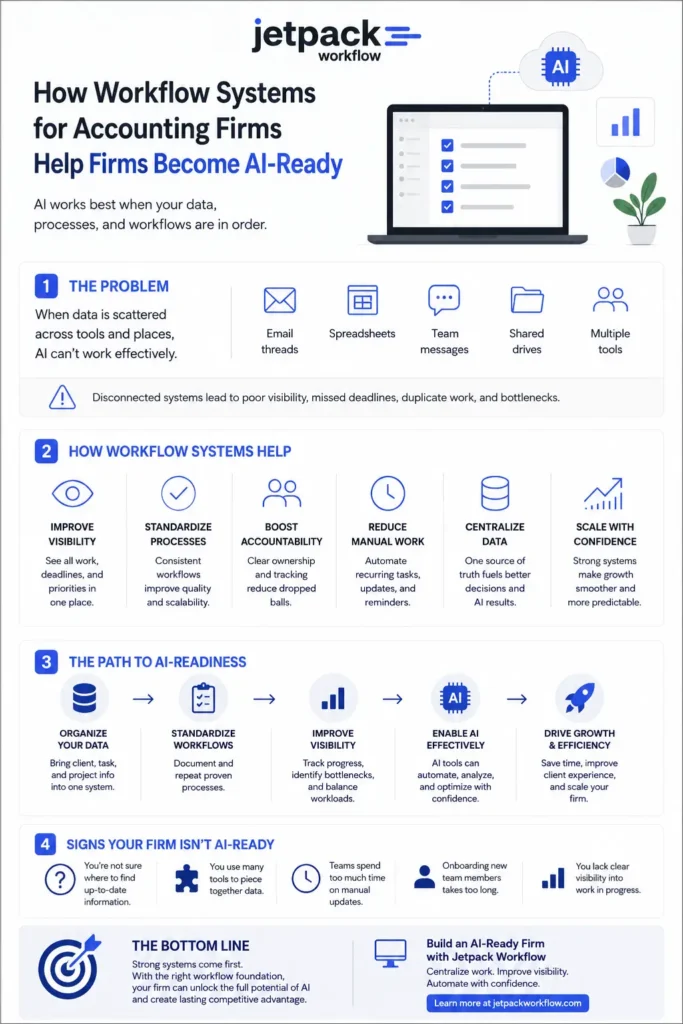
In many firms, important operational data lives across:
- Email threads
- Spreadsheets
- CRMs
- Project management tools
- Client portals
- Team notes
- Internal documents
This creates a major problem for AI adoption.
AI systems rely heavily on structured and accessible data. If operational information is fragmented across multiple systems, AI tools cannot work effectively.
As one automation consultant explained:
“People that want to be AI centric, like you have to be data centric first.”
This is why workflow systems for accounting firms are becoming increasingly important.
Firms that organize workflows, centralize operational data, and improve visibility are often in a much better position to implement AI successfully.
Why AI Requires Organized Operational Data
AI tools are only as effective as the data they can access.
Many accounting firms assume AI alone will solve operational inefficiencies, but automation cannot fix disorganized systems automatically.
If a firm cannot easily answer questions like:
- Where is client information stored?
- Where are recurring tasks tracked?
- Where are deadlines managed?
- Where are workflow updates documented?
- Where are client communications centralized?
then AI tools will struggle to operate consistently.
This creates several operational problems:
- Incomplete automation
- Poor workflow visibility
- Duplicate work
- Missed deadlines
- Inconsistent client experiences
- Limited scalability
Accounting firms often underestimate how much operational structure AI requires behind the scenes.
Why Workflow Systems for Accounting Firms Matter
Workflow systems for accounting firms help centralize recurring operational processes.
Instead of relying on scattered tools and manual follow-ups, workflow systems create a structured operational environment where work becomes easier to manage, track, and automate.
Modern workflow systems help firms:
- Track recurring deadlines
- Assign responsibilities
- Standardize operational processes
- Improve team visibility
- Centralize task management
- Reduce operational bottlenecks
This is why many growing firms are investing in workflow software for accountants to improve operational visibility and support automation initiatives. This operational structure becomes increasingly valuable as firms adopt AI-driven processes.
Without workflow systems, many accounting firms struggle to maintain operational consistency as complexity increases.
The Operational Problem Many Accounting Firms Ignore
Many firms still operate with fragmented systems built over time.
A typical accounting firm may manage information across:
- Email inboxes
- Multiple spreadsheets
- Slack messages
- CRM platforms
- Tax software
- Project management tools
- Internal notes
- Shared drives
While each system may solve an individual problem, the overall operational environment becomes fragmented.
The result is often:
- Poor visibility
- Repeated manual work
- Communication gaps
- Difficulty onboarding employees
- Workflow inconsistency
- Operational confusion
This fragmentation also limits the effectiveness of AI automation.
If data is incomplete or spread across disconnected systems, AI cannot reliably generate insights, automate tasks, or support workflows effectively.
How Centralized Workflow Systems Improve AI Readiness
Firms that successfully implement AI typically build strong operational foundations first.
Workflow systems for accounting firms help centralize operational data in ways that make automation significantly more effective.
Centralized systems improve:
- Workflow visibility
- Task accountability
- Operational consistency
- Team coordination
- Client tracking
- Reporting accuracy
When operational information is centralized, AI tools can:
- Identify workflow bottlenecks
- Generate automated task updates
- Improve reporting processes
- Support quality control
- Assist with recurring workflows
- Improve operational forecasting
This creates a much stronger foundation for scalable automation.
Why Visibility Is One of the Biggest Operational Advantages
Operational visibility is one of the most overlooked benefits of workflow systems.
Many accounting firm owners do not realize how much operational information is hidden inside disconnected systems until growth creates pressure.
Without visibility, firms struggle to answer questions like:
- Which deadlines are at risk?
- Which team members are overloaded?
- Which projects are delayed?
- Which clients require follow-up?
- Where are operational bottlenecks forming?
Workflow systems help firms create centralized visibility across recurring work.
This visibility becomes even more important when firms begin layering AI and automation into operational processes.
AI performs significantly better when systems provide clear, structured, and centralized operational data.
Why Standardized Processes Improve Scalability
As accounting firms grow, inconsistency becomes expensive.
Without standardized workflows:
- Employees complete tasks differently
- Client experiences vary
- Onboarding becomes harder
- Quality control becomes inconsistent
- Operational bottlenecks increase
Workflow systems help accounting firms standardize recurring processes across teams.
This creates:
- Greater operational consistency
- Faster onboarding
- Better accountability
- Easier automation
- Improved scalability
AI adoption becomes much easier when firms already have structured operational processes in place.
How Workflow Systems Help Reduce Manual Work
Many accounting firms still spend significant time on:
- Manual status updates
- Repeated follow-ups
- Internal coordination
- Tracking recurring deadlines
- Searching for client information
Workflow systems reduce these inefficiencies by centralizing operational management.
This allows firms to automate:
- Task reminders
- Workflow progression
- Team notifications
- Deadline tracking
- Recurring task creation
As AI tools become more advanced, firms with organized workflows will likely automate even more operational work.
What AI-Ready Accounting Firms Typically Have in Common
Accounting firms successfully adopting AI often share several operational characteristics:
- Centralized workflow systems
- Organized operational data
- Standardized recurring processes
- Strong workflow visibility
- Clear accountability systems
- Consistent documentation practices
These firms treat operational infrastructure seriously.
Instead of relying on fragmented systems and team memory, they build processes designed for scalability and automation.
Why Operational Infrastructure Will Matter More in the Future
The accounting industry is moving quickly toward automation.
AI adoption is already changing:
- Bookkeeping workflows
- Client communication
- Financial reporting
- Quality control
- Advisory services
- Internal operations
But firms with fragmented systems may struggle to benefit fully from these tools.
The firms most likely to gain long-term advantages are often the ones building organized operational systems today.
Workflow systems for accounting firms are no longer simply productivity tools.
They are becoming foundational operational infrastructure for AI-ready firms.
Frequently Asked Questions
Why are workflow systems for accounting firms important?
Workflow systems help accounting firms manage recurring work, improve visibility, standardize processes, and centralize operational data.
Why does AI require organized operational data?
AI tools rely on structured and accessible data to automate workflows, generate insights, and improve operational efficiency.
What happens when accounting firms use disconnected systems?
Disconnected systems often create poor visibility, repeated manual work, communication gaps, and operational bottlenecks.
How do workflow systems improve AI readiness?
Workflow systems centralize operational data and standardize processes, making automation and AI tools more effective.
Can small accounting firms benefit from workflow systems?
Yes. Small firms can improve operational efficiency, accountability, and scalability through organized workflow systems.
What operational problems do workflow systems help solve?
Workflow systems help reduce missed deadlines, manual tracking, poor visibility, communication gaps, and inconsistent processes.
Conclusion
Workflow systems for accounting firms are becoming increasingly important as AI adoption accelerates across the accounting industry.
Firms that centralize operational data, standardize workflows, and improve visibility are often in a much stronger position to implement automation successfully.
AI tools alone will not solve operational inefficiencies. The firms seeing the biggest long-term gains are typically the ones building strong operational infrastructure first.
As accounting firms continue adopting automation and AI-driven processes, organized workflow systems may become one of the biggest competitive advantages firms can build.
Last Updated: May 2026
Related Articles
- How to Simplify Your Accounting Firm: 5 Systems to Eliminate Bottlenecks
- How LaMichelle Built a 6-Figure Accounting Firm Serving Nonprofits
- From Spreadsheets to Systems: The Shift in Nonprofit Financial Management
- How Accounting Firms Are Valued in Today’s Market with Doug Lewis
- I Sold My Accounting Firm: A Panel Discussion on the Process and Lessons
- Inside the Minds of Firm Buyers: Lessons from Accounting M and A Leaders
- Scaling an Accounting Firm: Systems That Protect Client Experience
- How a Remote Accounting Firm Uses EOS to Scale from 6 to 10 Team Members in 90 Days
- The Power of Simplicity in Accounting Firms: Simplify Services with Better Packaging and Pricing
- How Tailor Hartman Took His Accounting Firm to 200K in Year 1
- Why Outsourcing plus Workflow Software is the Future of Accounting Firms
- How Jeff Seibert Is Using AI Accounting Firm Automation to Build a 90% Automated Firm
- How to Scale to a $1M Accounting Firm Without Hiring More Staff
Share this article