How Better Accounting Workflows Improve Client Retention

Accounting workflows play a direct role in client retention. When workflows are organized, standardized, and visible across the firm, clients experience fewer delays, better communication, and more consistent service. Firms with strong accounting workflows are often better positioned to retain clients, build trust, and create long-term relationships. As competition increases, operational excellence is becoming a key differentiator for accounting firms.
Key Takeaways
- Accounting workflows directly impact client retention.
- Missed deadlines and poor communication often cause client churn.
- Standardized workflows improve consistency and client experience.
- Workflow visibility helps teams deliver work on time.
- Better accounting workflows create stronger client trust.
- Workflow software helps firms manage recurring client work more efficiently.
Introduction
Many accounting firms focus heavily on winning new clients.
Far fewer spend time analyzing why existing clients leave.
While pricing and service offerings matter, client retention is often influenced by something less obvious: operational execution.
Clients rarely leave because a tax return was prepared correctly.
They leave because emails go unanswered, deadlines are missed, updates are inconsistent, and they feel forgotten.
In many cases, these issues are not technical accounting problems. They are workflow problems.
This is why accounting workflows have become increasingly important for firms that want to improve client retention and create a more reliable client experience.
Why Client Retention Matters for Accounting Firms
Retaining existing clients is often more profitable than acquiring new ones.
When firms maintain long-term client relationships, they benefit from:
- Higher lifetime value
- More referrals
- Lower acquisition costs
- Greater revenue stability
- Increased advisory opportunities
Client retention also improves operational efficiency because existing clients typically require less onboarding and fewer administrative resources.
The challenge is that retaining clients requires consistent execution across every interaction.
This is where accounting workflows become critical.
The Hidden Cost of Poor Accounting Workflows on Client Retention
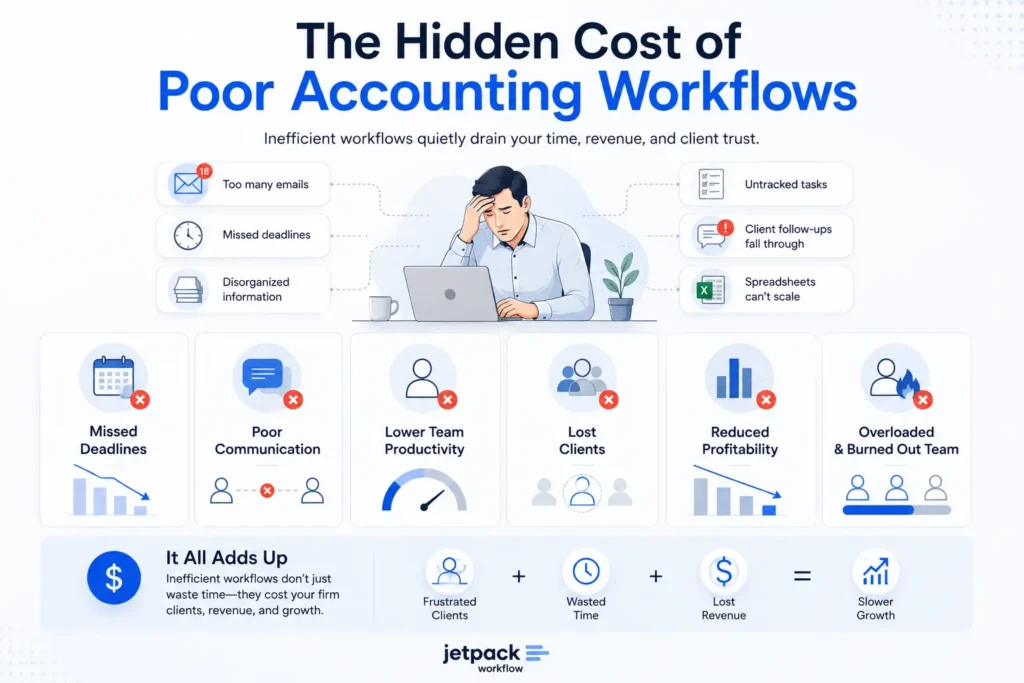
Many workflow issues are invisible until clients start leaving.
Common workflow problems include:
- Missed deadlines
- Inconsistent communication
- Delayed document requests
- Poor task ownership
- Lack of status visibility
- Forgotten follow-ups
- Bottlenecks during busy seasons
While these may seem like internal operational issues, clients experience them directly.
A client waiting for an update does not care whether the issue was caused by a spreadsheet, an overloaded manager, or a missed task assignment.
They simply see a lack of responsiveness.
Over time, these experiences erode trust.
How Missed Deadlines Damage Client Trust
Trust is one of the most valuable assets an accounting firm can build.
Clients depend on their accounting team to help them meet important deadlines related to:
- Tax filings
- Financial reporting
- Payroll
- Compliance requirements
- Advisory planning
When deadlines are missed repeatedly, clients begin to question whether their firm is organized enough to handle their needs.
Strong accounting workflows help prevent this by creating:
- Automated task schedules
- Clear due dates
- Assigned ownership
- Progress tracking
- Deadline visibility
The more predictable the workflow, the more confidence clients have in the firm.
Why Consistent Communication Improves Client Retention
One of the most common reasons clients become frustrated is poor communication.
Many firms only communicate when something goes wrong.
Clients often prefer proactive updates, even when there is nothing urgent to report.
Effective accounting workflows help support communication by ensuring:
- Client requests are tracked
- Follow-ups are scheduled
- Status updates are documented
- Team members have visibility into client interactions
When communication becomes part of the workflow rather than an afterthought, client satisfaction typically improves.
How Accounting Workflows Create a Better Client Experience
Clients may never see the workflow itself.
They do experience the results.
Strong accounting workflows create:
Faster Response Times
Questions are routed to the right person and tracked until completed.
Consistent Service Delivery
Every client receives the same level of attention regardless of who is handling the work.
Better Organization
Documents, deadlines, and communication remain centralized.
Fewer Errors
Standardized processes reduce mistakes and improve quality control.
Greater Transparency
Clients feel informed and supported throughout engagements.
Each of these factors contributes directly to stronger client retention.
The Role of Workflow Visibility in Client Service
Many firms struggle with visibility.
Managers often do not know:
- What work is currently in progress
- Which tasks are overdue
- Who owns specific assignments
- Which clients require attention
Without visibility, small issues become larger problems.
Workflow visibility allows firms to identify bottlenecks before they impact clients.
This helps teams:
- Stay ahead of deadlines
- Balance workloads
- Improve accountability
- Deliver a more reliable client experience
For growing firms, visibility becomes increasingly important as the number of clients and recurring tasks increases.
Common Workflow Problems That Cause Client Churn
Several workflow issues appear frequently in firms that struggle with retention.
Relying on Email for Task Management
Important requests often become buried in inboxes.
Lack of Standard Processes
Different team members follow different procedures, creating inconsistent experiences.
Manual Tracking Systems
Spreadsheets and sticky notes become difficult to manage as firms grow.
Poor Follow-Up Procedures
Clients feel ignored when communication is inconsistent.
No Centralized Workflow System
Work becomes fragmented across multiple tools and locations.
Addressing these issues often leads to measurable improvements in client satisfaction.
How Workflow Software Improves Accounting Workflows
As firms grow, manual workflow management becomes increasingly difficult.
Workflow software helps firms create structure and visibility across recurring client work.
Benefits often include:
- Deadline tracking
- Recurring task management
- Team accountability
- Capacity planning
- Process standardization
- Client work visibility
- Workflow automation
Many firms adopt workflow software for accountants because it helps eliminate operational blind spots that can negatively affect client relationships.
Instead of reacting to problems, firms gain the ability to proactively manage work and client expectations.
How High-Growth Firms Use Accounting Workflows to Retain Clients
Firms that consistently retain clients often share several characteristics.
They typically have:
- Documented workflows
- Standard operating procedures
- Clear task ownership
- Strong communication processes
- Workflow visibility
- Automated recurring tasks
- Consistent service delivery
These systems create predictability for both clients and employees.
As a result, clients experience fewer surprises and greater confidence in the firm’s ability to deliver.
Building Accounting Workflows That Support Long-Term Growth
If your firm wants to improve client retention, start by evaluating your current workflows.
Ask:
- Are recurring services standardized?
- Are deadlines tracked centrally?
- Can managers easily see workload status?
- Are client communications documented?
- Is ownership assigned for every task?
- Are follow-ups built into workflows?
- Are recurring processes automated where possible?
The answers often reveal opportunities for improvement.
Client retention is rarely driven by a single interaction.
It is the result of hundreds of small experiences over time.
Strong accounting workflows help ensure those experiences remain positive and consistent.
Conclusion
Better accounting workflows improve client retention by creating consistency, visibility, accountability, and stronger communication.
Clients stay with firms they trust.
That trust is built through reliable service delivery, proactive communication, and the confidence that deadlines will be met.
As firms grow, accounting workflows become one of the most important operational systems supporting long-term client relationships.
The firms that retain clients most effectively are often the firms with the strongest workflows behind the scenes.
Frequently Asked Questions
How do accounting workflows improve client retention?
Accounting workflows improve client retention by helping firms deliver consistent service, meet deadlines, improve communication, and create a better overall client experience.
Why do clients leave accounting firms?
Clients often leave accounting firms due to poor communication, missed deadlines, inconsistent service, lack of responsiveness, and operational issues that reduce trust.
What are the signs of poor accounting workflows?
Common signs include missed deadlines, overloaded staff, inconsistent communication, poor task ownership, and limited visibility into work progress.
How does workflow software help accounting firms retain clients?
Workflow software helps firms manage recurring tasks, improve accountability, track deadlines, standardize processes, and deliver more consistent client service.
What role does communication play in client retention?
Consistent communication helps clients feel informed, valued, and supported. Strong workflows ensure communication is documented and follow-ups are completed.
Can workflow automation improve client satisfaction?
Yes. Workflow automation reduces delays, improves consistency, and helps firms respond more efficiently to client needs, leading to a better client experience.
Last Updated: June 2026
Related Articles
- From Spreadsheets to Systems: The Shift in Nonprofit Financial Management
- How Accounting Firms Are Valued in Today’s Market with Doug Lewis
- I Sold My Accounting Firm: A Panel Discussion on the Process and Lessons
- Inside the Minds of Firm Buyers: Lessons from Accounting M and A Leaders
- Scaling an Accounting Firm: Systems That Protect Client Experience
- How a Remote Accounting Firm Uses EOS to Scale from 6 to 10 Team Members in 90 Days
- The Power of Simplicity in Accounting Firms: Simplify Services with Better Packaging and Pricing
- How Tailor Hartman Took His Accounting Firm to 200K in Year 1
- Why Outsourcing plus Workflow Software is the Future of Accounting Firms
- How Jeff Seibert Is Using AI Accounting Firm Automation to Build a 90% Automated Firm
- How to Scale to a $1M Accounting Firm Without Hiring More Staff
- The Accounting Firm Growth Strategy That Took Calculate to $10M in Revenue
- How Workflow Systems for Accounting Firms Help Firms Become AI-Ready
Share this article