The Business Growth Mistake That Leads to Financial Disaster

Many businesses assume more funding or debt will solve operational problems, but that often creates even bigger issues. When growth is fueled by constant borrowing instead of a healthy business model, companies can become trapped in unsustainable spending habits. Instead of fixing the core problem, additional capital can hide operational weaknesses and delay important decisions. Sustainable growth comes from improving systems, profitability, and operational discipline, not simply adding more money.
Key Takeaways
- Debt can temporarily hide deeper business problems
- Raising more capital does not automatically fix operations
- Poor financial habits often grow with the business
- Sustainable growth requires operational efficiency and profitability
- Businesses should identify root problems before taking on debt
- Strong systems and financial visibility reduce growth risks
Introduction
Many businesses believe that more money will solve growth problems.
When revenue slows, margins tighten, or operational issues appear, the first reaction is often to raise more capital, secure loans, or take on debt to keep the business moving.
But in many cases, that decision creates even larger problems.
Instead of fixing the core issue, additional funding can hide operational weaknesses and create a dangerous dependency on outside capital.
In a recent discussion about business growth and financial pressure, one point stood out clearly:
“The business wasn’t working, so adding more to what’s not working doesn’t make it any better.”
This is one of the most common business growth mistakes companies make when trying to scale quickly.
Why Businesses Turn to Debt During Growth
Growth creates pressure.
As businesses expand, they often experience:
- Higher operational costs
- Increased payroll
- More software expenses
- Marketing pressure
- Cash flow challenges
- Scaling inefficiencies
When these pressures increase, debt can appear to be the easiest solution.
Business owners often believe:
- More money will buy more time
- More spending will accelerate growth
- More capital will fix operational gaps
But if the underlying business model is weak, debt usually magnifies the problem instead of solving it.

How Debt Creates Dangerous Business Habits
One of the biggest risks with constant funding is behavioral.
Once businesses repeatedly solve problems with money, they can develop unhealthy operational habits.
Examples include:
- Overspending to compensate for poor systems
- Avoiding operational improvements
- Delaying difficult decisions
- Ignoring profitability issues
- Relying on constant cash injections
Over time, businesses stop solving root problems and start depending on funding to survive.
The problem is that this approach becomes difficult to sustain when revenue slows or capital becomes harder to access.
Why More Capital Can Hide Operational Problems
Additional funding can temporarily make a business look healthier than it really is.
Capital injections can mask:
- Poor operational efficiency
- Weak profit margins
- High burn rates
- Inefficient workflows
- Unclear positioning
- Lack of financial discipline
Instead of forcing the business to improve operations, more money often delays necessary changes.
This creates a dangerous cycle where companies continue spending aggressively without fixing the systems causing the problem in the first place.
The Difference Between Growth and Sustainable Growth
Not all growth is healthy growth.
Some businesses grow revenue quickly while losing operational control behind the scenes.
Signs of unsustainable growth include:
- Constant cash shortages
- Increasing debt dependency
- Low profitability
- Poor visibility into financial performance
- Operational bottlenecks
- Lack of process consistency
Sustainable growth looks very different.
Healthy businesses focus on:
- Operational efficiency
- Strong margins
- Predictable systems
- Clear financial visibility
- Scalable workflows
- Controlled spending
This creates a business that can grow without relying heavily on outside funding.
Why Operational Systems Matter During Growth
One of the biggest reasons businesses struggle financially during growth is operational inefficiency.
Without clear systems:
- Costs increase faster than revenue
- Teams become disorganized
- Workflows break down
- Visibility decreases
- Errors increase
- Profitability suffers
Strong operational systems help businesses:
- Improve efficiency
- Reduce unnecessary costs
- Standardize processes
- Increase accountability
- Maintain visibility during scaling
This becomes especially important for service-based businesses and firms managing recurring operational work.
How Financial Visibility Helps Prevent Bad Decisions
Many businesses take on debt because they lack clear financial visibility.
Without accurate operational and financial data, it becomes difficult to identify:
- Where money is being wasted
- Which services are profitable
- Which processes are inefficient
- What operational bottlenecks exist
This often leads to reactive decisions instead of strategic improvements.
Better visibility allows businesses to:
- Make data-driven decisions
- Improve operational planning
- Control spending
- Protect profitability
- Scale more responsibly
Why Efficiency Matters More Than Aggressive Spending
Many companies assume faster growth requires aggressive spending.
But operational efficiency often creates stronger long-term results than rapid spending expansion.
Efficient businesses focus on:
- Improving systems
- Reducing waste
- Increasing operational consistency
- Automating repetitive processes
- Improving team accountability
This creates healthier margins and reduces dependency on debt or outside funding.
Businesses with strong systems are also better positioned to adapt during economic uncertainty or slower growth periods.
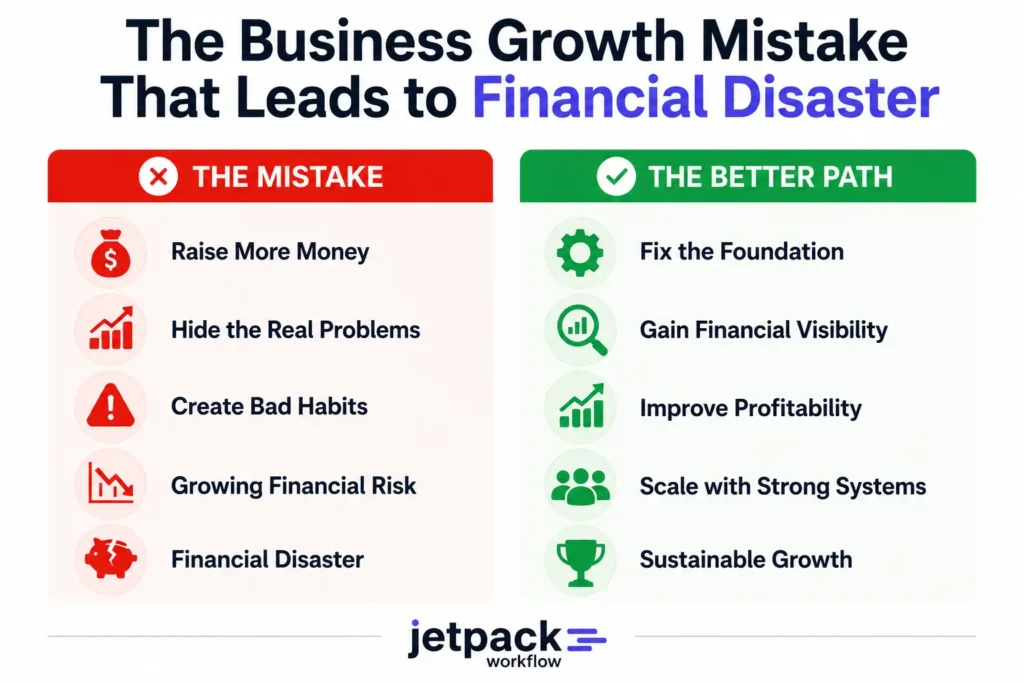
What Businesses Should Focus on Instead of Debt
Before taking on additional debt, businesses should evaluate:
- Whether the current business model is profitable
- Whether operational systems are efficient
- Whether workflows are scalable
- Whether costs are being controlled properly
- Whether recurring operational problems are being solved
In many cases, improving operations creates better long-term outcomes than simply adding more capital.
Businesses that focus on efficiency, profitability, and operational discipline often create more sustainable growth over time.
Conclusion
One of the biggest business growth mistakes companies make is assuming more money will solve operational problems.
In reality, debt and outside capital often delay the hard decisions businesses need to make around efficiency, profitability, and operational discipline.
Sustainable growth comes from building stronger systems, improving financial visibility, and creating scalable operations that support long-term profitability.
Businesses that focus on operational health early are often better positioned to grow without falling into financial traps later.
Frequently Asked Questions
Why is debt dangerous for growing businesses?
Debt becomes dangerous when businesses use it to cover operational problems instead of fixing the root causes behind poor performance.
Does raising more capital solve business problems?
Not always. Additional capital can temporarily hide operational inefficiencies, weak margins, or poor financial management.
What causes businesses to become dependent on debt?
Businesses often become dependent on debt when they repeatedly use funding to solve problems instead of improving systems and profitability.
What is sustainable business growth?
Sustainable growth focuses on profitability, operational efficiency, strong systems, and controlled spending instead of aggressive expansion fueled by debt.
How can businesses reduce financial risk while scaling?
Businesses can reduce risk by improving workflows, increasing visibility, controlling costs, and building scalable operational systems.
Why do operational systems matter during growth?
Operational systems help businesses maintain efficiency, accountability, visibility, and profitability as workload and complexity increase.
Related Articles
- How to Simplify Your Accounting Firm: 5 Systems to Eliminate Bottlenecks
- How LaMichelle Built a 6-Figure Accounting Firm Serving Nonprofits
- From Spreadsheets to Systems: The Shift in Nonprofit Financial Management
- How Accounting Firms Are Valued in Today’s Market with Doug Lewis
- I Sold My Accounting Firm: A Panel Discussion on the Process and Lessons
- Inside the Minds of Firm Buyers: Lessons from Accounting M and A Leaders
- Scaling an Accounting Firm: Systems That Protect Client Experience
- How a Remote Accounting Firm Uses EOS to Scale from 6 to 10 Team Members in 90 Days
- The Power of Simplicity in Accounting Firms: Simplify Services with Better Packaging and Pricing
- How Tailor Hartman Took His Accounting Firm to 200K in Year 1
- Why Outsourcing plus Workflow Software is the Future of Accounting Firms
- How Jeff Seibert Is Using AI Accounting Firm Automation to Build a 90% Automated Firm
- How to Scale to a $1M Accounting Firm Without Hiring More Staff
Share this article