The Staffing Strategy Growing Accounting Firms Use

Many growing accounting firms are struggling to scale because highly skilled CPAs are spending too much time on repetitive administrative work. One of the most effective staffing strategies used by scalable firms is separating basic operational tasks from higher-level accounting work. By using part-time support staff, workflow systems, and clearer task delegation, accounting firms can improve efficiency without immediately adding expensive full-time hires. Firms that organize staffing and workflows properly often reduce bottlenecks, improve turnaround times, and scale more sustainably.
Key Takeaways
- Growing accounting firms often separate administrative work from CPA-level work
- Part-time staffing can reduce operational bottlenecks
- Workflow systems improve visibility and accountability
- Delegating repetitive tasks improves efficiency
- Flexible staffing models help firms scale sustainably
- Practice management systems help coordinate growing teams
Introduction
One of the biggest operational mistakes growing accounting firms make is assigning highly skilled accountants to tasks that do not require CPA-level expertise.
As firms grow, teams often become overwhelmed with:
- Data entry
- Client follow-ups
- Document collection
- Administrative setup
- Basic workflow updates
- Manual operational tasks
Over time, these repetitive responsibilities create operational bottlenecks that slow growth and increase pressure on senior staff.
Many scalable firms solve this problem differently.
Instead of hiring expensive full-time accountants immediately, they separate operational work into different layers and use part-time support staff for lower-complexity tasks.
This staffing strategy allows firms to:
- Reduce CPA workload
- Improve operational efficiency
- Scale capacity faster
- Lower hiring pressure
- Maintain profitability during growth
Combined with workflow software for accountants, this approach helps firms create more organized and scalable operations.
Why Growing Accounting Firms Need Better Staffing Structures
As accounting firms grow, operational complexity increases quickly.
New clients create more:
- Emails
- Documents
- Recurring deadlines
- Administrative requests
- Workflow coordination
- Client communication
Without clear staffing structures, highly trained employees often become overloaded with work that could be delegated more efficiently.
This creates several operational problems:
- Slower turnaround times
- Reduced profitability
- Burnout among senior staff
- Poor workflow visibility
- Hiring pressure
- Lower operational efficiency
Many firms eventually realize they do not necessarily need more CPAs immediately.
They need better task allocation.
The Staffing Strategy Growing Firms Use
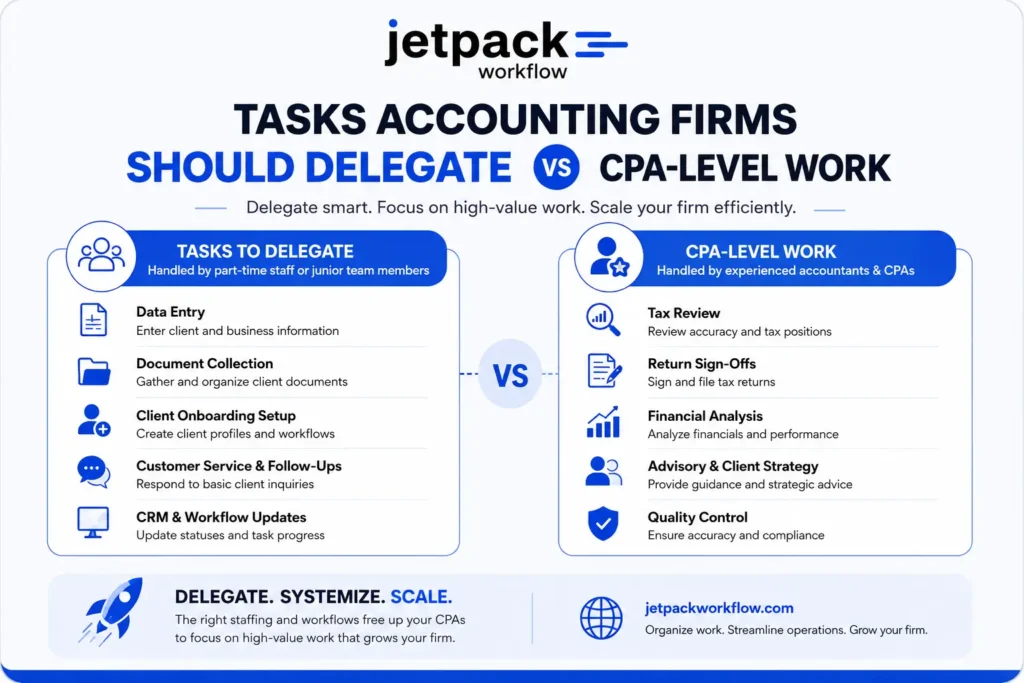
Many scalable accounting firms divide work into different operational categories.
For example:
Administrative and Repetitive Tasks
These tasks are often handled by part-time staff or junior support employees.
Examples include:
- Data entry
- Client onboarding setup
- Document collection
- EIN and business information entry
- Basic tax workflow preparation
- CRM updates
- File organization
- Customer service support
CPA-Level and Advisory Work
These responsibilities remain with experienced accountants and firm leaders.
Examples include:
- Tax review
- Financial analysis
- Advisory services
- Complex bookkeeping review
- Client strategy
- Return sign-offs
- Quality control
This separation allows senior staff to focus on higher-value work while operational tasks are handled more efficiently.
Why Part-Time Staffing Works for Accounting Firms
Part-time staffing gives firms more operational flexibility.
Many accounting firms hire:
- Accounting students
- CPA candidates
- Interns
- Seasonal support staff
- Administrative assistants
These employees often handle repetitive operational work while gaining experience in an accounting environment.
For firms, this creates several advantages:
- Lower operational costs
- More staffing flexibility
- Reduced pressure on senior employees
- Faster processing times
- Easier scalability during busy seasons
For example, many tax workflows include repetitive steps that do not require CPA-level expertise.
Tasks like:
- Entering business names
- Organizing client documents
- Uploading files
- Updating workflow statuses
- Preparing client information
can often be delegated safely and efficiently.
Why Workflow Systems Matter for Staffing Efficiency
As firms add part-time employees and support staff, operational visibility becomes much more important.
Without organized workflow systems, firms often struggle with:
- Task confusion
- Missed deadlines
- Communication gaps
- Duplicate work
- Inconsistent processes
This is why many growing firms invest in workflow software for accountants to improve visibility and coordinate team operations more effectively.
Workflow systems help firms:
- Assign responsibilities clearly
- Track recurring deadlines
- Standardize processes
- Improve accountability
- Monitor work progress
- Reduce operational bottlenecks
As staffing structures become more layered, workflow visibility becomes critical.
How Practice Management Systems Help Growing Teams
Practice management systems help accounting firms coordinate work across multiple employees, departments, and recurring processes.
This becomes especially important when firms manage:
- Part-time staff
- Remote employees
- Seasonal hires
- Junior support teams
- Multiple service lines
Without centralized systems, managers often spend too much time manually tracking work and following up internally.
Practice management systems improve:
- Team coordination
- Task visibility
- Operational consistency
- Deadline management
- Workflow accountability
This allows firms to grow without creating operational chaos.
Why Delegation Improves Profitability
Many accounting firms underestimate how expensive inefficient task allocation can become.
If highly paid accountants spend large portions of their day on administrative work, profitability often suffers.
Delegation helps firms:
- Increase operational efficiency
- Improve utilization rates
- Reduce bottlenecks
- Improve turnaround times
- Scale more sustainably
Firms that organize work properly often create stronger operational leverage as they grow.
What a Scalable Accounting Firm Team Looks Like
Scalable accounting firms often share several operational characteristics:
- Clear task ownership
- Layered staffing structures
- Standardized workflows
- Centralized workflow visibility
- Delegated administrative work
- Strong operational systems
- Organized practice management processes
These firms build systems that allow teams to operate consistently as client volume increases.
Why Operational Systems Become More Important During Growth
Growth creates operational pressure.
As client volume increases, accounting firms often experience:
- More recurring tasks
- More communication
- More internal coordination
- More deadline management
- More workflow complexity
Without operational systems, firms often become dependent on memory, manual follow-ups, and reactive management.
Workflow systems help firms maintain operational control as complexity increases.
This becomes especially important when managing part-time teams and growing operational structures.
Conclusion
The staffing strategy growing accounting firms use is often much simpler than many firm owners expect.
Instead of immediately hiring large numbers of expensive full-time accountants, scalable firms often separate repetitive operational work from higher-value CPA responsibilities.
By combining part-time staffing, better delegation, workflow systems, and practice management processes, firms can improve efficiency while scaling more sustainably.
As accounting firms continue growing, operational organization and workflow visibility may become just as important as technical accounting expertise.
Frequently Asked Questions
Why do accounting firms use part-time staff?
Many accounting firms use part-time staff to handle repetitive operational tasks, improve efficiency, and reduce pressure on senior accountants.
What tasks can accounting firms delegate safely?
Firms often delegate data entry, document collection, onboarding setup, CRM updates, and other administrative tasks.
Why are workflow systems important for growing accounting firms?
Workflow systems improve visibility, accountability, task tracking, and operational consistency as firms grow.
How does delegation improve accounting firm profitability?
Delegation allows highly skilled accountants to focus on higher-value advisory and review work instead of repetitive operational tasks.
What is workflow software for accountants?
Workflow software for accountants helps firms manage recurring work, assign tasks, track deadlines, and improve operational visibility.
How do practice management systems help accounting firms?
Practice management systems help firms coordinate teams, standardize workflows, manage deadlines, and improve operational efficiency.
Last Updated: May 2026
Related Articles
- From Spreadsheets to Systems: The Shift in Nonprofit Financial Management
- How Accounting Firms Are Valued in Today’s Market with Doug Lewis
- I Sold My Accounting Firm: A Panel Discussion on the Process and Lessons
- Inside the Minds of Firm Buyers: Lessons from Accounting M and A Leaders
- Scaling an Accounting Firm: Systems That Protect Client Experience
- How a Remote Accounting Firm Uses EOS to Scale from 6 to 10 Team Members in 90 Days
- The Power of Simplicity in Accounting Firms: Simplify Services with Better Packaging and Pricing
- How Tailor Hartman Took His Accounting Firm to 200K in Year 1
- Why Outsourcing plus Workflow Software is the Future of Accounting Firms
- How Jeff Seibert Is Using AI Accounting Firm Automation to Build a 90% Automated Firm
- How to Scale to a $1M Accounting Firm Without Hiring More Staff
- The Accounting Firm Growth Strategy That Took Calculate to $10M in Revenue
- How Workflow Systems for Accounting Firms Help Firms Become AI-Ready
Share this article