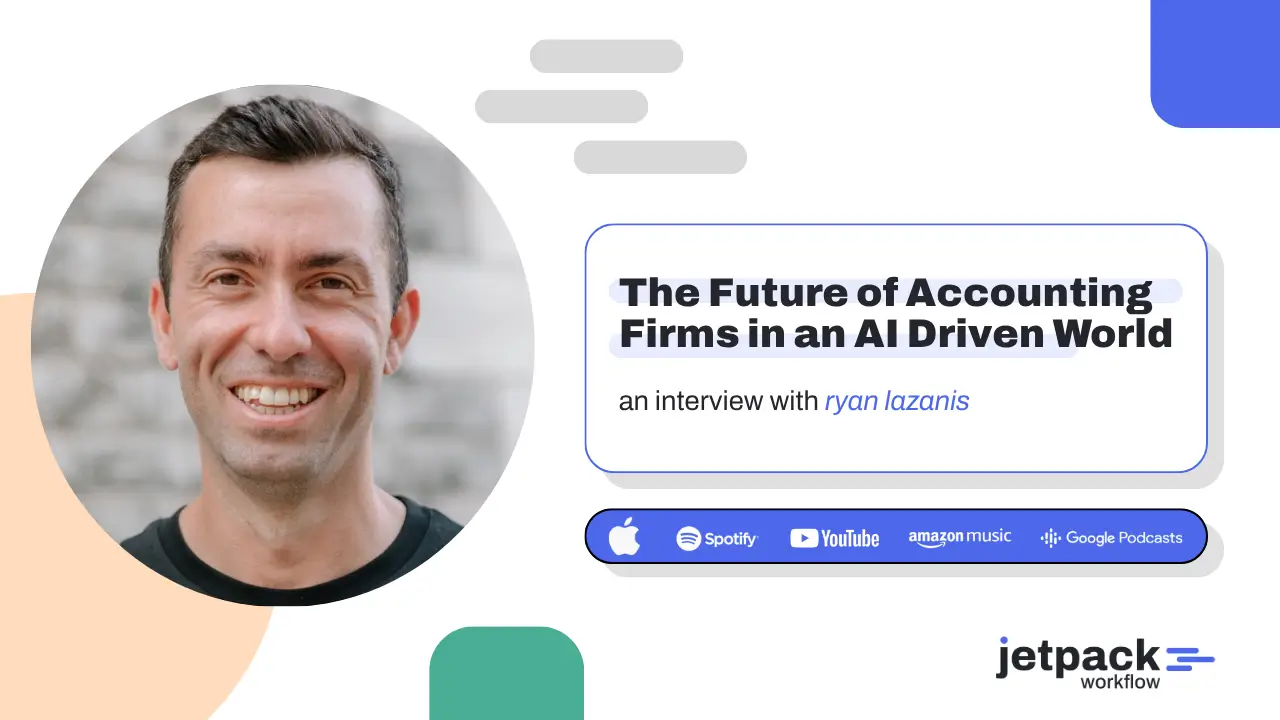
The Future of Accounting Firms in an AI Driven World with Ryan Lazanis
The accounting industry is changing faster than ever. Automation, artificial intelligence, and remote work are rewriting the way firms operate. Yet one principle remains clear: firms that balance technology with human connection will lead the next decade.
Key Takeaways
-
Build systems and processes that can run without you.
-
Delegate operations early to reduce risk and free your time.
-
Use AI to enhance efficiency but never lose your human touch.
-
Protect profitability with better pricing and clear service packaging.
-
Invest in authenticity and relationships as your main differentiators.
In this episode of Growing Your Firm, Jetpack Workflow founder David Cristello talks with Ryan Lazanis, founder of Future Firm and one of the industry’s most forward-thinking voices. Ryan shares how a personal setback reshaped his approach to business, why human connection matters more than ever, and what accounting firm leaders should focus on in an AI-driven world.
A Concussion That Changed Everything
Four months before the interview, Ryan suffered a concussion that forced him to step away from work almost entirely.
“There were days I couldn’t look at a screen or even walk,” he recalled.
The experience revealed how well his systems were built and where they could improve. Because he had documented workflows, trained team members, and delegated key functions, Future Firm continued operating while he recovered.
Ryan reflected,
“You can plan for vacations, but not for an injury. I was fortunate to have built enough structure that things kept moving without me.”
For accounting firm owners, it was a reminder that systems and delegation are not luxuries. They are safeguards.
The Power of Delegation and Structure
Ryan explained that having the right people in defined roles was critical. He had trained specialists in operations and marketing who could make decisions without constant oversight.
“Delegation never came naturally to me. I’m a perfectionist. But being forced to step back made me realize how important it is to trust your team.”
He emphasized the value of a strong operations lead, often a fractional or full-time Director of Operations, who can manage processes, team structure, and performance. According to Ryan, this investment can cost around $100,000 or more but it is one of the best decisions a firm can make when approaching the seven-figure mark.
AI Is Making Work Easier and Harder
Ryan is known for testing new technologies early. He has even built an AI clone of himself, complete with voice and video, called Ryanbot, which helps members of the Future Firm Accelerate program get advice 24/7.
But his take on AI might surprise you.
“AI is making my life harder. It makes it easier to create good content, but that means everyone else can create good content too.”
He explained that AI has raised the baseline of quality and speed across all industries. Firms can now produce reports, marketing materials, and even tax plans faster than ever but so can their competitors.
“To stand out, you have to do much more and do it better. Clients will soon use AI tools to generate 95% of what they need. Your value will come from the 5% that only a human can deliver.”
That five percent is empathy, judgment, and authentic communication.
Human Connection Is the New Competitive Edge
Despite his deep involvement in technology, Ryan believes human connection will define the next generation of successful firms.
“People want to deal with people. They crave the human experience. AI can’t replicate empathy, listening, or accountability.”
He pointed to his own business model, where members still pay thousands for live coaching and community access, even though they could use Ryanbot for nineteen dollars a month. The difference is human interaction, the accountability, understanding, and shared progress that AI cannot replace.
Firms that deliver that experience will thrive. Whether through advisory conversations, authentic communication, or personal follow-ups, humanizing the client relationship will separate firms that grow from those that fade into automation.
Pricing, Packaging, and Profitability Still Matter Most
Even with all the talk about AI, Ryan noted that most firm struggles remain the same. In his community of more than seven hundred firms, the biggest problems are pricing, overwork, and low margins.
“Many firms run on 10% to 15% profit margins. Others make 50% but work themselves to exhaustion. The balance point is building a model that supports your lifestyle, not just your top line.”
The solution starts with pricing and packaging, charging what your service is worth, setting clear boundaries, and protecting your time. Without that foundation, no amount of technology or automation can fix burnout.
What Comes Next for Accounting Firms
Ryan sees two parallel paths ahead for firm leaders: embracing technology while doubling down on human authenticity.
AI will accelerate repetitive work, automate reports, and support marketing, but clients will still choose firms that make them feel understood.
“The future belongs to firms that combine automation with empathy. Technology should make room for more connection, not replace it.”
Conclusion
The conversation with Ryan Lazanis is a timely reminder that progress in accounting is not just about technology. It is about using technology to protect what matters most, your people, your time, and your ability to connect with clients.
The future of accounting firms is not just AI driven. It is human enabled.
Frequently Asked Questions
1. How can accounting firms use AI effectively without losing the human touch?
Firms can use AI to handle repetitive tasks like data entry, reporting, and workflow automation while using the extra time to strengthen relationships and provide higher-value advisory services. The goal is to let AI support efficiency, not replace empathy.
2. What are the biggest risks of relying too much on AI in accounting?
Overreliance on AI can make a firm feel impersonal, reduce trust with clients, and create errors if outputs are not reviewed carefully. Firms must balance automation with human oversight, authenticity, and proactive communication.
3. How can firm owners prepare their teams for an AI driven future?
Leaders should invest in systems, documented processes, and clear role definitions. Training staff to use AI tools responsibly and encouraging open discussion about technology’s role helps create a team that adapts confidently rather than fears change.
4. What will define successful accounting firms in the next decade?
Firms that combine automation, efficient workflows, and strong human relationships will outperform others. Clients will choose firms that use technology to deliver faster results without sacrificing trust and personalization.
Related Articles
-
The First 100 Days After an Acquisition – Ashley Rhoden’s Integration Framework
Learn how Ashley Rhoden helps firms navigate post-acquisition integration with clarity, communication, and structure. -
Questions Every Firm Leader Should Ask Before Taking Private Equity – Jennifer Wilson’s Guide
Jennifer Wilson shares the critical questions every firm owner should ask before partnering with private equity investors. -
How to Finance Accounting Firm Acquisitions – SBA Insights from Sarah Sharp and Shannon Hay
Discover how SBA financing can help firm owners expand strategically through acquisitions. -
I Sold My Accounting Firm – A Panel Discussion on the Process and Lessons
Hear firsthand insights from firm owners who successfully sold their practices and what they learned along the way. -
Inside the Minds of Firm Buyers – Lessons from Accounting M&A Leaders
Explore what drives today’s firm buyers and how to position your practice for future opportunities.
Build a Firm That Runs Without You
Jetpack Workflow helps accounting leaders automate recurring work, document every process, and gain full visibility across clients and deadlines. Free your time to focus on what matters most, your team and your clients.
Share this article