How Adam Shay Scaled and Sold a $2.5M Accounting Firm

Building a successful accounting firm is not just about winning new clients. According to Adam Shay, CPA and founder of a firm that grew to nearly $2.5 million in revenue before being acquired, sustainable growth comes from documented processes, team ownership, proactive client service, and the ability to remove yourself as the firm’s biggest bottleneck.
In a recent episode of the Growing Your Firm podcast, Adam shared how he built a scalable accounting practice, improved profitability through proactive tax planning, empowered employees to improve workflows, and ultimately positioned the business for a successful sale.
Key Takeaways
- Standardized workflows helped create a consistent client experience.
- Team members were encouraged to identify and fix broken processes.
- Proactive tax planning increased client value and revenue per client.
- Delegation was essential for scaling beyond founder-dependent growth.
- Capacity and profitability were monitored closely.
- A strong operational foundation increased the firm’s attractiveness to buyers.
- Letting go of control was one of the biggest lessons learned.
How Adam Shay Built a $2.5M Accounting Firm
A few years before selling his firm, Adam Shay had built a team of approximately 10 employees and generated close to $2 million in annual revenue.
The firm primarily served business owners through:
- Tax planning and preparation
- Accounting and bookkeeping services
- Advisory services
- Fraud and forensic accounting
- Tax controversy services
While many firms focus heavily on compliance work, Adam intentionally shifted toward proactive client relationships. Rather than simply filing returns, his team focused on helping clients make better financial decisions throughout the year.
This approach allowed the firm to generate more revenue per client while reducing the overall number of client relationships the team needed to manage.
“We really built it on the proactive approach and proactive technology.” – Adam
Why Proactive Tax Planning Became a Growth Lever
One of the most important strategic decisions Adam made was requiring tax clients to participate in proactive tax planning services.
Instead of offering standalone compliance work, the firm bundled:
- Business tax returns
- Individual tax returns
- Tax projections
- Ongoing tax planning
The result was a higher-value client base and stronger client relationships.
Rather than serving hundreds of lower-value compliance-only engagements, the firm concentrated on clients who valued advice and strategic guidance.
This shift improved profitability while helping the team focus on deeper client relationships.
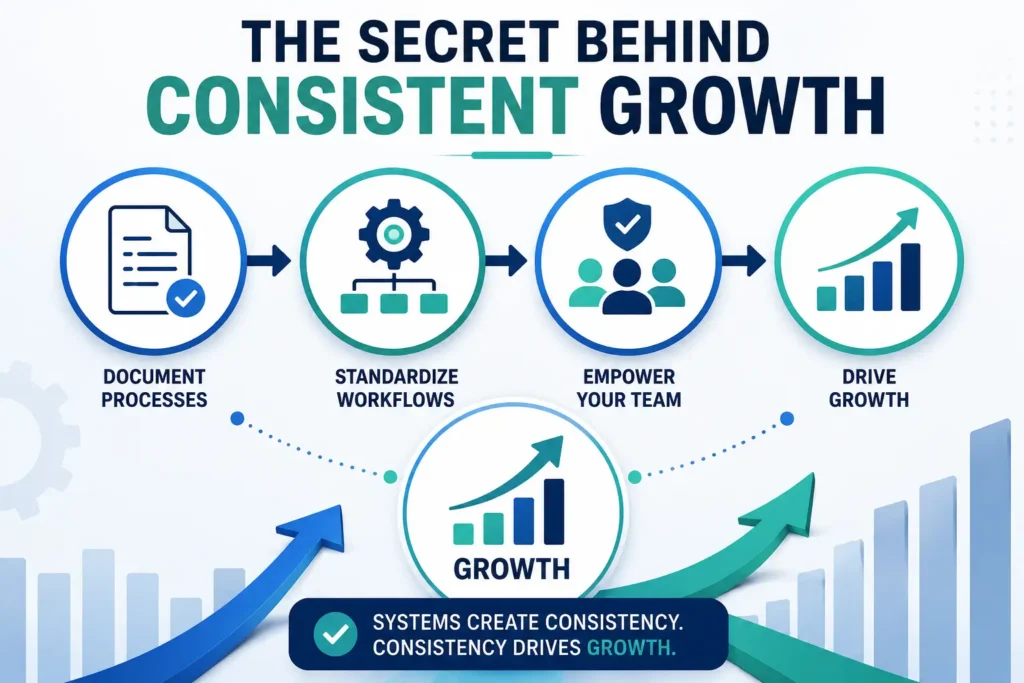
The Secret Behind Consistent Growth: Processes and Workflows
When asked what contributed most to the firm’s growth, Adam pointed directly to processes and workflows.
Many accounting firms struggle because knowledge lives inside employees’ heads. When a team member leaves, consistency suffers and client service becomes unpredictable.
Adam took a different approach.
His firm documented processes so that:
- New employees could get up to speed faster
- Clients received a consistent experience
- Work could be completed regardless of who handled it
- Operational knowledge stayed inside the organization
This reduced dependency on any single team member and created a more scalable business model.
For accounting firms looking to grow, documented workflows are often one of the highest-leverage investments they can make.
The Broken Process Document That Improved Operations
One of the most practical ideas Adam shared was a simple tool his team used called the “Broken Process Document.”
Whenever an employee encountered a recurring issue, inefficiency, or workflow problem, they recorded it in a shared document.
Examples included:
- Client deliverables being sent incorrectly
- Communication breakdowns
- Missing workflow steps
- Training gaps
- Technology issues
Each month, the team reviewed the list and determined:
- Was this a process problem?
- Was this a training problem?
- Was this a technology problem?
From there, an owner was assigned to investigate and implement improvements.
The process was intentionally simple.
Instead of allowing frustrations to disappear after busy season, issues were captured, reviewed, and resolved.
Why Team Ownership Matters

Many firm owners believe they need to personally design every process.
Adam found the opposite.
His team became more engaged when they were involved in improving workflows.
Rather than dictating procedures from the top down, employees helped:
- Identify bottlenecks
- Suggest improvements
- Refine processes
- Take ownership of solutions
This created stronger buy-in and often resulted in better ideas than management could develop alone.
Employees are often closest to the work. Giving them a voice can significantly improve operational efficiency.
How Adam Avoided Becoming the Bottleneck
One of Adam’s biggest lessons came from recognizing how easily firm owners become bottlenecks.
As firms grow, owners often continue making every decision.
The result:
- Delayed decisions
- Reduced team confidence
- Slower growth
- Increased stress
Looking back, Adam believes he held onto too much responsibility for too long.
manage.
“A key to really scaling is realizing that you’re the bottleneck and realizing where you’ve got to let go.”
His advice to firm owners is simple:
- Let go sooner.
- Trust your team.
- Delegate responsibility before it becomes necessary.
When employees brought problems to him, he encouraged them to come with possible solutions rather than simply presenting the issue.
This small shift helped build leadership skills throughout the organization while reducing founder dependency.
The Metrics That Helped Drive Performance
While many firms focus on dozens of KPIs, Adam concentrated on a few critical metrics.
Capacity
The firm monitored how much client revenue each team member managed.
This helped leadership understand:
- Team utilization
- Workload distribution
- Staffing needs
- Growth capacity
Profitability
Because the firm used fixed-fee pricing, profitability was easier to evaluate at both the client and employee levels.
Rework
One of the most valuable metrics tracked was rework.
Reviewers manually recorded when work had to be sent back for corrections.
Tracking rework helped identify:
- Training opportunities
- Process weaknesses
- Quality control issues
- Performance trends
Even without sophisticated software, this simple metric provided meaningful operational insight.
Preparing an Accounting Firm for Sale
Eventually, Adam and his partner began considering an exit.
After years of growth, the firm had reached a point where additional scaling would require a different leadership style.
Adam describes himself as a builder.
He enjoys creating and growing businesses from the ground up.
The next stage required someone focused on scaling beyond that foundation.
This self-awareness played an important role in the decision to sell.
The firm ultimately completed a successful acquisition in 2023.
What Buyers Look For in Accounting Firms
Adam’s experience highlights several characteristics that make firms more attractive to buyers:
- Documented processes
- Strong client relationships
- Consistent profitability
- Reliable workflows
- Reduced founder dependency
- Stable revenue streams
- Experienced team members
In many ways, the same systems that help firms scale also increase enterprise value.
A business that runs independently of the owner is typically worth more than one that depends entirely on founder involvement.
The Biggest Lesson From Selling His Firm
Perhaps Adam’s most important takeaway was not operational.
It was personal.
After selling the firm, he stayed on during the transition period and later remained as an employee before stepping away.
The transition required him to separate his identity from the business he had built.
For many firm owners, this can be one of the most difficult parts of succession planning.
The business may be sold on paper, but emotionally, the transition often takes much longer.
Conclusion
Adam Shay’s journey demonstrates that accounting firm growth is rarely about one breakthrough tactic.
Instead, it comes from consistently improving systems, empowering employees, documenting processes, and creating a firm that can operate without constant owner involvement.
Whether your goal is to scale beyond $1 million in revenue, improve profitability, or eventually sell your firm, the foundation remains the same:
Build better systems.
Develop stronger workflows.
Empower your team.
And stop allowing yourself to be the bottleneck.
Frequently Asked Questions
How did Adam Shay grow his accounting firm to $2.5 million?
Adam Shay focused on proactive tax planning, standardized workflows, documented processes, and team ownership. These systems helped create a consistent client experience while allowing the firm to scale efficiently.
What role did workflows play in Adam Shay’s success?
Workflows helped ensure that every team member followed consistent procedures, reducing errors and improving client service. This made the firm less dependent on any one employee and easier to scale.
What is a broken process document?
A broken process document is a shared list where team members record recurring issues, bottlenecks, or inefficiencies. The team reviews these items regularly and assigns owners to implement improvements.
Why is delegation important for accounting firm growth?
Delegation helps firm owners avoid becoming operational bottlenecks. By empowering team members to take ownership, firms can improve efficiency, develop future leaders, and support long-term growth.
What metrics did Adam Shay track in his accounting firm?
Key metrics included employee capacity, profitability, client revenue managed per team member, and rework rates. These metrics helped identify opportunities for improvement and maintain operational efficiency.
What makes an accounting firm more valuable to buyers?
Buyers typically look for documented processes, recurring revenue, strong client relationships, operational consistency, and reduced dependency on the owner. These factors make the business easier to transition and scale.
Related Articles
- How to Simplify Your Accounting Firm: 5 Systems to Eliminate Bottlenecks
- The Future of Accounting Firms in an AI Driven World with Ryan Lazanis
- How Coaching Transforms Accounting Leaders: Lessons from Douglas Slaybaugh
- How Tailor Hartman Took His Accounting Firm to 200K in Year 1
- Why Outsourcing plus Workflow Software is the Future of Accounting Firms
- AI Tools That Help Accounting Firms Scale Faster
- How to Scale to a $1M Accounting Firm Without Hiring More Staff
- Tax Resolution for Accountants: A $100K Client Opportunity
- ChatGPT for Accountants: How to Create High-Level Advisory Reports with Better Prompts
- How Jeff Seibert Is Using AI Accounting Firm Automation to Build a 90% Automated Firm
- How Nonprofits Manage Grants Using QuickBooks (And Where It Falls Short)
Ready to Build a More Scalable Accounting Firm?
Growth becomes easier when your workflows, deadlines, and team responsibilities are organized in one place.
See how Jetpack Workflow helps accounting firms streamline operations, improve accountability, and scale with confidence. Schedule a free demo today.
Share this article