CPA Firm Acquisitions: Toby Kommer on Buying 35 Firms and Scaling to 250 Employees
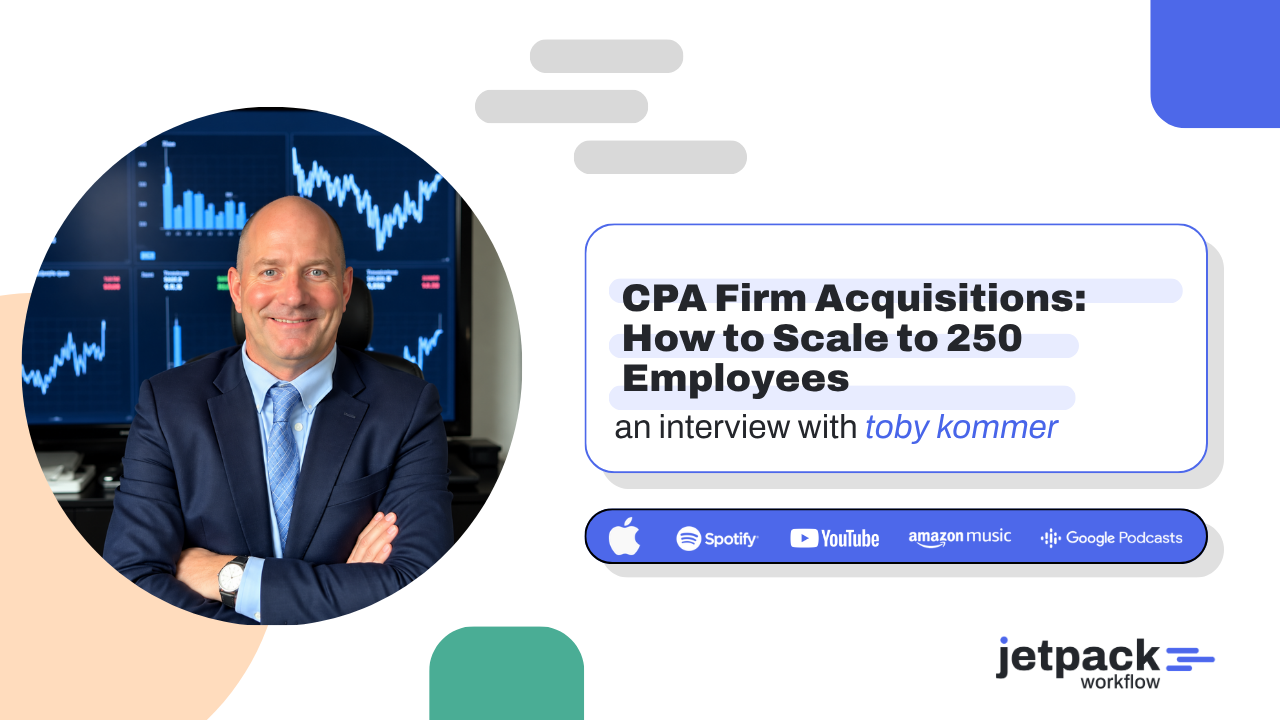
Acquiring a CPA firm is one thing. Acquiring approximately 35 firms, bringing them into one organization, and growing to roughly 250 employees is an entirely different challenge.
And what makes Toby Kommer‘s story interesting is that he did not originally set out to build a large accounting firm.
When I sat down with Toby for the Growing Your Firm podcast, he explained that his initial vision was a relatively small business offering banking, accounting, insurance, wealth management, and legal services under a coordinated model.
He expected to build something with perhaps 20 to 25 employees and one location.
Instead, over roughly a decade, he became a frequent acquirer of CPA practices, built a multi-office organization, and developed a management model designed to combine the personal service of a smaller accounting firm with the resources of a much larger one.
Today, that story offers useful lessons for firm owners considering acquisitions, preparing for succession, or simply trying to scale without losing operational control.
But the most interesting part of our conversation was not the number of firms Toby acquired.
It was how he thinks about integrating them, measuring performance, rewarding employees, developing leaders, and keeping multiple offices operating as one firm.
Key Takeaways
- Toby Kommer reports completing approximately 35 CPA firm acquisitions over 10 years, growing his broader organization from about 12 to 250 employees.
- His organization typically acquires five to eight firms annually, depending on their size.
- His original business model combined accounting with banking, insurance, wealth management, and eventually legal services.
- The CPA firm became the center of his business model after he recognized the influence accountants have in client relationships.
- Acquired firms adopt common branding and technology while retaining much of their local leadership and client-service experience.
- Each office maintains its own profit and loss statement, budget, and location leadership.
- Employee compensation is influenced by production and efficiency rather than billable hours alone.
- Toby uses leadership development, regional meetings, and companywide events to maintain organizational cohesion.
- His organization has announced a long-term intention to transition toward employee ownership through an ESOP.
- Successful acquisition-led growth requires consistent systems, accountability, leadership, and execution.
How Toby Kommer Built a CPA Firm Acquisition Strategy
Toby did not begin his career in traditional public accounting.
Although he was a CPA, he spent nearly 20 years in banking, working across finance, auditing, and mergers and acquisitions.
That experience shaped his original business idea.
He wanted to create an integrated professional services organization for small and midsized business owners.
The concept brought together services that entrepreneurs often need but typically obtain from separate providers:
- Accounting and tax services
- Banking
- Business insurance
- Wealth management
- Legal services
His first acquisitions included a bank and a CPA firm.
At the time, Toby believed banking would become the central relationship connecting those services.
That assumption changed.
Once he began operating the accounting practice, he recognized that accountants often had stronger relationships with business owners than bankers did.
As Toby explained:
“I thought the bank was going to be the center of the universe. That’s what I knew. That’s what I grew up in.”
He ultimately shifted his strategy toward accounting as the central service.
That decision became a turning point in the organization’s growth.
From 12 Employees to Approximately 250
Toby explained that his acquisition activity accelerated partly because he occupied an unusual position in the market.
He was an entrepreneurial CPA with acquisition experience, access to capital, and an interest in buying smaller accounting practices.
Over time, he became an attractive option for owners considering a sale.
At the time of the interview, Toby reported the following figures:
These figures describe Toby’s organization at the time of the recorded conversation. They should not be interpreted as independently verified current totals.
What began as a small professional services business evolved into a multi-office acquisition platform.
The challenge then became making that platform operate effectively.
Why Smaller CPA Firms Are Attractive Acquisition Targets
Not every accounting firm owner wants to sell to a large national organization or private equity-backed consolidator.
Some owners have spent decades building client relationships and want to preserve the culture of their practice.
Others are interested in succession planning but do not necessarily want to retire immediately.
Still others want to continue serving clients while giving up the administrative responsibilities of ownership.
Toby’s model attempts to address those situations.
He explained that his organization is particularly attractive to smaller firms because it aims to preserve the experience of working in a local practice while providing centralized resources.
A selling owner may gain access to:
- Dedicated IT support
- Recruiting and human resources capabilities
- Financial and operational leadership
- Employee training
- Standardized technology
- Additional professional services
- A larger organizational structure
These resources can be difficult for a small practice to maintain independently.
For an owner who wants to keep working but no longer wants responsibility for every technology problem, staffing decision, or administrative task, that can be a compelling proposition.
CPA Firm Succession Planning Is Not Just About Retirement
One interesting point from our conversation was how Toby sees the motivations of selling owners changing.
Historically, succession planning often meant a retiring partner selling to another firm.
Toby is also seeing interest from younger owners who want to become part of a larger organization.
They may not be ready to stop working.
Instead, they want access to a more scalable operating structure and fewer administrative responsibilities.
That distinction matters.
A CPA firm acquisition can be both an ownership transition and an operational growth strategy.
For some sellers, the opportunity is not simply to cash out. It is to continue their careers within an organization that provides additional support.
How Toby Integrates Acquired Accounting Firms
Acquiring practices is only the beginning.
Once a transaction closes, the buyer must decide what to standardize and what to preserve.
Toby has a relatively clear approach.
He wants acquired firms to feel like one organization rather than a collection of unrelated businesses with the same owner.
That requires changes.
Branding and Technology Become Standardized
Toby explained that two elements generally change following an acquisition:
The firm’s name and its technology.
Acquired practices move under the organization’s common branding and technology structure.
He considers these changes necessary for achieving the operational benefits of a larger firm.
Without common systems, an acquisition platform can become difficult to manage.
Employees may work in incompatible applications. Client information may be fragmented. Reporting becomes harder. Training becomes inconsistent.
The organization might own multiple practices without functioning as one firm.
Toby wants to avoid that outcome.
Local Relationships Remain Important
At the same time, his goal is not to eliminate everything that made the acquired practice successful.
He hopes clients continue working with familiar employees and receive the same personal attention.
Pricing structures generally remain similar, according to Toby, although the organization standardizes key operating elements.
The objective is to preserve local relationships while strengthening the infrastructure behind them.
That creates a useful distinction between centralized operations and localized client service.
A growing accounting firm does not necessarily need every office to feel identical.
But it does need consistent processes, technology, and accountability.
The Small-Firm Experience With Large-Firm Resources
Toby described his acquisition model as trying to deliver the best of both worlds.
Clients should experience the familiarity and accessibility of a smaller firm.
Behind the scenes, employees should have access to resources normally associated with a larger organization.
He reported approximately 15 offices, many employing between 10 and 20 people.
Rather than consolidating everyone into one or two large locations, the organization maintains smaller offices supported by shared resources.
These include dedicated IT personnel, recruiting, executive leadership, and training functions.
This model creates a particular operational challenge.
How do you make 15 offices function like one firm without removing their local identity?
Toby’s answer involves a combination of centralized systems, local financial accountability, and intentional leadership development.
How to Manage Accounting Firm Operations Across Multiple Offices
One of the most practical parts of our discussion concerned operational management.
Toby explained that each office maintains its own profit and loss statement and budget.
Each also has local leadership responsible for performance.
That structure gives the organization visibility into individual locations without treating every office as a completely independent business.
It also provides a framework for accountability.
Location-Level Financial Reporting
Each office’s performance can be reviewed within the broader organization.
This helps leadership understand how individual locations contribute to overall results.
It also gives local managers a clearer understanding of the financial performance they are responsible for.
Toby emphasized that financial transparency extends beyond senior leadership.
Employees have visibility into company and location financial information, including profit and loss statements.
That transparency supports his broader approach to compensation and employee ownership.
Why Operational Visibility Matters During Acquisitions
When an accounting firm expands through acquisitions, complexity increases quickly.
Leadership must understand:
- Which offices are performing well
- Where additional support is needed
- How employees contribute to production
- Whether work is being completed efficiently
- How local teams are adapting to common processes
- Whether acquired practices are operating within the broader organization
Without consistent reporting and workflows, these questions become difficult to answer.
This is particularly relevant for accounting firms using multiple systems or relying heavily on manual updates.
The more locations and employees a firm adds, the more important operational visibility becomes.
Why Toby Rewards Production Instead of Billable Hours
Toby’s compensation philosophy differs from the traditional public accounting model.
He explained that his organization does not use the conventional progression of associate, senior associate, manager, senior manager, and partner.
Instead, employee compensation is influenced by the value of the work they produce.
He also described a review process in which employees meet with leadership three times annually to discuss their performance.
The $2,500 Tax Return Example
Toby used a straightforward example.
Suppose an employee completes a $2,500 tax return.
One employee takes 10 hours.
Another completes work of equivalent quality in five hours.
Toby believes the second employee’s efficiency creates additional value.
As he explained:
“I think you should be rewarded on your production, not on your hours.”
The underlying principle is that compensation should recognize productive output rather than simply time spent working.
That does not mean his firm has eliminated time tracking.
Toby specifically stated that hours are still tracked to understand client profitability and where employees spend their time.
However, hours are not the primary basis for rewarding employees.
How the Compensation Model Works
Employees receive salaries rather than direct commissions on every engagement.
Their production influences annual salary adjustments.
This means two employees with similar experience and tenure may earn different salaries if their contributions differ.
Toby views that as appropriate, provided the compensation criteria are transparent.
He also recognizes that employees have different personal priorities.
Someone may want to maximize earnings during one stage of life, while another may prioritize family time.
His model is intended to accommodate those differences without requiring identical production levels from everyone.
Does Production-Based Compensation Work for CAS and CFO Services?
Toby believes the approach can also apply to client accounting services and outsourced CFO engagements.
In some cases, he considers those services easier to measure because an individual may be directly responsible for most of the work.
For tax engagements, multiple employees may contribute to preparation, review, signing, and administration.
For certain CFO or CAS engagements, the relationship between an individual’s work and the resulting deliverables may be more direct.
He also sees a connection between production-based compensation, fixed-fee pricing, and automation.
If an employee can produce the same quality deliverable in less time, the firm may improve capacity and margins.
That creates an incentive to work efficiently rather than maximize billable hours.
Importantly, the interview does not provide a universal compensation formula or a detailed allocation methodology. Toby describes the philosophy and how it influences salary decisions, not a calculation that other firms can copy directly.
Standardize Workflows as Your Accounting Firm Grows
Acquiring firms or adding employees should not mean losing visibility into client deadlines, recurring work, and team responsibilities.
Jetpack Workflow helps accounting firms standardize recurring tasks, assign ownership, track deadlines, and keep client work organized as operations expand.
How AI Could Change CPA Firm Profitability
Toby also connected productivity-based compensation to the growing use of AI.
His argument is that automation can improve the economics of accounting work when pricing is not directly tied to hours.
Consider a recurring CAS engagement.
If an employee previously needed 20 hours to complete a set of deliverables but can now complete equivalent work in 10 hours, that creates additional capacity.
The employee may be able to serve more clients without increasing working hours proportionally.
Under a fixed-fee model, that efficiency may also improve engagement margins.
Toby sees potential for employees to benefit from those productivity gains through his compensation approach.
However, the interview does not establish a measured AI productivity improvement at his firm.
The 20-hour versus 10-hour example is illustrative, not evidence that AI has already halved his team’s workload.
The broader lesson is that automation, pricing, and employee incentives should support the same operational objectives.
For accounting firms, improving workflows before introducing AI can make those gains easier to manage and measure.
Standardize Accounting Workflows Before Scaling Further
There is an important connection between Toby’s acquisition strategy and the day-to-day reality of managing an accounting practice.
Acquisitions introduce new clients, employees, deadlines, processes, and service expectations.
Without standardization, every additional practice can increase operational complexity.
For example, one office may manage recurring tax deadlines through spreadsheets.
Another may use individual task lists.
A third may rely on email reminders.
Even when the teams perform similar services, leadership cannot easily see progress across the organization.
Standardized workflows help address that problem by defining:
- What work must be completed
- Who is responsible
- When each task is due
- Which steps depend on earlier work
- How progress is tracked
- When follow-up or review is required
- How recurring engagements are managed
This is an operational application of Toby’s broader emphasis on common technology and consistent execution, rather than a claim that his firm uses Jetpack Workflow.
Build Consistent Workflows as Your Firm Grows
Whether you are acquiring another practice or expanding your existing team, recurring work becomes harder to manage when every employee follows a different process.
Jetpack Workflow helps accounting firms standardize recurring tasks, track deadlines, assign responsibilities, and maintain visibility across client work.
How Toby Builds a Unified Culture Across 15 Offices
Standardized technology alone cannot create a unified organization.
Toby was clear that maintaining cohesion requires ongoing attention.
His team uses several approaches, including regional meetings, companywide gatherings, and leadership development.
Strategic Management Meetings
Location managers participate in strategic meetings held several times a year.
Toby described an upcoming two-day meeting that would include reviewing the recent tax season and discussing priorities such as AI.
These meetings create opportunities for local leaders to contribute to companywide decisions.
They also reinforce the expectation that each location is part of one organization.
Companywide Events
Toby also described annual events that bring employees and their spouses together.
These gatherings are intended to strengthen relationships across offices.
The goal is not simply to organize a corporate event.
It is to help employees who rarely work together develop personal connections.
That can make collaboration easier when people return to their individual locations.
Inside Toby Kommer’s Leadership Academy
As his organization grew, Toby recognized that he could no longer maintain the same direct relationships with employees that he had when the business employed only 12 people.
He became particularly concerned about losing touch with emerging leaders below his immediate management team.
His solution was to establish a Leadership Academy.
The program brings developing leaders together for two-day sessions several times a year over approximately two years.
Toby personally facilitates the sessions.
What the Leadership Academy Covers
The program combines leadership education with practical organizational discussions.
Participants may be asked to read a leadership book or study a relevant documentary before attending.
During the sessions, they discuss the material and consider how the lessons apply to their professional and personal lives.
Toby mentioned resources including:
- The Energy Bus by Jon Gordon
- The Five Dysfunctions of a Team by Patrick Lencioni
- The Last Dance, the documentary series about Michael Jordan and the Chicago Bulls
- Leadership material from Brian Dodge
The second day typically focuses more directly on company issues.
Participants may discuss compensation, communication, AI priorities, or other organizational challenges.
Toby also uses employee feedback to identify areas where the company needs to improve.
Leadership Development as an Integration Strategy
The program does more than train future managers.
It creates relationships across locations.
Employees from different offices spend time together, work on common challenges, and develop a better understanding of the organization.
That can reduce the sense that each office is operating independently.
Toby shared an example of an employee from the Minneapolis office visiting colleagues in Scottsdale after developing relationships through company events.
These connections help reinforce the culture of one firm.
He also described a notable internal career progression: the organization’s CFO began as a tax intern approximately 10 years earlier.
For Toby, developing employees is not solely about preparing them for their next position.
It is also about helping them grow as individuals.
Why Execution Matters More Than Strategy
One of Toby’s most useful observations came during our discussion of leadership.
He argued that businesses often pursue similar strategies.
What separates successful organizations is their ability to execute consistently.
As Toby put it:
“You don’t win in business by your strategy, you win based on execution, right?”
That idea applies directly to CPA firm acquisitions.
Buying another practice may increase revenue, clients, and employees.
But the transaction alone does not guarantee stronger operations.
The buyer still has to integrate systems, develop leaders, retain relationships, manage workloads, and deliver consistent service.
A well-designed acquisition strategy without operational execution can create a larger but less manageable organization.
This is why the work after the acquisition matters so much.
The Long-Term Plan: Employee Ownership Through an ESOP
Another distinctive element of Toby’s model is his stated plan for employee ownership.
At the time of the interview, he said he owned 100% of the firm and intended to transition toward an employee stock ownership plan, or ESOP.
He explained that the plan had already been announced internally and that the organization expected to begin that journey in approximately three years.
This was a future intention described in the interview, not confirmation that the ESOP has since been implemented.
Why Financial Transparency Matters
Toby wants employees to understand how the business performs.
That includes visibility into company financials and location-level results.
His reasoning is that employees who may eventually become owners should understand the economics of the organization.
They should know what drives performance and why productivity, accountability, and strong teams matter.
The approach connects several parts of his operating model:
Financial transparency, production-based compensation, leadership development, and eventual employee ownership.
Together, these are intended to encourage employees to think beyond their individual tasks.
What CPA Firm Owners Can Learn From Toby Kommer’s Acquisition Model
Toby’s organization is unusual, and not every firm owner will want to replicate it.
Most accounting practices will not acquire 35 firms or operate across 15 offices.
But several of his principles apply to firms at much smaller stages of growth.
For a smaller firm, these principles may translate into simpler actions.
You might begin by standardizing recurring client workflows, defining employee responsibilities, improving management reporting, or documenting onboarding procedures.
The goal is not to copy the size of Toby’s organization.
It is to develop the operational discipline that makes growth sustainable.
The Challenges of Growing Through CPA Firm Acquisitions
Toby was also open about the difficulties.
Not every acquisition worked as expected.
He acknowledged that the organization had made acquisitions he would reconsider.
He also described personnel decisions that did not work out, including bringing in people who were not the right fit and retaining some employees longer than he should have.
Those admissions are important because acquisition-led growth can appear straightforward when viewed only through revenue, employee counts, and transaction totals.
The reality is more complicated.
Each acquisition introduces new people, expectations, and operational risks.
Even an experienced buyer will make mistakes.
The Personal Challenge of Success
Interestingly, Toby identified a more personal challenge as one of the hardest parts of his journey.
He grew up in a working-class household and described struggling with a form of imposter syndrome as his business became successful.
Despite his experience and achievements, he sometimes found it difficult to fully enjoy what he had built.
That was not something he expected when starting the company.
It was a reminder that building a large organization introduces personal challenges alongside financial and operational ones.
A Practical CPA Firm Acquisition Integration Framework
Drawing from Toby’s experience, here is a framework accounting firm owners can use when evaluating how to integrate an acquired practice.
This is an editorial framework based on the interview, not a formal acquisition checklist supplied by Toby.
The framework highlights a critical point.
CPA firm acquisitions should be evaluated not only as transactions, but also as long-term operational commitments.
A buyer needs the capacity to integrate the business after the deal closes.
Frequently Asked Questions About CPA Firm Acquisitions
How many CPA firms has Toby Kommer acquired?
Toby Kommer stated in the Growing Your Firm interview that his organization had completed approximately 35 CPA firm acquisitions over the preceding 10 years. He reported growing the broader organization from about 12 to roughly 250 employees across its affiliated businesses.
How does Toby Kommer integrate acquired CPA firms?
His organization generally standardizes branding and technology while seeking to preserve local employees and client relationships. Each office maintains local leadership, budgets, and financial reporting within the broader organization.
Why do CPA firm owners sell their practices?
Reasons can include retirement, succession planning, administrative burden, and a desire to join a larger organization with more resources. Toby described growing interest from younger owners who want to continue working while gaining access to a scalable operating structure.
How can accounting firms scale through acquisitions?
Acquisition-led growth requires more than purchasing additional practices. Firms need consistent technology, financial reporting, leadership, employee development, and client-service processes to integrate new teams successfully.
How does Toby Kommer compensate accounting firm employees?
Toby described a salary-based model in which employee production and efficiency influence compensation increases. Employees are not paid direct commissions for every engagement, and time tracking remains important for understanding profitability.
What role does technology play in CPA firm acquisitions?
Technology standardization helps acquired practices operate as one organization. Consistent systems can improve training, reporting, recurring workflow management, and operational visibility across offices.
What is an ESOP in an accounting firm?
An employee stock ownership plan, or ESOP, is a structure through which employees can acquire beneficial ownership in their employer. Toby discussed plans to move toward employee ownership, although the interview does not confirm that the transition has been completed.
The Bottom Line
Toby Kommer’s story is not simply about buying 35 CPA firms.
It is about building the operating structure needed to support that kind of growth.
He started with a vision of a small, integrated professional services business. Over time, accounting became the center of the model, acquisitions accelerated, and the organization grew to roughly 250 employees.
Along the way, he developed an approach centered on common technology, local accountability, productivity-based compensation, leadership development, and financial transparency.
The lesson for accounting firm owners is that growth creates complexity.
Acquisitions can bring new revenue, clients, and talent. But without consistent systems and capable leadership, they can also introduce fragmentation.
The firms best positioned to scale are not necessarily the ones that acquire the most practices. They are the ones that can successfully integrate and manage what they acquire.
And even if you never plan to buy another CPA firm, that principle still applies.
As your client base and team grow, your processes need to become more repeatable, visible, and dependable.
Last Updated: October 2026
Related Articles
- AI Use Cases for Accounting Firms: Jan Haugo on What Firms Should Automate First
- AI for Accounting Firms: Isaac Perdomo on Automating Workflows and Efficiency
- How Jeff Seibert Is Using AI Accounting Firm Automation to Build a 90% Automated Firm
- How to Grow a Solo CPA Firm: Angel Zhen on Scaling Past $500K Without Hiring
- Value Pricing for Accounting Firms: Ron Baker on Why AI Is Killing the Billable Hour
- ChatGPT for Accountants: Advisory Reports and Prompts
- AI Automation for Accounting Firms: Preston Cardwell on What to Automate First
- Accounting Firm Sales: Shane, Marcus & Roman on Turning Prospects Into Better-Fit Clients
Build Workflows That Scale With Your Accounting Firm
Whether you are integrating an acquired practice, expanding into new services, or growing your existing team, consistent workflows help keep everyone aligned.
Jetpack Workflow helps accounting firms organize recurring client work, manage deadlines, assign responsibilities, and track progress across their teams.
Listen to this episode of Growing Your Firm on Spotify or Apple Podcasts.
Share this article