AI Automation for Accounting Firms: Preston Cardwell on What to Automate First
AI is moving fast enough that accounting firm owners can easily feel like they are already behind.
Every week there seems to be another model, AI agent, automation platform, or feature promising to transform the profession. The natural reaction is to start asking which tool your firm should adopt next.
But that may be the wrong place to start.
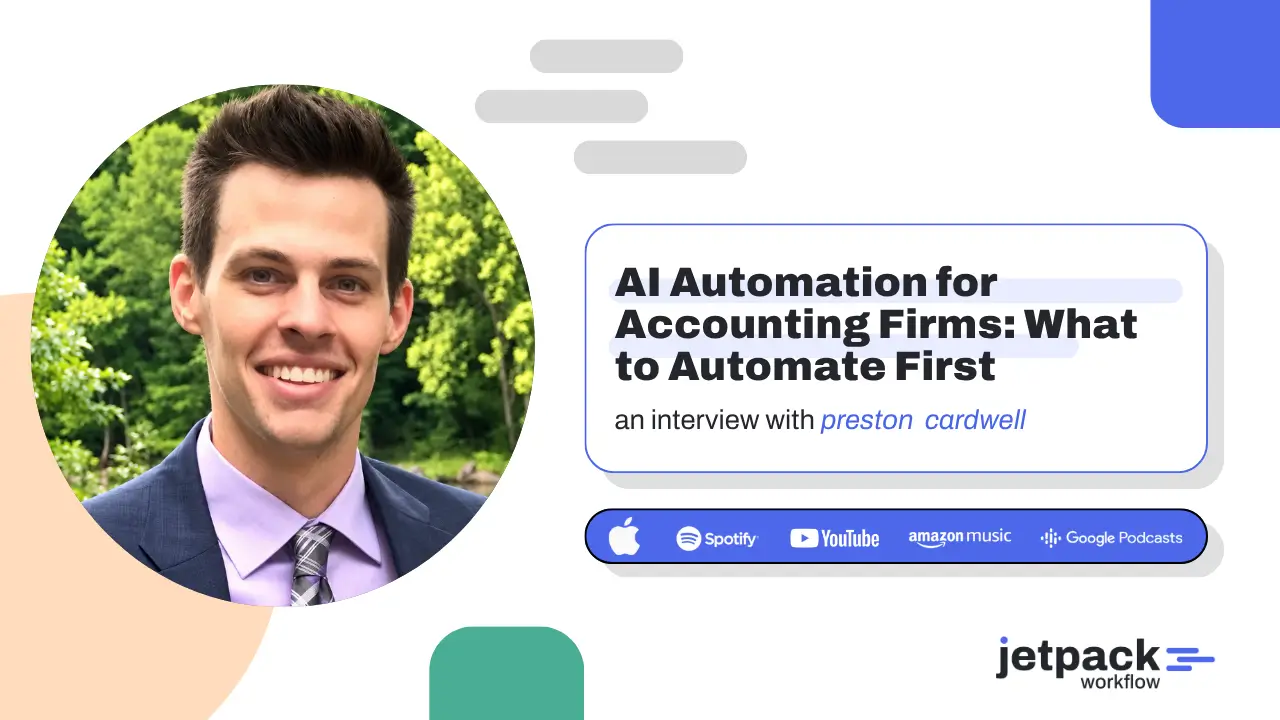
I recently sat down with Preston Cardwell, founder of Memorial Ridge, to talk about how accounting firms should approach AI and automation. Preston works primarily with firms in the $2 million to $10 million revenue range, often with teams of roughly 10 to 30 employees.
And one of the most common questions he hears is surprisingly simple:
Where do we start?
His answer is not to chase the newest AI tool.
Start by understanding the work your firm is already doing.
Key Takeaways
- Start with process mapping before choosing AI automations.
- Client communication and email management are common opportunities for quick wins.
- Document intake is another major source of repetitive administrative work.
- Use AI to solve specific workflow problems instead of trying to automate the entire firm.
- Do not let constant AI product releases distract you from learning a few useful tools well.
- AI is likely to change accounting roles and future hiring needs, even when it does not eliminate existing positions.
- Firms need ongoing AI training rather than one-time software training.
- Build a small group of internal AI champions who can test, document, and improve new workflows.
- AI agents may eventually become another participant inside accounting workflows.
- Strong processes and documentation become even more important as firms automate.
Start With the Process, Not the AI Tool
When firms come to Preston for help, one of the first things he does is an AI assessment.
But underneath the AI terminology, it is essentially process mapping.
He talks with people throughout the firm to understand:
- What work are they doing?
- What tools are they using?
- Where does information live?
- What does the existing tech stack look like?
- Which processes consume the most time?
- Where are the repetitive administrative tasks?
Only after understanding those processes does he start looking for AI opportunities.
I think this is one of the most important lessons for firms experimenting with AI.
Do not start with:
What can Claude do?
Or:
What AI agent should we build?
Start with:
Where is our team losing time?
Then determine whether AI is the right tool for solving that problem.
What Should Accounting Firms Automate First?
I asked Preston which pain points tend to appear repeatedly when he works with accounting firms.
Two stood out immediately:
Client communication and document intake.
That makes sense.
Neither is necessarily the most exciting application of artificial intelligence. But both create a huge amount of repetitive work.
And that is exactly where firms can often find practical automation opportunities.
1. Email and Client Communication
Most accountants do not need an explanation of the email problem.
You open your inbox Monday morning and find messages that need responses, follow-ups that should have happened days ago, missing documents, client questions, and requests that need to be routed somewhere else.
Preston sees email management as one of the easiest places to start.
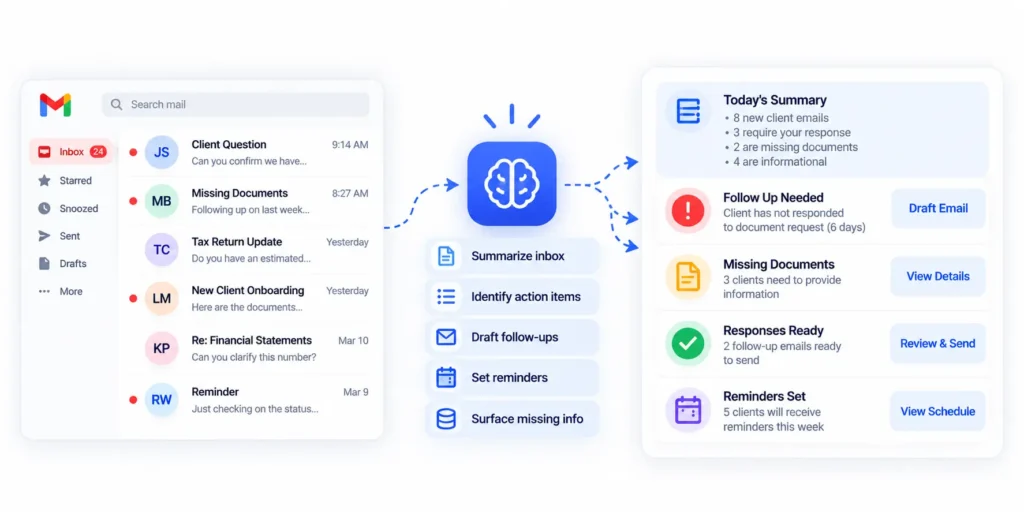
Tools such as Claude Cowork can help summarize an inbox and surface outstanding items. A firm could also create a morning briefing showing what arrived recently and what still requires attention.
The more interesting opportunity comes from follow-up automation.
For example:
It has been six days since we requested information from this client. Draft a reminder and alert the responsible team member.
That is not replacing professional judgment.
It is preventing administrative work from quietly accumulating until ten returns suddenly need attention at the same time.
2. Document Intake
The second major opportunity is document intake.
Accounting firms constantly need to determine whether they have everything required to start a return, complete bookkeeping, or move an engagement forward.
Then those documents need to be received, organized, saved, and connected to the right client or system.
There are already specialized vendors tackling tax intake, and Preston believes many of those tools are doing useful work.
But firms can also simplify parts of the process using broader AI tools.
For firms receiving information through email, for example, AI can potentially assist with drafting responses, processing information, and saving documents into a document management system.
The bigger opportunity is not simply receiving documents faster.
It is knowing:
Do we have everything required to move this engagement forward?
That is where automation becomes part of workflow management rather than another isolated tool.
3. Repetitive Administrative Follow-Ups
This is probably the least glamorous AI use case and one of the most valuable.
Accounting firms contain hundreds of small administrative actions:
- Follow up with a client.
- Check whether information was received.
- Draft a reminder.
- Save a document.
- Flag something that has been sitting too long.
- Notify the responsible team member.
- Prepare a summary of outstanding items.
Individually, these tasks may only take a few minutes.
Across hundreds of clients and dozens of employees, they create significant operational overhead.
This is where I think firms should be looking for AI leverage first.
Not necessarily the work requiring the most expertise.
The work that repeatedly consumes attention.
Build Better Workflows Before You Automate Them
AI can eliminate repetitive work, but it works best when your firm’s recurring processes are already clear, assigned, and trackable.
Jetpack Workflow helps accounting firms standardize recurring work, assign ownership, track deadlines, and build the operational foundation needed for smarter automation.
Do Not Overcomplicate AI
One of Preston’s strongest arguments was that the current AI market has become unnecessarily confusing.
New models launch constantly.
Software vendors announce new AI features.
Then a new tool arrives that appears to make the previous feature irrelevant.
For firm owners, it can feel impossible to keep up.
Preston’s advice is to simplify.
Instead of trying every new product, learn what is already accessible and useful to your firm.
He specifically discussed Claude Cowork as an approachable option because users can connect it to existing information and start experimenting without building complicated systems.
As Preston put it:
“I think it’s over-complicated right now.”
And later:
“If you just learned Co-Work, you would be 98% of the way there on all the stuff that you need.”
The point is not that every accounting firm needs Claude Cowork.
The point is that firms probably do not need twenty AI tools either.
Learn how to get meaningful value from a small number of tools before adding more.
AI Automation Will Change Accounting Jobs
We also discussed one of the more uncomfortable questions surrounding AI.
Will it replace accounting jobs?
Preston pushed back against the popular line that AI will simply make everyone better without replacing any human work.
His view is more nuanced.

Existing employees may not suddenly disappear. Instead, their responsibilities may change because AI allows them to accomplish more.
That can affect future hiring.
If the same team can produce more work, a firm may not need to hire the same number of people during its next hiring cycle.
Job titles and responsibilities may also evolve.
That does not mean professional judgment disappears.
Accounting still requires context, experience, review, and the ability to recognize when something does not look right.
But firm owners should be thinking about how AI changes the capacity of the people they already have.
AI Training Needs to Become Continuous
The biggest bottleneck Preston currently sees is not necessarily technology.
It is adoption.
Firms are asking:
- Should we invest in AI training?
- Should we simply give employees access and let them experiment?
- How do we handle security?
- Which use cases are appropriate?
Preston believes firms need to start treating AI as an important area of professional training.
The challenge is that AI training is different from traditional software training.
You cannot teach someone a platform once and assume their knowledge remains current.
The tools change. Features change. Models improve. Entire workflows can change within months.
As Preston explained, AI creates a constant learning process.
You Do Not Need Everyone to Become an AI Expert
This was another practical takeaway.
Imagine you train 50 employees and only five or ten become genuinely interested in building with AI.
That can still be enough.
Those people can become the firm’s internal AI champions.
They can:
- Test new tools.
- Identify automation opportunities.
- Build repeatable workflows.
- Document successful use cases.
- Help other employees adopt AI.
- Monitor important changes in the market.
- Eventually help develop and manage AI agents.
The other employees do not necessarily need to understand how every automation was built.
They may simply become part of the resulting workflow.
Preston put it this way:
“Every firm needs some subset of people that are their AI champions.” – Preston Cardwell
That is a much more achievable goal than expecting every accountant in the firm to become an AI engineer.
From AI Tools to AI Coworkers
The next stage gets more interesting.
Right now, many firms use AI conversationally.
Ask a question. Generate an email. Summarize a document. Analyze some information.
But both Preston and I see the direction moving toward AI becoming an actual participant inside a workflow.
Imagine a process where:
- A human completes steps one and two.
- An AI agent performs steps three and four.
- The AI prepares a draft or deliverable.
- A human reviews the output.
- The workflow continues.
At that point, AI starts feeling less like another software application and more like another participant in the process.
Preston believes firms that develop a small group of capable AI users today will be better positioned to build and manage those workflows as the technology improves.
AI Makes Workflow Documentation More Important
There is another implication here for accounting firms.
AI agents need instructions.
They need context.
They need access to the right information.
They need to know what should happen next.
That sounds remarkably similar to onboarding a human employee.
You need documented processes.
You need SOPs.
You need clear responsibilities.
You need review standards.
And you need a workflow that defines when work moves from one person or system to another.
This is why I do not think AI makes workflow management less important.
It makes workflow management more important.
If your firm’s processes exist primarily inside someone’s head, automating them becomes much harder.
A Practical AI Automation Framework for Accounting Firms
If you are trying to decide what to automate first, I would use a simple framework based on our conversation:
This keeps AI tied to an operational problem rather than turning AI adoption into the objective itself.
The Accounting Firm Operating System Is Changing
Toward the end of our conversation, I asked Preston where he thinks all of this is going.
His answer was interesting.
He sees AI increasingly becoming something closer to an operating system.
Instead of constantly moving between disconnected tools to gather information, employees may increasingly work through an AI layer that can access information from multiple systems, help make decisions, and create deliverables.
The exact platform that wins does not really matter for this discussion.
What matters is the direction.
Accounting professionals will increasingly work with AI across their existing systems, rather than treating AI as a separate chatbot sitting in another browser tab.
Build the Workflow Before You Automate It
This is where the conversation connects directly to what we think about every day at Jetpack Workflow.
Before your firm automates recurring work, you need to understand that work.
- What needs to happen?
- Who owns it?
- When is it due?
- What information is required?
- What happens when the client does not respond?
- Where should a human review the output?
- What triggers the next step?
Those questions matter whether the work is performed by a human, an automation, or eventually an AI agent.
Frequently Asked Questions
What should accounting firms automate first with AI?
Start with repetitive, clearly defined administrative work. Client follow-ups, email management, document intake, information retrieval, reminders, and recurring administrative tasks can provide practical starting points.
How should an accounting firm start using AI?
Begin by mapping existing processes and identifying where employees spend time on repetitive or manual work. Then evaluate whether AI can improve a specific part of the workflow rather than adopting AI without a defined problem.
What are practical AI use cases for accounting firms?
Examples discussed by Preston Cardwell include email summaries, client follow-up reminders, document intake, saving information into document management systems, identifying outstanding information, and assisting with recurring administrative processes.
Will AI replace accounting jobs?
Preston expects AI to change job duties and increase individual productivity, which could affect future hiring needs and job structures. He also emphasized that professional judgment and context remain important.
Do accounting firms need AI training?
Yes. Preston recommends treating AI as an important ongoing training area. Unlike traditional software, AI tools change rapidly, so firms should expect continuous learning rather than one-time training.
What is an AI champion in an accounting firm?
An AI champion is someone inside the firm who takes a stronger interest in AI adoption. They may test tools, identify use cases, build workflows or agents, document successful processes, and help other employees adopt new ways of working.
The Bottom Line
Accounting firms do not need to automate everything.
They need to automate the right things.
Start with the processes your team already performs. Find the repetitive work that consumes attention. Fix the workflow. Then determine where AI can remove friction without removing the judgment your clients depend on.
The firms that get the most from AI may not be the ones chasing every new model or feature.
They will be the firms that understand their processes well enough to know exactly where automation belongs.
Last Updated: September 2026
Related Articles
- AI Use Cases for Accounting Firms: Jan Haugo on What Firms Should Automate First
- AI for Accounting Firms: Isaac Perdomo on Automating Workflows and Efficiency
- How Jeff Seibert Is Using AI Accounting Firm Automation to Build a 90% Automated Firm
- How to Grow a Solo CPA Firm: Angel Zhen on Scaling Past $500K Without Hiring
- Value Pricing for Accounting Firms: Ron Baker on Why AI Is Killing the Billable Hour
- ChatGPT for Accountants: Advisory Reports and Prompts
Turn Better Workflows Into Smarter Automation
AI can help your accounting firm eliminate repetitive administrative work, but automation works best when the underlying process is clear.
Jetpack Workflow helps accounting firms standardize recurring work, assign ownership, track deadlines, and create the operational visibility needed to introduce automation without losing control of client work.
Share this article