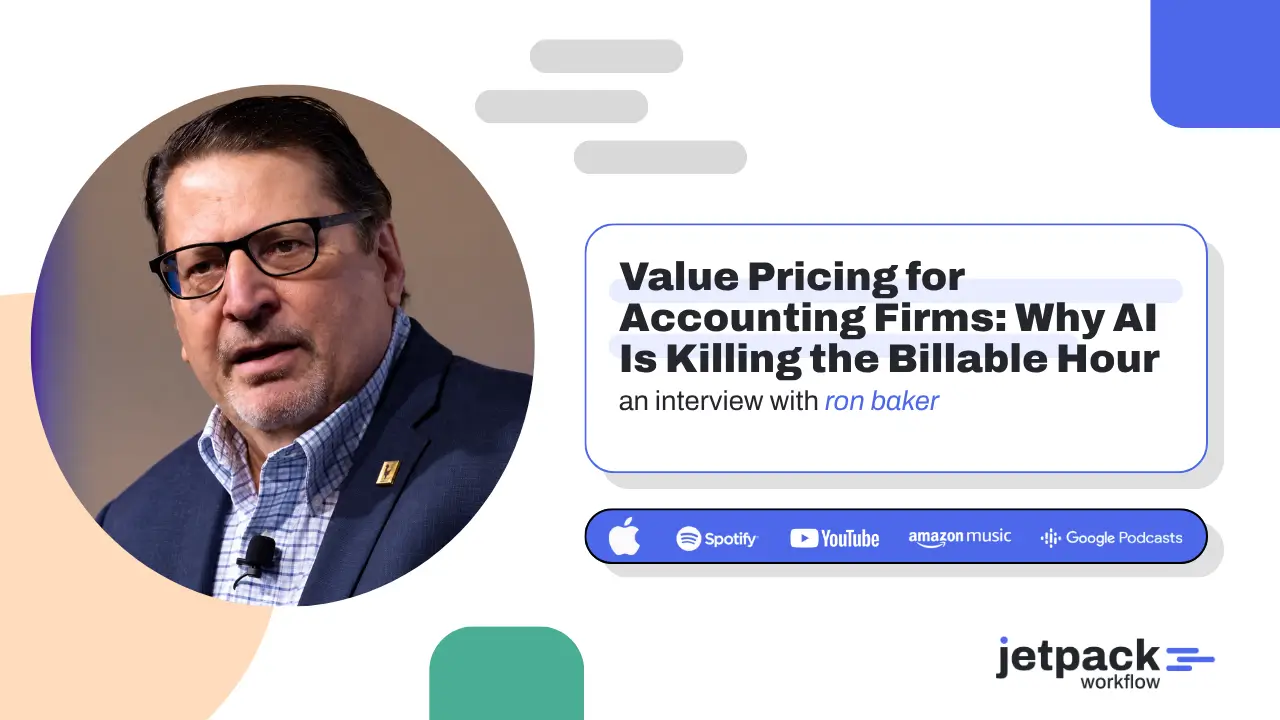
Value Pricing for Accounting Firms: Ron Baker on Why AI Is Killing the Billable Hour
For decades, accounting firms have tied price to time.
A job takes five hours, ten hours, or twenty hours. The firm calculates the labor involved, applies an hourly rate or builds a fixed fee around the expected effort, and sends the client a bill.
Artificial intelligence is making that relationship increasingly difficult to defend.
If AI allows an accounting firm to complete work that once required ten hours in five, should the client pay half as much? If the same outcome can eventually be produced in one hour, should the firm’s revenue fall again?
For Ron Baker, the answer is clear.
During a fireside chat with David Cristello, founder and CEO of Jetpack Workflow, Baker argued that AI is accelerating a change he has advocated for throughout his career: separating what accounting firms charge from how long the work takes.
“The billable hour’s been dead for decades. We just haven’t had the funeral yet,” Baker said during the discussion. “AI is delivering the funeral.”
But Baker’s argument goes further than simply replacing hourly billing with fixed fees. He believes accounting firms need to rethink what clients are actually paying for, how premium services are packaged, why subscriptions may become more important, and which metrics firms should use when time is no longer the foundation of pricing.
For accounting firm owners navigating AI, pricing, and changing client expectations, the discussion points toward a different model: price the relationship, transformation, and outcome rather than the hours required to produce them.
Key Takeaways
- AI is weakening the connection between hours worked and value delivered.
- Value pricing is not the same as fixed pricing based on estimated hours.
- Baker argues that value is subjective and psychological, while price ultimately communicates a story about the offering.
- Firms should consider offering multiple pricing options, including a premium or white-glove option.
- The most valuable accounting relationships may increasingly focus on client transformations rather than individual services.
- Subscription pricing can give clients ongoing access to the firm’s expertise instead of pricing every task separately.
- Firms moving toward premium models need to be clear about what they do and what they do not do.
- Baker believes firms should track outcomes, deadlines, performance, and learning rather than billable hours.
- Niching can make premium pricing and subscription models easier to implement.
- AI makes documented workflows and operational visibility more important because firms still need to manage delivery even when technology reduces the labor required.
Why AI Is Challenging the Billable Hour
Baker originally expected competition for talent to be the force that finally pushed professional firms away from the billable hour.
Instead, he believes AI is doing it.
The reason is straightforward.
When pricing is connected to hours, increased efficiency creates a pricing problem.
Imagine an accounting engagement that previously required ten hours. AI and automation reduce that work to five hours while producing the same or potentially better result.
Under an hourly model, becoming twice as efficient can mean generating half as much revenue.
The tension becomes even greater as AI takes over more predictable and repetitive work.
Baker’s argument is that the profession needs to break the connection between effort and worth.
The customer is not necessarily receiving less value because the accountant completed the work faster. In some cases, faster delivery may actually increase the value of the service.
That leads to one of the central ideas from the discussion:
Price should not be determined by the cost or effort required to produce the result.
Baker noted that if businesses could simply calculate their costs, add profit, and arrive at the correct price, businesses would not fail as frequently as they do.
The customer’s perception of value ultimately matters.
What Is Value Pricing for Accounting Firms?
Value pricing for accounting firms means determining price based on the value of the relationship, outcome, or transformation to the client rather than calculating the fee primarily from hours worked.
That distinction is important because value pricing is sometimes confused with fixed pricing.
A firm might estimate that an engagement requires ten hours, multiply those hours by an internal rate, add a margin, and quote one fixed amount.
The client receives price certainty, but the firm’s underlying pricing logic is still based on time.
Baker described that type of fixed price as a reasonable foundation or minimum, but not necessarily value pricing.
Instead, he encourages firms to consider the customer’s circumstances, desired outcome, available choices, and perception of value.
Value Is Not a Number
One of Baker’s most important observations during the session was:
“Value is not a number. Value’s a feeling.”
Price eventually has to become a number.
Value does not.
Customers make purchasing decisions based on far more than the cost required to create a product or deliver a service.
Brand, trust, urgency, confidence, experience, risk, convenience, access, and the importance of the desired result can all affect what something is worth to a particular buyer.
Baker used the example of a hypothetical $10,000 Rolls-Royce.
Most buyers would not immediately think they had discovered an incredible deal. They would probably wonder what was wrong with the vehicle.
The price itself communicates information.
That is why Baker argues that pricing should be understood partly through psychology rather than treated only as an analytical exercise.
For accounting firms, this means understanding what clients believe they are buying before deciding what the relationship should cost.
Why Accounting Firms Should Not Price Themselves

Baker also offered an unconventional recommendation for firm owners:
Do not price yourself.
His reasoning is based on human behavior.
People can often advocate more confidently for someone else’s expertise than their own.
Baker compared this with professional athletes, actors, and authors who use agents to negotiate on their behalf.
A partner may be comfortable explaining why another partner’s expertise deserves a premium price but become far more conservative when assigning a price to their own work.
For solo practitioners, Baker even suggested having a spouse or another trusted person participate in the pricing process.
The underlying lesson is that underpricing is not always a mathematical problem.
Sometimes it is a confidence problem.
Fixed Pricing vs. Value Pricing
The distinction between fixed pricing and value pricing came up directly during the discussion.
Baker explained that fixed pricing is often built from estimated hours.
The calculation might look conceptually like this:
Expected hours × internal rate = fixed price
The client no longer receives an hourly invoice, but time still determines the price.
Value pricing starts somewhere else.
It asks questions such as:
- What problem is the client trying to solve?
- What outcome does the client want?
- How important is that outcome?
- What risks are being reduced?
- What opportunities are being created?
- What level of access or experience does the client want?
- What alternatives can the firm offer?
The final price is then connected to the value of the relationship and outcome rather than simply the firm’s production cost.
Give Clients Choices Instead of One Price
One practical strategy Baker recommends is offering multiple choices.
Rather than presenting a single service package, a firm can offer different levels of experience.
For example:
Baker noted that many customers will select the middle option, while some will choose the highest tier.
But a client cannot choose the premium option if the firm never offers one.
His analogy was straightforward: if American Express never offered a Platinum Card, nobody could buy one.
Accounting firms should therefore consider whether they have created a genuine premium option for clients who want the highest level of service.
What Does a Premium Accounting Service Actually Sell?
This is where value pricing becomes more interesting.
A premium package should not simply contain more deliverables.
Baker encouraged firms to think about the transformation they help create.
An accountant might help a client:
- Retire sooner
- Grow a business
- Prepare a business for sale
- Increase the eventual value of a business
- Plan for a child’s education
- Create an estate strategy
- Build a legacy
- Navigate a major financial transition
- Improve the financial health of a company
Tax returns, reports, forecasts, meetings, and accounting services may all be involved.
But those services are the means.
The transformation is the end.
Baker argued that clients increasingly are not buying individual services. They are buying a desired future state and a trusted professional who can help guide them toward it.
From Delivering Services to Guiding Transformations
This represents a meaningful change in how an accounting firm thinks about its role.
Traditional thinking might begin with:
What services do we provide?
Baker’s model begins closer to:
What transformation are we helping this client achieve?
If the client’s goal is to retire sooner, for example, the accounting firm’s work can be organized around that outcome.
Tax planning, cash flow analysis, business advisory, forecasting, succession planning, and other services become components of a broader relationship.
As Baker put it during the discussion, the services required to create that transformation are the means rather than the end.
This also makes AI less threatening to the firm’s value proposition.
AI may automate portions of the means.
It does not automatically own the client relationship, understand the client’s aspirations, take responsibility for the outcome, or replace the professional’s role as a trusted guide.
Why AI Makes Value Pricing More Important
One of David Cristello’s questions captured a concern many firm owners are likely to have.
If AI reduces a ten-hour engagement to five hours, and the firm’s margin improves, should the firm feel uncomfortable charging the same amount?
Baker’s answer comes back to the distinction between cost and value.
The amount of time required to deliver the result does not determine what the result is worth to the customer.
Consumers rarely ask how many labor hours were required to manufacture a car before deciding what they are willing to pay for it.
Restaurant customers do not usually calculate how many minutes the chef spent preparing a meal and then determine whether the menu price is justified.
Accounting services do not necessarily need to operate differently.
As AI improves productivity, firms that remain anchored to hours may find themselves penalized financially for becoming more efficient.
Value pricing breaks that link.
Why Ron Baker Thinks Subscription Pricing May Be Next
Interestingly, Baker does not see value pricing as the final destination.
He believes subscription models may become increasingly appropriate for accounting firms.
The distinction is important.
Instead of pricing individual services or even individual transformations, a subscription can price the ongoing relationship and access to the professional.
Baker compared this psychological relationship with memberships such as Amazon Prime and other subscription businesses.
Once someone becomes a member, the relationship changes.
For accounting firms, that might mean clients are not paying every time they need a specific interaction.
They are paying for ongoing access to the firm within a clearly defined role.
As Baker put it:
“You price the relationship.”
He believes AI could accelerate this transition because AI will increasingly perform predictable, rote work.
When less of the client’s value is tied to the manual production of individual tasks, the relationship, judgment, guidance, and transformation become more important.
Subscription Pricing Can Reduce the Scope Creep Problem
Scope creep has long been a source of frustration for accounting firms.
A client adds employees.
They open another account.
They create another entity.
Something changes, and suddenly the firm needs to revisit the engagement, calculate additional effort, communicate a new price, and potentially negotiate again.
Baker questioned whether firms need to structure relationships this way at all.
He pointed to direct primary care and concierge medicine.
A physician operating under this model does not necessarily price every interaction separately. The patient pays for an ongoing relationship and access within the physician’s defined area of responsibility.
The physician still has boundaries.
They simply define those boundaries differently.
Baker believes accounting firms can learn from this model.
Instead of obsessing over every individual task included in scope, firms can become much clearer about the role they perform and the work they do not perform.
Define What Your Firm Does Not Do
One of Baker’s strongest observations was that firms can be defined as much by what they refuse to do as by what they offer.
This matters particularly when building premium or subscription relationships.
Removing rigid scope does not mean promising every possible service to every client.
A general practitioner does not perform every medical procedure.
They operate within a defined area of expertise and refer patients to specialists when necessary.
Accounting firms can take a similar approach.
Define the firm’s lane.
Be clear about the role the firm plays.
Know where that responsibility stops.
When the client needs something outside that role, help direct them toward the appropriate specialist.
This can create a more flexible relationship without turning the firm into an unlimited source of unrelated work.
What Accounting Firms Can Learn From Concierge Medicine
Baker repeatedly returned to direct primary care and concierge medicine because he sees parallels with professional accounting services.
Traditional general practitioners may serve very large patient panels, which limits the amount of time they can spend with each individual.
Direct primary care and concierge models generally operate with fewer patients and deeper relationships.
That creates a different economic model:
Fewer clients + higher value + deeper relationships + premium experience
For accounting firms, the equivalent could mean deliberately serving fewer clients while becoming more important to each one.
Instead of maximizing the number of tax returns, bookkeeping accounts, or individual transactions completed, the firm can focus on becoming deeply embedded in the financial success of a smaller client base.
This supports both premium pricing and a more advisory-oriented relationship.
Fewer Clients Can Create a Better Client Experience
The idea of serving fewer clients may feel uncomfortable to firms accustomed to measuring growth by client count.
But a premium model changes the economics.
If a firm serves fewer clients at higher prices, professionals can spend more attention on each relationship.
That can create room for:
- More proactive conversations
- Better strategic guidance
- Faster responses
- Deeper knowledge of the client’s business
- Better planning
- Stronger relationships
- More personalized service
The objective is not simply to charge more.
It is to create an offering that justifies a different level of price because the experience and relationship are genuinely different.
Why Niching Makes Value Pricing Easier
Cristello asked whether firms need to niche to implement these models successfully.
Baker said specialization makes the process easier, although general firms can still use value or subscription pricing.
A niche does not necessarily need to be an industry.
It could be based on:
- Profession
- Business model
- Demographic
- Platform
- Revenue profile
- Particular financial challenge
- Type of entrepreneur
Specialization helps because the firm becomes more familiar with a narrower set of client problems.
That can make it easier to build repeatable expertise, communicate differentiated value, define a premium experience, and price the relationship.
Baker’s broader argument is that a common offering is likely to command a common price.
An uncommon offering can command an uncommon price.
What If a Client Insists on Hourly Billing?
Not every client will accept the transition.
During the fireside chat, Baker was asked how firms should respond when a client continues asking for hourly billing or demands to see the hours worked.
His answer was direct:
They may not be the right client.
A firm cannot successfully value price a customer who fundamentally believes professional value should be measured through effort.
Baker said those situations are relatively uncommon, but when they occur, the firm may need to stand behind its business model or refer the client elsewhere.
Cristello added a practical transition strategy.
Firms can build confidence by implementing value pricing successfully with other clients first. For clients who remain committed to the old model, the firm can create a professional offboarding process and recommend other providers that may be a better fit.
A poor-fit client for one established firm may be an excellent client for another practice.
How to Transition Existing Clients to Subscription Pricing
Moving an existing accounting firm from hourly or value pricing to subscriptions is not simply a billing change.
Baker described subscription as a different business model.
The firm’s systems, accounting, key performance indicators, offering, and value capture may all change.
He said firms can move directly from hourly billing to subscriptions without first adopting value pricing.
However, one approach Baker has seen produce a higher probability of success is creating a new entity around the new offering.
That gives the firm an opportunity to build the model without being constrained by legacy systems and assumptions.
He also predicted a possible bifurcation as AI develops.
One side of the firm could handle increasingly automated services.
The other could focus on ideation, advisory, judgment, and human relationships.
Baker compared this to having Toyota and Lexus within the broader organization: different offerings designed around different customer experiences.
Should Subscription Prices Be the Same for Every Client?
Not necessarily.
Baker explained that a highly specialized firm with a narrow offering may be able to charge the same subscription price across its customer base.
Other firms may segment customers and use different prices.
The appropriate model depends on factors such as:
- Firm size
- Number of customers
- Type of work
- Niches served
- Client needs
- Level of access
- Desired customer experience
One benefit of subscriptions is that they can potentially reduce some of the administrative burden associated with pricing every client engagement individually.
However, Baker stressed that firms can still use bespoke subscription pricing where appropriate.
Do Accounting Firms Still Need Timesheets?
The conversation eventually arrived at one of the most controversial questions in professional services:
If a firm no longer bills by the hour, should employees still track their time?
Baker’s answer was simply:
No.
His argument is that what a business measures communicates what the business values.
If employees are measured primarily through hours, the organization will naturally optimize around hours.
Instead, Baker recommends measuring results.
That could include questions such as:
- Was the work completed?
- Was it completed by the deadline?
- Were client commitments met?
- Did the process produce the intended outcome?
- What went wrong?
- What went well?
- What should change next time?
For an accounting firm, this shifts operational management from hours consumed to work completed and outcomes delivered.
Replace Timesheets With Better Operational Metrics
Removing timesheets does not mean abandoning accountability.
It means replacing a time-based measure with measures more closely connected to performance.
Baker specifically pointed toward deadlines and after-action reviews.
An accounting firm could monitor:
- On-time completion
- Missed deadlines
- Work in progress
- Recurring task completion
- Client deliverables
- Review issues
- Rework
- Process exceptions
- Client outcomes
- Team responsibilities
After-action reviews add another dimension that timesheets cannot provide.
Instead of simply recording that an employee spent four hours on an engagement, the team discusses what happened.
What worked?
What failed?
What should be changed?
What did the firm learn?
Baker argues that this reflective process helps firms capture tacit knowledge and improve their systems and SOPs over time.
AI Makes Workflow Visibility More Important, Not Less
There is an important operational implication for accounting firms considering Baker’s pricing philosophy.
Removing billable hours does not remove the need to manage work.
In fact, if firms stop relying on timesheets as a central management mechanism, they need better visibility into the actual workflow.
A firm still needs to know:
- What work is due
- Which client it belongs to
- Who owns it
- When it needs to be completed
- Whether it is on schedule
- Where work is blocked
- Which processes need improvement
AI can reduce the amount of manual labor required inside a process.
It does not eliminate the process itself.
This is where a workflow management system such as Jetpack Workflow becomes particularly relevant.
Jetpack Workflow helps accounting firms organize recurring client work, assign ownership, manage due dates, standardize processes, and see work coming down the pipeline.
As the profession moves away from measuring effort and toward measuring outcomes, that operational visibility becomes increasingly important.
What AI Means for the Future of Accounting Firm Pricing
Baker also challenged the idea that AI should be viewed as simply another software application.
He described AI as more relational than conventional software because it can identify patterns and relationships across disciplines.
For professional firms, this matters because the opportunity is not limited to completing existing tasks faster.
AI could change which tasks professionals perform in the first place.
As predictable production work becomes easier to automate, the human professional can spend more time on areas such as:
- Judgment
- Advisory
- Relationships
- Interpretation
- Strategy
- Accountability
- Client transformation
That changes the economics of the firm.
If the value proposition remains “we complete these tasks,” automation threatens the basis of the price.
If the value proposition becomes “we help you achieve this outcome,” automation can improve the firm’s ability to deliver the result.
Take Responsibility for Outcomes, Not Tasks
Near the end of the conversation, Baker summarized what he believes the profession needs to rediscover as AI advances.
Professionals should take responsibility for outcomes rather than simply delivering tasks.
That may be the most important distinction in the entire value pricing discussion.
AI will continue to make individual tasks faster.
Tax preparation will evolve. Bookkeeping will evolve. Reporting will evolve. Research will evolve. Administrative work will evolve.
But clients will still have goals, risks, businesses, families, financial decisions, and desired futures.
The opportunity for accounting firms is to move closer to those outcomes.
That means asking a different question.
Not:
How many hours will this take us?
But:
What are we helping this client accomplish?
Frequently Asked Questions
What is value pricing for accounting firms?
Value pricing for accounting firms means setting prices based on the perceived value of the relationship, outcome, or transformation to the client rather than primarily calculating fees from hours worked. Ron Baker argues that firms need to separate the effort required to perform the work from what the result is worth to the customer.
What is the difference between fixed pricing and value pricing?
Fixed pricing may still be based on estimated hours multiplied by an internal rate. Value pricing starts with the customer’s needs, desired outcomes, perceived value, and available choices rather than using time as the primary basis for the price.
How is AI affecting the billable hour?
AI can reduce the time required to complete predictable accounting tasks. Under hourly billing, increased efficiency can reduce revenue even when the client receives the same or greater value. Baker argues that this makes pricing relationships, transformations, and outcomes increasingly important.
Should accounting firms consider subscription pricing?
Baker believes subscription pricing can be a strong next step because it allows firms to price an ongoing relationship and access rather than individual services. He expects this model to become more relevant as AI automates more predictable work.
Do accounting firms need timesheets if they stop billing hourly?
Baker argues that they do not. Instead, he recommends tracking results such as whether work is completed by deadlines and using after-action reviews to identify what worked, what failed, and how processes should improve.
Can a general accounting firm use value or subscription pricing?
Yes. Baker said specialization can make value and subscription pricing easier because the firm can create a more differentiated offering, but he has also seen general accounting and tax firms implement these models successfully.
How should accounting firms transition clients away from hourly billing?
Firms can introduce value or subscription pricing to new clients or selected existing clients first, refine the model, and then expand it. Baker also discussed creating a separate entity for a new subscription offering as one approach that can reduce the constraints of legacy systems and business models.
The Bottom Line
AI is not simply making accounting work faster.
It is exposing a fundamental weakness in pricing professional expertise according to the time required to produce it.
For Baker, the future belongs to firms that can separate value from effort, create differentiated experiences, price relationships and transformations, and measure performance through outcomes rather than hours.
That does not make operations less important.
It makes them more important.
A firm that promises premium outcomes needs reliable systems behind those promises. Recurring work still needs owners. Deadlines still need to be met. Processes still need to improve. Clients still need consistency.
AI may help accounting firms spend fewer hours delivering the work.
The opportunity is to make those hours less relevant to what the client is actually buying.
Last Updated: September 2026
Related Articles
- Ira Rosenbloom on Accounting Firm Succession Planning: Build a Profitable Firm That Lasts
- Selling an Accounting Firm: How Mike Payne Scaled, Merged, and Planned His Next Chapter
- Accounting Firm Growth: How Yuri Kapilovich Built a $290K Firm as a Team of One
- How Adam Shay Scaled and Sold a $2.5M Accounting Firm
- Joe Manganelli’s Accounting Firm Growth Strategy Behind Calculate’s $10M Success
- AI for Accounting Firms: Isaac Perdomo on Automating Workflows and Efficiency
- How Jeff Seibert Is Using AI Accounting Firm Automation to Build a 90% Automated Firm
- Tax Resolution for Accountants: Michael Rozbruch Explains a $100K Opportunity in Your Client Base
- CPA Firm Valuation Multiples in 2026: Insights From Geoff Bruskin
- AI Use Cases for Accounting Firms: Jan Haugo on What Firms Should Automate First
- How to Grow a Solo CPA Firm: Angel Zhen on Scaling Past $500K Without Hiring
Share this article