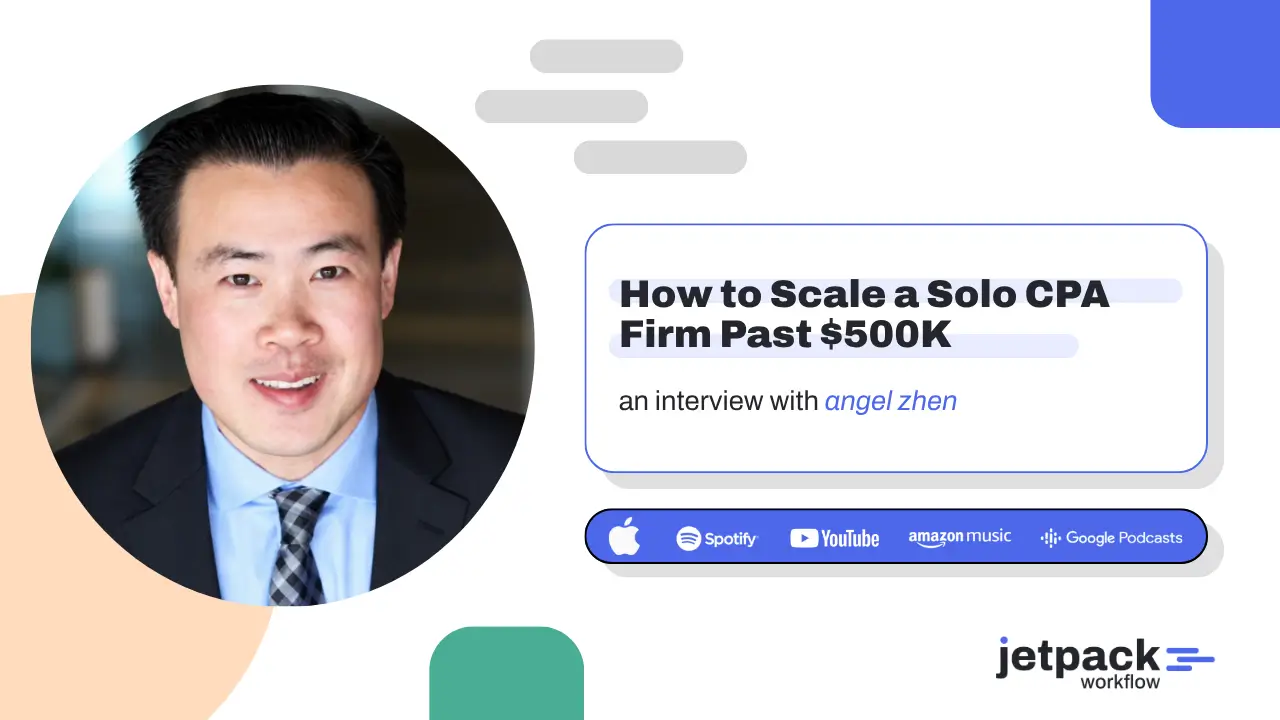
How to Grow a Solo CPA Firm: Angel Zhen on Scaling Past $500K Without Hiring
Most accounting firm growth stories follow the same basic formula.
Win more clients. Add more work. Hire more employees. Add another layer of management. Repeat.
Angel Zhen chose a different path.
After launching Angel Zhen CPA in 2020, he built a solo practice serving roughly 300 clients nationwide and generating more than $500,000 in annual revenue. He has done it without building a traditional team. At the same time, he has taken around 12 weeks away from the firm in multiple years, including extended international trips.
That combination makes his story particularly interesting for solo CPAs.
Zhen has not eliminated busy season. He has not found a single AI tool that runs the firm for him. And he is not arguing that every accounting firm should avoid hiring.
Instead, he has designed his practice around a different set of priorities: better systems, selective technology, value-based pricing, strong client relationships, professional trust, and control over his time.
In a conversation with Jetpack Workflow founder and CEO David Cristello, Zhen explained how those pieces work together and why scaling an accounting firm does not necessarily require scaling headcount.
Key Takeaways
- Angel Zhen built a $500K+ solo CPA firm serving roughly 300 clients without a traditional team.
- Instead of automatically hiring as revenue increased, he focused on technology, systems, and client experience.
- Zhen uses tools such as ChatGPT, Claude, and Perplexity according to their different strengths.
- His AI strategy starts with the client’s problem, not the technology.
- He positions himself as a tax advisor who provides clarity and recommendations, rather than simply preparing returns.
- Value-based pricing helps separate revenue growth from hours worked.
- Zhen believes trust, reputation, credentials, and digital presence influence what clients are willing to pay.
- Systems and asynchronous communication allow him to maintain client service while traveling.
- He has taken approximately 12 weeks away from the practice in multiple years.
- His model shows that firm owners can optimize for profitability and freedom rather than assuming growth must mean more employees.
Can a Solo CPA Firm Scale Past $500K?
For many practitioners, reaching $500,000 in annual revenue as a one-person firm may sound unrealistic.
Accounting work has traditionally been capacity constrained.
There are only so many tax returns one person can prepare, so many client meetings one person can attend, and so many hours available during busy season.
The conventional solution is hiring.
Zhen experimented with that route, but it did not fit how he wanted to operate.
He enjoyed the control and flexibility that came with working independently. Rather than continuing to build a team after early hiring attempts did not work out, he began leaning further into systems and technology.
That changed the growth question.
Instead of asking:
Who should I hire next?
His model effectively asks:
How can I create more value without adding unnecessary complexity?
Zhen credits technology, systems, customer experience, and higher-value work with helping make that possible.
The objective is not simply doing more work faster. It is increasing the leverage behind the work he chooses to do.
Growth Does Not Have to Mean Headcount
There are different ways to build an accounting firm.
One owner may want a multi-office organization with dozens of employees. Another may want a boutique advisory practice with a small specialized team.
A solo practitioner can optimize for something different again.
For Zhen, maintaining control over his schedule and firm matters.
That means growth has to come from sources other than simply adding employees.
Those sources can include:
- Better workflows
- More efficient technology
- AI-assisted research and communication
- Higher-value services
- Better pricing
- Stronger client selection
- Asynchronous communication
- More standardized client processes
- A stronger professional reputation
The underlying principle is leverage.
When administrative friction decreases and the value of each client relationship increases, revenue becomes less dependent on adding another employee every time the firm grows.
Technology Is Leverage, Not the Strategy

Technology plays an important role in Zhen’s firm, but he does not treat software as the solution to everything.
As a solo owner, he has the flexibility to experiment.
He can try a platform, evaluate whether it improves his process, and move on if it does not. He does not have to retrain a 20-person team every time he changes an application.
That has allowed him to test different technologies and AI platforms.
But Zhen made an important distinction during the conversation:
“At the end of the day, those are all just tools.”
That idea should guide any accounting firm’s technology strategy.
The objective is not to accumulate the largest tech stack.
The objective is to build a better operating system for the firm and create better outcomes for clients.
A tool that does not improve either one is unlikely to create meaningful leverage.
How Angel Zhen Uses AI in His CPA Firm
Zhen has experimented with several major AI platforms, including ChatGPT, Claude, and Perplexity.
He does not necessarily expect one platform to handle everything.
Instead, he looks at the relative strengths of different tools.
He described Perplexity as useful for finding more current information. Claude can be particularly useful for writing. ChatGPT can support creative work and broader problem solving.
That willingness to experiment has made him what Cristello described as an AI power user.
But Zhen also warned against overcomplicating AI adoption.
The fact that a CPA can run the same prompt through three different models does not mean that is always the best use of time.
The better starting point is the client’s problem.
What does the client need?
What outcome are they trying to achieve?
What information would help them make a decision?
Once those questions are clear, the accountant can decide which technology is useful.
Start With the Client Problem, Not the AI Tool
This distinction matters because AI adoption can easily become backwards.
A firm discovers a new tool and then searches for something to automate with it.
Zhen’s approach is closer to:
Problem → desired outcome → appropriate tool → professional judgment
That keeps technology connected to actual client value.
For example, a client asking a tax question probably does not want to receive several pages of AI-generated research.
They want to understand what the issue means for them.
The CPA can use AI to accelerate research, compare information, organize findings, or draft explanations.
But the professional still needs to determine what matters.
That is where the advisor creates value.
Do Not Overwhelm Clients With AI-Generated Information
Generative AI has dramatically reduced the cost of producing information.
That creates a new problem.
It is now extremely easy to produce too much of it.
Zhen does not believe the CPA’s role is to send a client a large amount of research and leave them to interpret it.
As he put it:
“You’re not there to make yourself sound too smart.”
The client does not necessarily need to see everything that went into the analysis.
They need clarity.
That means the accountant may perform extensive research behind the scenes, analyze different possibilities, and use multiple tools before distilling everything into a recommendation the client can actually understand.
The professional value lies in that distillation.
AI can provide information.
The CPA still needs to provide context, judgment, and guidance.
Move From Tax Preparer to Tax Advisor
Zhen applies the same philosophy to tax preparation.
He sees an important difference between processing a tax return and advising the person behind it.
A preparer can take the information supplied by the client, complete the return, and send it back.
An advisor takes another step.
Once Zhen has substantially completed a return, he looks at the bigger picture.
What may be missing?
Why does the client owe money?
Why are they receiving a refund?
What could have been handled differently?
What should they consider before next year’s filing?
Are there planning opportunities that should be discussed?
This additional layer helps the client understand the return rather than simply receiving it.
The goal is to put the client in a better position to make decisions.
Create a Year-Round Advisory Cycle
Tax preparation can also become the beginning of another conversation rather than the end of the engagement.
Zhen provides tax planning and tax presentations in addition to preparation.
That creates a more complete cycle:
Prepare → Review → Explain → Recommend → Plan → Prepare again
The approach has two advantages.
First, it creates a stronger client experience because clients receive guidance rather than only a completed document.
Second, it can increase the value of the relationship without requiring the firm to maximize the volume of returns being processed.
For a solo CPA, that distinction matters.
Scaling through volume eventually collides with capacity.
Scaling through expertise and advisory value creates another path.
Client Experience Is Part of the Growth Engine
A solo firm has little room for unnecessary administrative friction.
Every unclear document request, repetitive follow-up, avoidable meeting, and poorly organized client interaction consumes the owner’s limited capacity.
That makes client experience an operational issue as much as a marketing issue.
Zhen uses systems to help clients upload information and communicate with the practice.
He also does not believe every interaction requires a video meeting.
Too many Zoom calls can create fatigue and fill the calendar with conversations that could have been handled asynchronously.
Written communication can often allow a CPA to answer thoughtfully while preserving flexibility.
That is particularly important for Zhen because his goal is not simply to operate efficiently from his office.
He wants the practice to continue functioning when he is somewhere else.
How a Solo CPA Can Take 12 Weeks Away From the Firm
Zhen has taken roughly 12 weeks away from the practice in multiple years.
He also discussed returning from a six-week trip to Asia, something he had done several times.
That does not mean he completely shuts the business down.
Some maintenance work continues.
He can still advise clients when necessary.
But he is not traveling internationally while maintaining a traditional 40-hour office schedule.
The ability to do that comes from the way the firm is designed.
Documents can be uploaded digitally.
Information is accessible remotely.
Client communication does not depend entirely on in-person meetings.
Work is organized through technology.
The practice does not require Zhen to be physically present in the same location every day.
That type of flexibility would have been extraordinarily difficult for a solo CPA several decades ago.
Modern technology makes it possible.
But the technology still needs systems behind it.
Taking Time Off Is Part of Firm Design
There is also a mindset component.
Zhen did not start his own firm simply to recreate a corporate job with a different name.
He wanted more control over his life.
That includes financial opportunity, but it also includes freedom and recovery.
As he explained:
“I think the whole purpose of going and having your own practice is not only just making a lot of money, but also avoiding burnout.”
Busy season still exists.
Zhen described March and April as particularly demanding, with September and October also becoming busy.
He compares the process to a marathon.
You have to pace yourself.
The goal is not to pretend the work disappears. It is to structure the rest of the year so intense periods do not become the permanent operating model.
Burnout Prevention Can Improve Client Service
Time away from the firm is sometimes treated as the opposite of client service.
Zhen sees the relationship differently.
A practitioner who works continuously without meaningful recovery can eventually experience mental fatigue.
That can affect decision-making, responsiveness, patience, and the quality of professional judgment.
Rest therefore has an operational purpose.
It allows the owner to return to the firm with more energy.
For Zhen, extended travel is not something he intends to postpone until retirement.
It is part of what he wants entrepreneurship to make possible.
Do Not Recreate Your Corporate Job
Cristello highlighted another lesson from Zhen’s story.
Accountants sometimes leave corporate employment while carrying corporate assumptions directly into entrepreneurship.
The office changes, but the model does not.
The owner still assumes:
- More work means more hours.
- More revenue means more employees.
- Busyness proves productivity.
- Time off should remain limited.
- Growth should be measured primarily through company size.
Zhen’s practice challenges those assumptions.
A firm owner gets to decide what the firm is designed to optimize.
That might be maximum enterprise value.
It might be headcount.
It might be revenue.
It might be personal income.
It might be flexibility.
Or it may be a combination of profitability, meaningful client work, and substantial time away.
The important part is making the decision intentionally.
Value-Based Pricing Helps Break the Capacity Ceiling
Zhen’s pricing model is another important part of his ability to remain solo.
He does not primarily charge by the hour.
Instead, his pricing varies according to the client, the work involved, and the value of the relationship.
That means two clients do not necessarily receive identical pricing simply because they require the same category of service.
Factors can include:
Zhen does not present this as a perfect formula.
Pricing requires judgment.
That is precisely why confidence matters.
Why Hourly Billing Can Limit a Solo CPA Firm
Hourly billing creates a basic capacity problem.
A solo practitioner has a finite number of hours.
Once those hours are sold, increasing revenue requires some combination of working longer, increasing the hourly rate, or hiring someone else.
Value-based pricing weakens that relationship between revenue and time.
A client is not necessarily paying only for the minutes required to answer a question or complete a return.
They may be paying for years of experience, professional judgment, research, planning, clarity, responsiveness, and confidence that the work is being handled correctly.
This becomes increasingly important as AI and automation reduce the time required to complete portions of accounting work.
If technology allows a CPA to solve the client’s problem faster, the value of the solution does not automatically decrease.
Confidence Is Part of Pricing
Zhen believes many CPAs undercharge because they do not fully believe they can command higher fees.
Hourly pricing can feel safer because there is a visible calculation behind it.
Hours multiplied by a rate produces a number that can be explained.
Value-based pricing requires more judgment.
The CPA has to believe the service is worth the price.
That confidence develops through experience, expertise, reputation, and demonstrated client results.
It also connects directly to another major theme from the interview: trust.
Become the Most Trusted Advisor
Before discussing price, Zhen wants to establish something more important.
Trust.
His goal is to position himself as the trusted advisor the client wants helping them make financial and tax decisions.
That process begins before the prospect ever contacts him.
A prospective client can search his name.
They can review his website.
They can inspect his LinkedIn profile.
They can look at credentials and professional recognition.
They can evaluate whether his online presence appears credible.
Zhen recommends accountants do the same thing themselves.
Search your own name and examine what a potential client sees.
Does the result inspire confidence?
Your Digital Presence Is a Trust Signal
This is particularly important for firms that want to command higher fees.
Premium positioning and weak digital credibility do not fit together well.
A prospective client considering a significant engagement is likely to look for evidence that the professional is a safe choice.
Important signals can include:
- A professional website
- A complete LinkedIn profile
- Clear credentials
- Professional awards and recognition
- Useful content
- Consistent positioning
- Search visibility
- Reviews or other reputation signals
Zhen has deliberately invested in building that profile.
His recognition as the 2025 Digital CPA Innovative Practitioner Award winner adds another trust signal, but the broader lesson applies to any CPA.
Trust is built cumulatively.
Referrals Work Better When Your Reputation Supports Them
Referrals naturally help a professional service business because some trust is transferred from the person making the introduction.
But prospects can still verify what they have been told.
Someone may hear:
“You should talk to this CPA.”
Their next action may be searching Google or LinkedIn.
If what they find reinforces the recommendation, confidence grows.
If it contradicts the recommendation, friction appears.
That means referral marketing and digital positioning should not be treated as separate strategies.
They support each other.
A Practical Framework for Growing a Solo CPA Firm
Zhen’s experience does not point to one secret piece of software or one pricing technique.
The model works because several decisions reinforce one another.
1. Define what you want the firm to provide
Before chasing a revenue target, determine what kind of business you actually want.
Do you want employees?
Do you want a larger organization?
Do you want more personal flexibility?
Do you want to travel?
Do you want a smaller number of higher-value relationships?
Firm design should begin with the destination.
2. Standardize recurring work
Identify the activities that happen repeatedly across clients.
Build clear processes around document collection, tax preparation, follow-ups, planning, communication, and deadlines.
The less recurring work depends on memory, the easier the practice becomes to manage.
3. Use technology deliberately
Do not add software because everyone else is using it.
Start with the problem.
Then select the tool that improves the workflow or client outcome.
4. Use AI to increase clarity
AI can accelerate research, writing, analysis, and problem solving.
The final output to the client should still be useful, concise, and professionally interpreted.
5. Move toward advisory
Look beyond completing the immediate task.
Explain what happened, identify what the client should consider next, and create opportunities for proactive planning.
6. Reconsider hourly pricing
Evaluate whether hours accurately reflect the value being delivered.
For some firms and engagements, value-based pricing may create a better alignment between expertise, client outcomes, and firm economics.
7. Build trust before the sales conversation
Audit your website, LinkedIn profile, credentials, search results, and overall professional positioning.
Prospects should encounter evidence that reinforces your expertise.
8. Reduce unnecessary communication friction
Not every interaction requires a meeting.
Use structured and asynchronous communication where it improves both the client experience and owner capacity.
9. Build time away into the model
Do not wait for a mythical future when the firm has no work.
Design processes that allow the practice to continue operating when you are not sitting at your desk.
What Solo CPA Firm Owners Should Avoid
The interview also highlights several traps that can make a solo practice harder to scale.
Hiring before fixing broken processes. Adding people to an inefficient workflow can add complexity rather than capacity.
Collecting technology instead of solving problems. A larger tech stack does not automatically create a better firm.
Sending information instead of providing advice. Clients can increasingly access information themselves. Professional interpretation becomes more valuable.
Underpricing because of uncertainty. Low confidence can create a revenue ceiling before actual capacity becomes the problem.
Turning every client interaction into a meeting. Calendar-heavy service models can make a solo firm difficult to scale.
Treating burnout as the cost of success. Periods of intense work may be unavoidable, but permanent overwork does not need to be the business model.
Workflow Management Matters Even When You Have No Employees
Workflow management is often discussed as a team problem.
It is just as relevant to a solo practice.
A practitioner serving hundreds of clients may be responsible for hundreds of deadlines, document requests, tax returns, follow-ups, planning engagements, and recurring responsibilities.
Without an external system, those commitments begin competing for space in the owner’s memory.
That creates risk.
The problem becomes even more significant if the owner wants the freedom to travel or step away.
A well-designed workflow system answers fundamental questions:
- What needs to be done?
- Which client does it belong to?
- When is it due?
- What is waiting on the client?
- What has already been completed?
- What needs attention next?
The owner should not have to reconstruct those answers from memory every morning.
Better Systems Create More Than Efficiency
The purpose of workflow improvement is not simply shaving minutes off individual tasks.
Better systems can create capacity.
Capacity can then be invested in higher-value advisory work, better client service, professional development, business growth, or personal time.
That is where Zhen’s story connects directly with workflow design.
The goal is not automation for automation’s sake.
The goal is building a firm that operates according to the owner’s priorities.
For one owner, that additional capacity might support another 50 clients.
For another, it might support deeper advisory relationships.
For Zhen, part of it supports extended travel.
Build a Solo Firm That Does Not Depend on Memory
A solo practice does not need more administrative complexity as it grows.
It needs stronger operating systems.
Jetpack Workflow helps accounting firms standardize recurring processes, organize client work, manage deadlines, and maintain visibility into what needs to happen next.
For solo practitioners, that means less dependence on inboxes, spreadsheets, and memory, and more time available for the work clients actually value.
Frequently Asked Questions
Can a solo CPA firm make more than $500,000 per year?
Yes. Angel Zhen described building a solo CPA practice generating more than $500,000 in annual revenue while serving roughly 300 clients. His approach combines systems, technology, value-based pricing, advisory services, and strong client relationships rather than relying primarily on additional headcount.
How can a solo CPA firm scale without hiring?
A solo CPA can create additional capacity by standardizing recurring workflows, using technology and automation, reducing unnecessary meetings, improving pricing, offering higher-value advisory services, and organizing client work so fewer activities depend on manual administration or memory.
How does Angel Zhen use AI in his accounting practice?
Zhen uses and experiments with tools including ChatGPT, Claude, and Perplexity. Rather than using AI simply because it is available, he emphasizes starting with the client’s problem and selecting the technology that can help him research, analyze, communicate, or create a better solution.
What is value-based pricing for a CPA firm?
Value-based pricing considers factors such as client needs, complexity, advisory requirements, perceived value, trust, and the impact of the service rather than determining the fee solely from hours worked. Zhen said his pricing varies based on the individual client and what he can do for them.
How can CPAs build trust before a prospect contacts them?
Zhen recommends evaluating the signals prospective clients see online, including the firm’s website, LinkedIn profile, credentials, search results, professional recognition, and overall reputation. These signals can help establish the CPA as a credible and trusted advisor before the initial conversation.
Can a solo CPA take extended vacations?
Zhen has taken approximately 12 weeks away from his practice in multiple years and discussed taking six-week international trips. He is not necessarily completely offline, but digital systems and remote communication allow him to maintain limited advisory and maintenance work while traveling.
Why are workflows important for a solo accounting firm?
A solo practitioner still has to manage deadlines, recurring tasks, client documents, follow-ups, and engagement progress. Standardized workflows reduce dependence on memory, make work easier to track, and can create additional capacity for advisory work, growth, or time away.
The Bottom Line
Angel Zhen’s story challenges the idea that accounting firm growth has to follow a predetermined path.
He did not reach more than $500,000 in annual revenue and immediately build a larger team.
He built leverage.
Technology helps. AI helps. Value-based pricing helps. A strong reputation helps.
But none of those elements works particularly well in isolation.
The underlying model is a firm intentionally designed around the owner’s goals.
For Zhen, that means remaining solo, serving clients as an advisor, maintaining control over his practice, continuing to experiment with technology, and creating enough flexibility to take meaningful time away.
The lesson is not that every accounting firm should remain a firm of one.
It is that headcount is only one way to grow.
For a solo CPA who wants greater revenue without automatically building a larger organization, the better question may be:
Last Updated: September 2026
Related Articles
- Ira Rosenbloom on Accounting Firm Succession Planning: Build a Profitable Firm That Lasts
- Selling an Accounting Firm: How Mike Payne Scaled, Merged, and Planned His Next Chapter
- Accounting Firm Growth: How Yuri Kapilovich Built a $290K Firm as a Team of One
- How Adam Shay Scaled and Sold a $2.5M Accounting Firm
- Joe Manganelli’s Accounting Firm Growth Strategy Behind Calculate’s $10M Success
- AI for Accounting Firms: Isaac Perdomo on Automating Workflows and Efficiency
- How Jeff Seibert Is Using AI Accounting Firm Automation to Build a 90% Automated Firm
- Tax Resolution for Accountants: Michael Rozbruch Explains a $100K Opportunity in Your Client Base
- CPA Firm Valuation Multiples in 2026: Insights From Geoff Bruskin
- AI Use Cases for Accounting Firms: Jan Haugo on What Firms Should Automate First
- Value Pricing for Accounting Firms: Ron Baker on Why AI Is Killing the Billable Hour
Share this article